
Lewis Cohen
(1857 – 1915)
LEWIS COHEN (1857-1915)
VIEW OF GRANADA, 1910
OIL ON WOOD PANEL
GIFT OF THE ARTIST
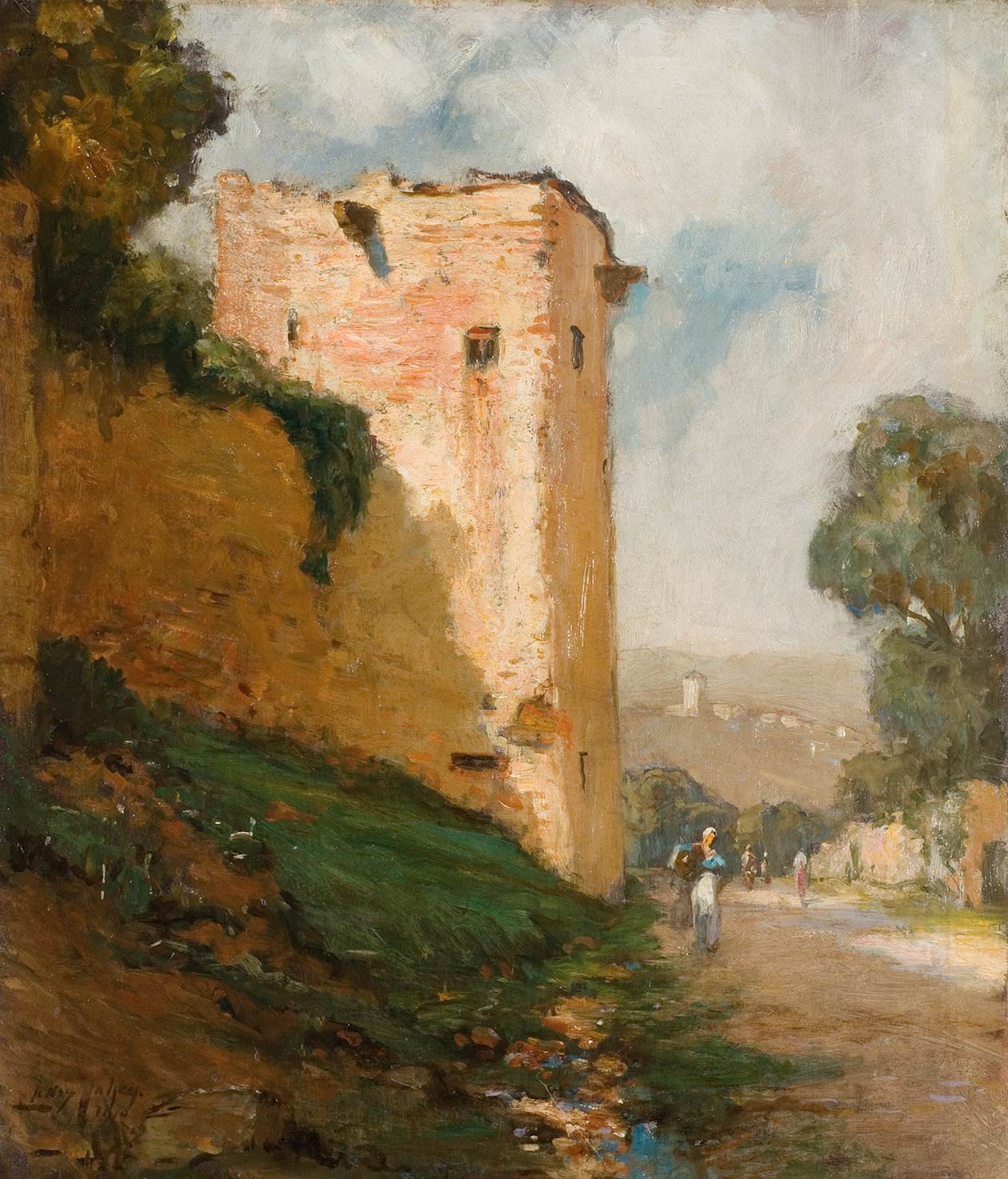
Cohen’s early work at the Lyme Art Colony shows the influence of Henry Ward Ranger, which he gratefully acknowledged. (See, for instance, the door panels he painted for the Art Colony Parlor.) After the arrival of the Impressionist Childe Hassam in 1903, Cohen’s landscapes became somewhat sketchier, sunnier, and more colorful. Trips to Spain in 1909 and 1910 (and a later trip to Italy in 1913) resulted in even more vigorous and dramatic depictions of the sights he saw there, as this panel shows.
The old tower is bathed in strong sunlight, shadows are colored (not gray or black), vegetation is a vibrant green, and the blue sky sparkles in the parts not covered by billowy white clouds.
Cohen also embraces one of the favorite compositional devices of the Impressionists: asymmetry. The close-up view of masonry and greenery that dominates the left side of the panel is countered by a plunge into distance on the right that prompts a push-pull sensation. The sense of depth is itself upstaged to some extent by the figure of a woman coming toward us. There is also vertical movement, for the woman’s blue blouse connects her visually with the blue of the sky and with the blue patch of water at the bottom edge, while her small size is offset by the towering structure to her left.
An American born in London, Cohen was raised in New York. After graduating from Dartmouth College, he studied at London’s Slade School and lived in the city for twenty years, exhibiting at the Royal Academy and other British venues, the Paris Salon, and occasionally in America. In Old Lyme he boarded with Florence Griswold until 1909, then bought a house nearby.
Besides travel to Spain in 1910, Cohen was also instrumental that year in getting the Old Lyme art colonists to refurbish the Griswold House, which badly needed repair. It was done as a surprise for Miss Florence while she was away.
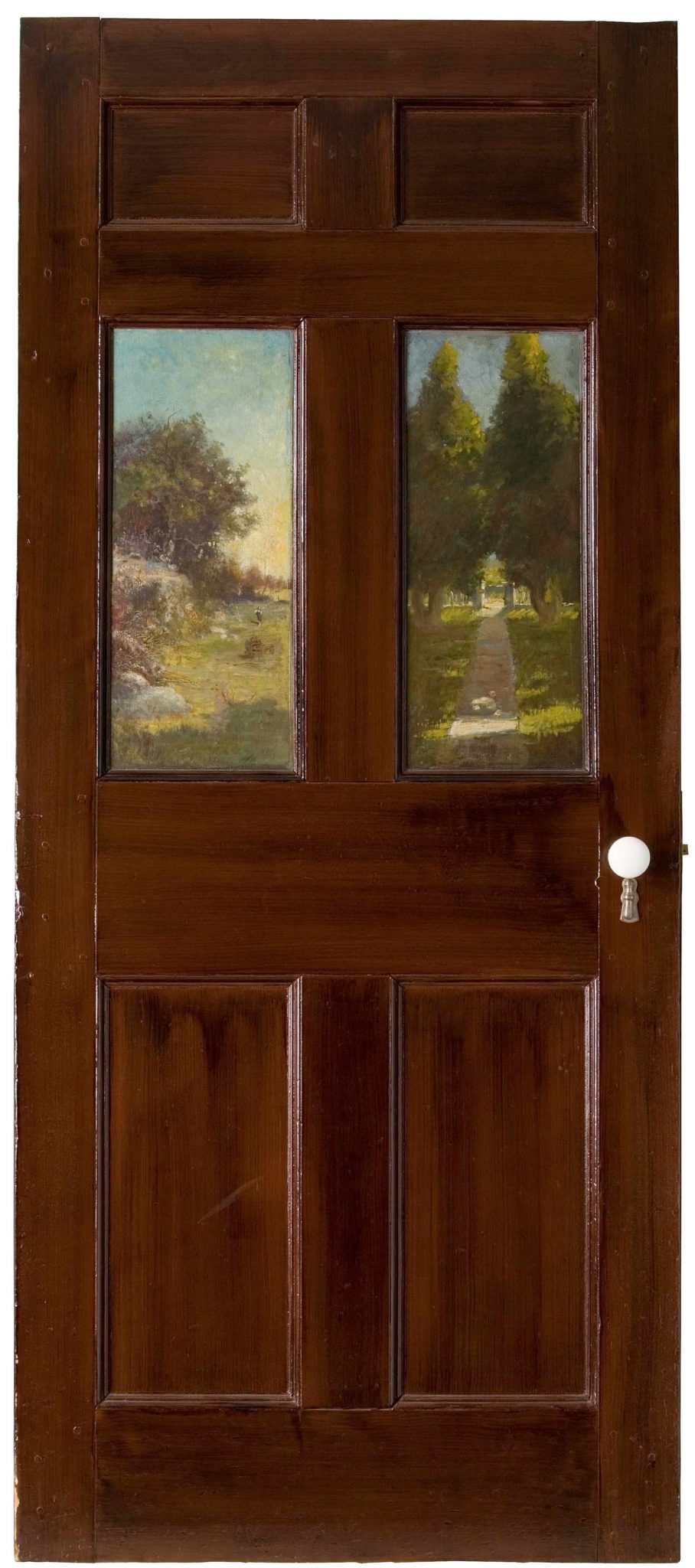
LEWIS COHEN (1857–1915), "LANDSCAPE WITH A STROLLING MAN" (LEFT PANEL) & "THE GARDEN WALK" (RIGHT PANEL), N.D. OIL ON WOOD PANEL. FLORENCE GRISWOLD MUSEUM, GIFT OF THE ARTIST
Other Old Lyme artists who painted on the doors in the Griswold House treated a pair of panels as a single image (as if seen through a window), although, in some instances, as in many Japanese woodblock prints, each panel could also be viewed as an image complete in itself. The two landscapes that Lewis Cohen painted, however, seem separate and unrelated. Odd couple though they are, they are permanently “installed” next to one another, so perhaps should be looked at as a pair.
The striking difference between Cohen’s two panels is that one is a natural landscape and the other has been fashioned by humankind. The view on the right depicts what the art colonists saw from the front door of the Griswold House: a man-made path to the opening in the white wooden fence that separated the property from Lyme Street, along with trees planted many years earlier (damaged during the hurricane of 1938), and a lawn. On the left is a pasture with ancient oaks and boulders, a natural setting that reduces the lone strolling man to little more than a dot.
Cohen plays the two images against each other in several ways, but he unites them with a limited palette of similar colors, horizon lines at about the same level, and a play of light and shadow that draws the eye back and forth between the two. Although both images can be characterized as tonal, Cohen also employs aspects of Impressionism.
In The Garden Walk, the symmetrical composition on the right, a block of sunlight “attacks” the linear perspective of the path and thereby one’s illusion of depth, and the dense foliage of the trees blocks a view of the sky. In the left panel, Landscape with a Strolling Man, the natural setting achieves a sense of depth – even though one’s eye is drawn more immediately to the foreground than to the rest of the image – by Cohen’s careful asymmetry, his arrangement of colors, and his manipulation of sunlight and shadow. Perhaps the manmade setting speaks of people’s need to impose order on nature, while the natural setting implies nature’s ultimate predominance.
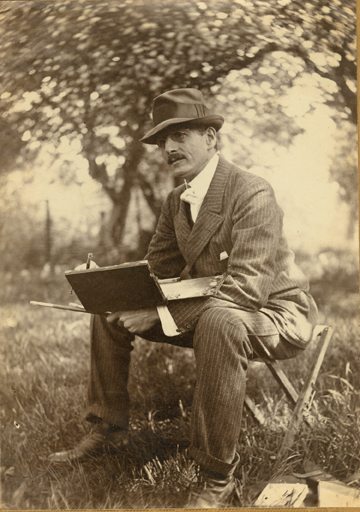
Lewis Cohen en plein air
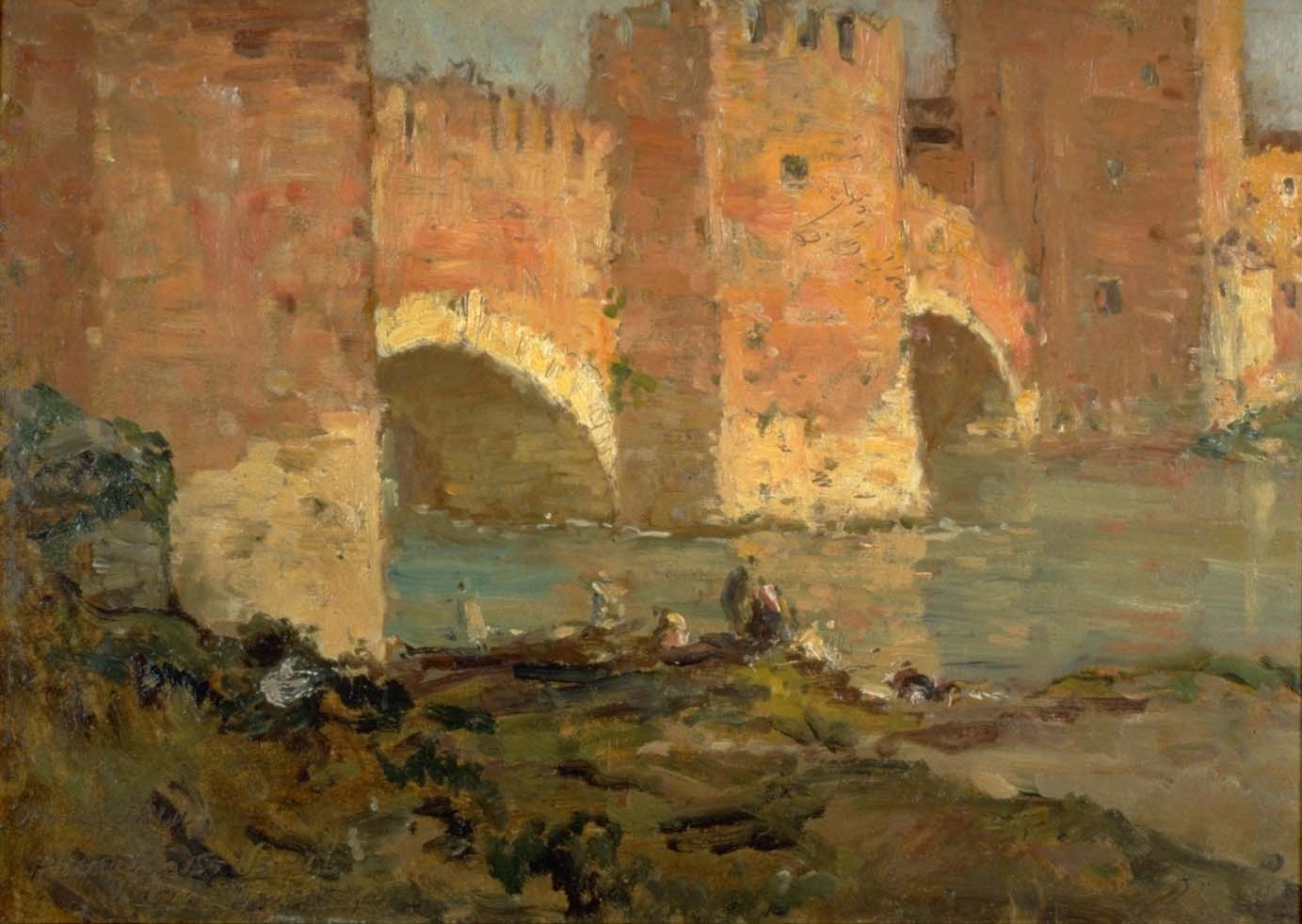
Lewis Cohen (1857–1915), Verona, 1913. Oil on canvas, 12 in. x 18 in. Florence Griswold Museum, Gift of Mr. Alfred T. Morris, Jr.
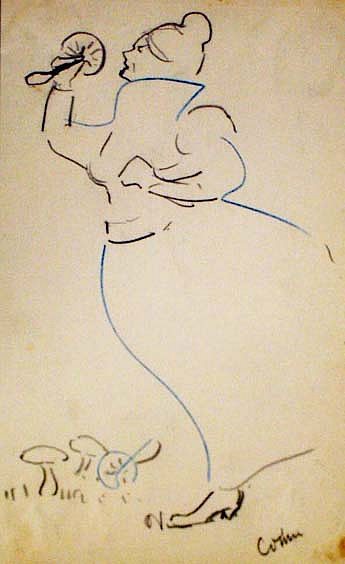
Lewis Cohen (1857–1915), Wiggle Drawing, n.d. Graphite on paper, 5 1/2 in. x 9 in. Florence Griswold Museum
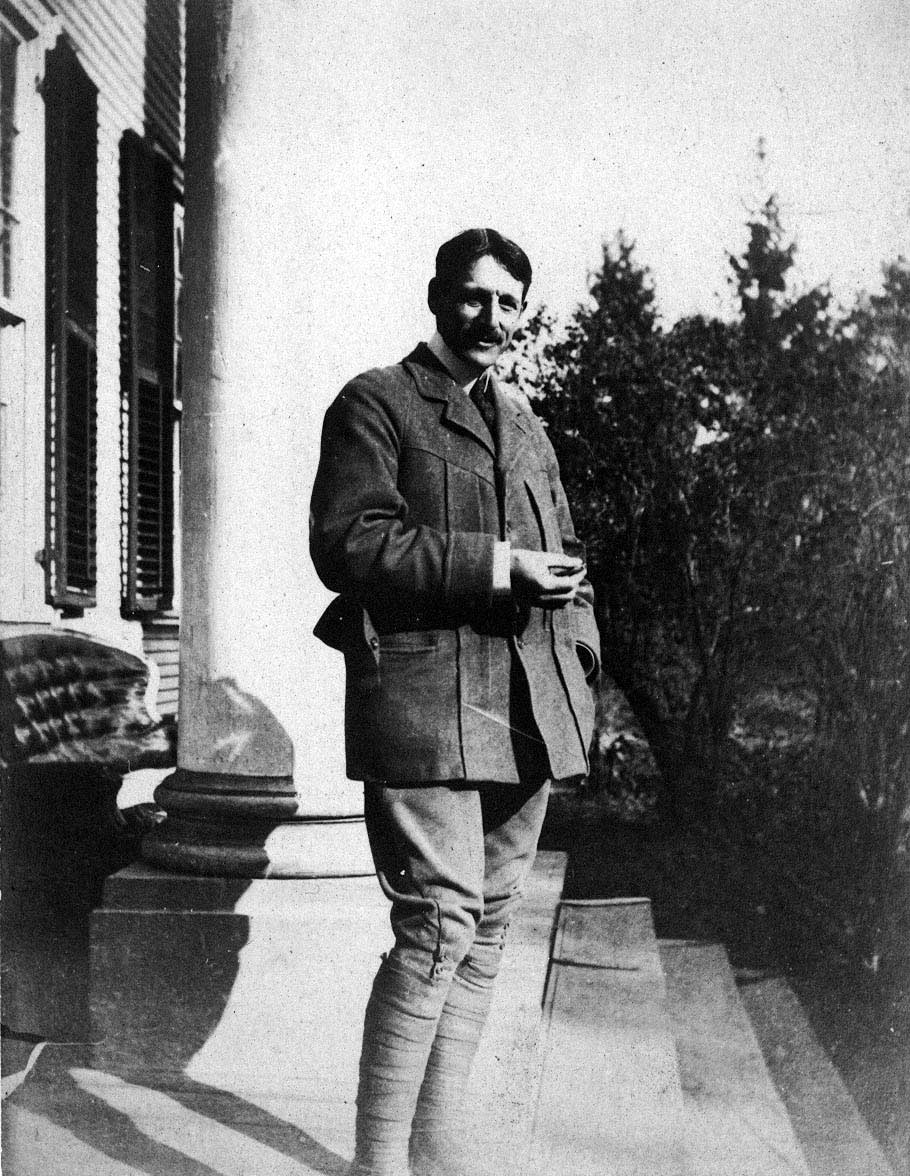
Lewis Cohen on the front porch of the Florence Griswold House
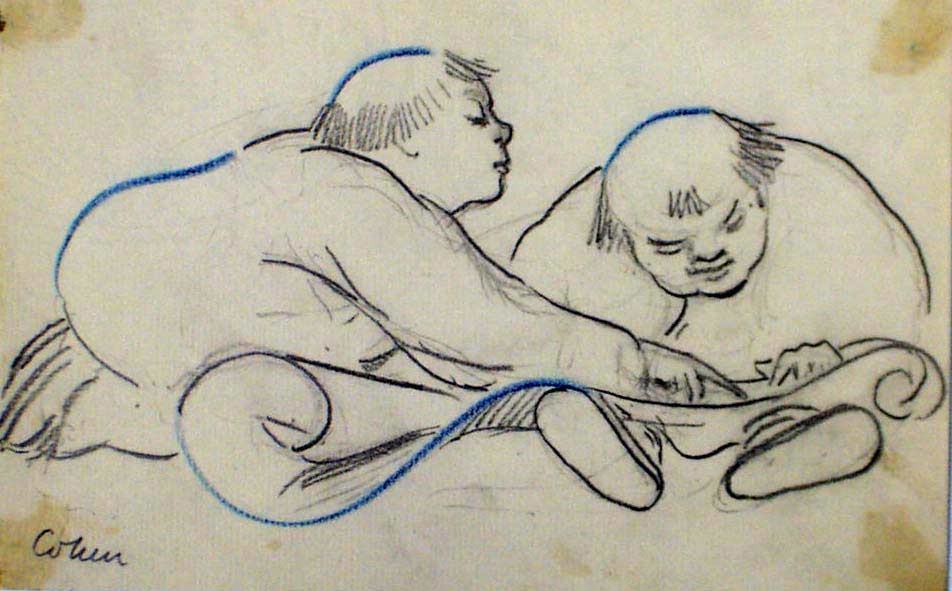
Lewis Cohen (1857–1915), Wiggle Drawing, n.d. Graphite on paper, 5 5/8 x 8 3/4 in. Florence Griswold Museum