
Frank Alfred Bicknell
(1866 – 1943)
HENRY RANKIN POORE (1859–1940)
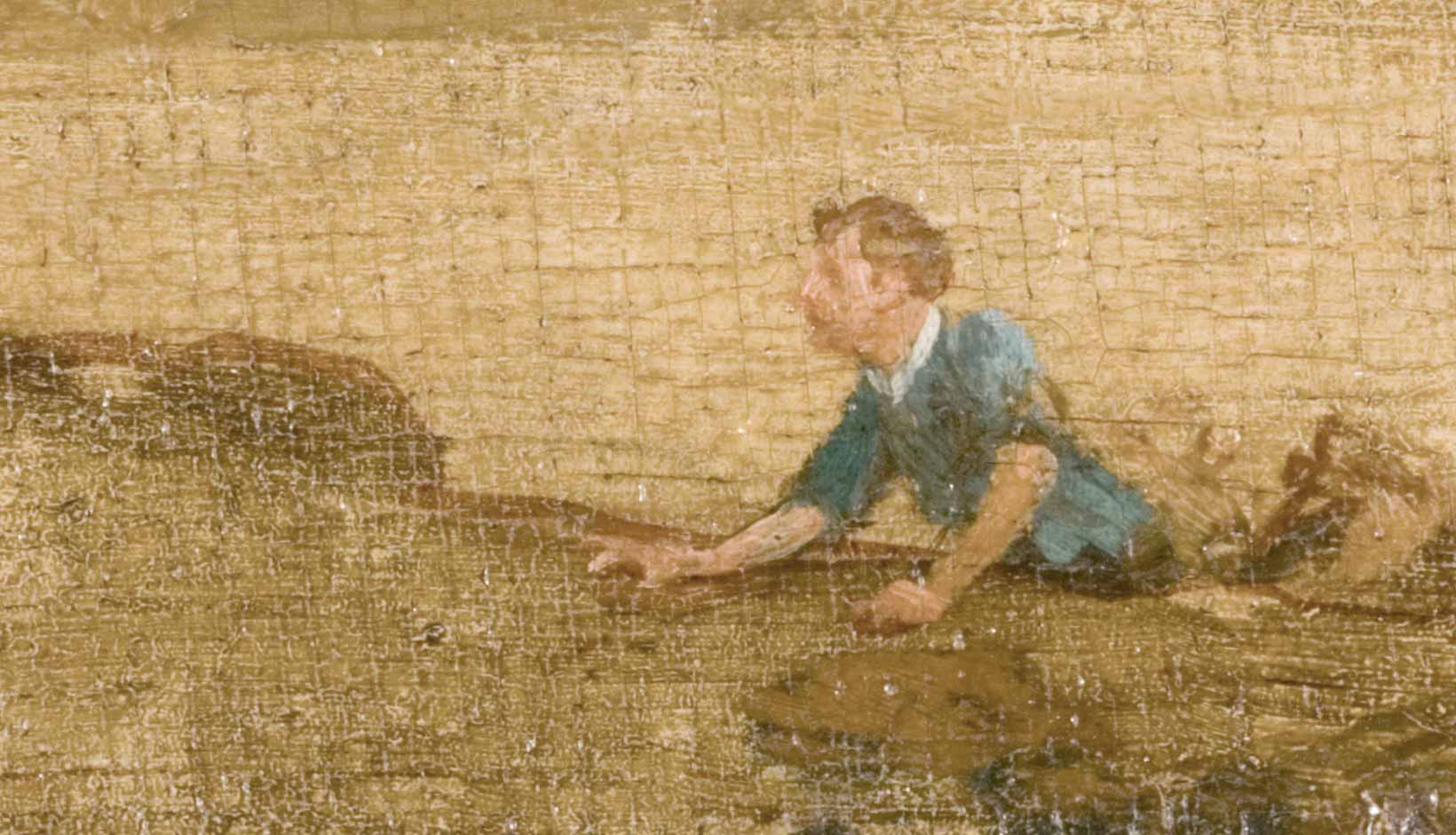
THE FOX CHASE (detail), 1901-1905; REVISED C. 1920
OIL ON WOOD PANEL
FLORENCE GRISWOLD MUSEUM
GIFT OF THE ARTIST
Born February 17, 1866, Augusta, Maine
Died April 9, 1943, Essex, Connecticut
In Old Lyme, c. 1902-1940
Bicknell began his artistic training with his father’s cousin, the artist Albion Harris Bicknell (1837-1915), in Malden, Massachusetts. He later trained in New York and Paris. By 1892, not only was one of his paintings accepted into the French Salon, a statement of worldwide artistic acclaim, but it was hung at eye level rather than “skied,” a rare and desirable occurrence indeed for an American first timer. Once back in the United States, Bicknell rented a lush studio in the famed Towers of Madison Square Garden where he would host musicales for members of high society.
Although he was very social, Bicknell never married. Indeed, he was most likely gay and traveled often with companions to various fashionable and exotic locales. The New York society columns were filled with his travel exploits: “In November Mr. Bicknell will leave Paris with Mr. Jack Holbrook to spend the winter in Italy and on the Nile.” By 1902, he adopts the members of the Lyme Art Colony as his “family” and has long been considered one of Miss Florence’s favorites. He painted a panel with mountain laurel and birch trees for her dining room.
His letters to her are playful and intimate, suggesting that he would even stay in her barn if he had to. When in residence at the boardinghouse he would join in the fun, playing cards, and adding to the regular hi-jinks. He considered himself one of the “inmates” of the house. After 1909, he would share the house and studio up the road with fellow artist Lewis Cohen, who eventually left it to Bicknell.
After his first visit in 1902, Bicknell spent decades in Old Lyme, where he found a second home after the sudden death of his partner, J.C.S. Parcher (1845–1903), while on a train between New York and their home in Boston. Bicknell and Parcher, a costumer and dressmaker, had traveled the world from Japan to Europe, and in the 1890s occupied an eclectically-furnished apartment and studio in the tower designed by Stanford White for New York’s Madison Square Garden. There, they hosted receptions and concerts that garnered notices in the city papers, as had their travels: “Mr. Bicknell’s studio has been the scene of some most delightful entertainments, both artistic and musical, and an invitation to one of his Monday afternoons is greatly sought for by society and artists alike.”
Perhaps because he arrived at a time of such personal loss, Bicknell described Florence Griswold and other art colony members as “family.” He became especially close to landscape painter Lewis Cohen, in whose house he would inherit a half interest when Cohen passed away. Observing Bicknell on a 1909 visit to the Griswold boardinghouse, future president Woodrow Wilson wrote to a friend, “Mr. Bicknell is a bachelor, and a very whimsical, delightful fellow, who can strike off excellent jests by merely giving his mind its natural play: a man of great charm of personality and very good to look at. I do not see how Madge can have spent a summer with him (last summer) and not fallen in love with him. He is the sort of man I should think women would fall in love with at once: and I do not often think that of a man.” In addition to painting outdoors alongside fellow art colony members, Bicknell used his craft skills to reupholster some of Miss Florence’s furniture when her artist boarders refurbished the house in 1910.
Bicknell would make a specialty of painting the Connecticut landscape with textured brushwork that was especially effective in his depictions of blooming mountain laurel. From 1919 to 1925, the artist served as an associate professor at the Carnegie Institute of Technology in Pittsburgh, now Carnegie Mellon University. There, he formed a relationship with Charles Graham Gibbs, who appears in Bicknell’s only portrait. The artist’s scrapbook has been preserved among Gibbs’s descendants, with a copy in the Museum’s archives. Bicknell returned to the Cohen house in Old Lyme, but with deteriorating health moved to a nursing home in Essex, CT, where he died in 1943.
In The Fox Chase (detail above), Bicknell is shown pulling himself over a small rise, looking up towards the bare-chested Childe Hassam painting at his easel. Despite this somewhat clumsy caricature, Bicknell was described as “rather tall and slender with dark hair and a very light mustache” by an unidentified reporter for a San Francisco newspaper, who interviewed Bicknell as he prepared to board the S.S. Coptic to Japan in 1895. This was one of more than a dozen ocean voyages Bicknell would take during his life.
For his contribution to the décor of Miss Florence’s dining room (below), Frank Bicknell chose a subject that was dear to the Old Lyme colonists – the mountain laurel that blooms exuberantly at the edge of water and woods in early June. Many of the artists painted laurel scenes, which seem made to order for an impressionistic treatment of the kind Bicknell offers.
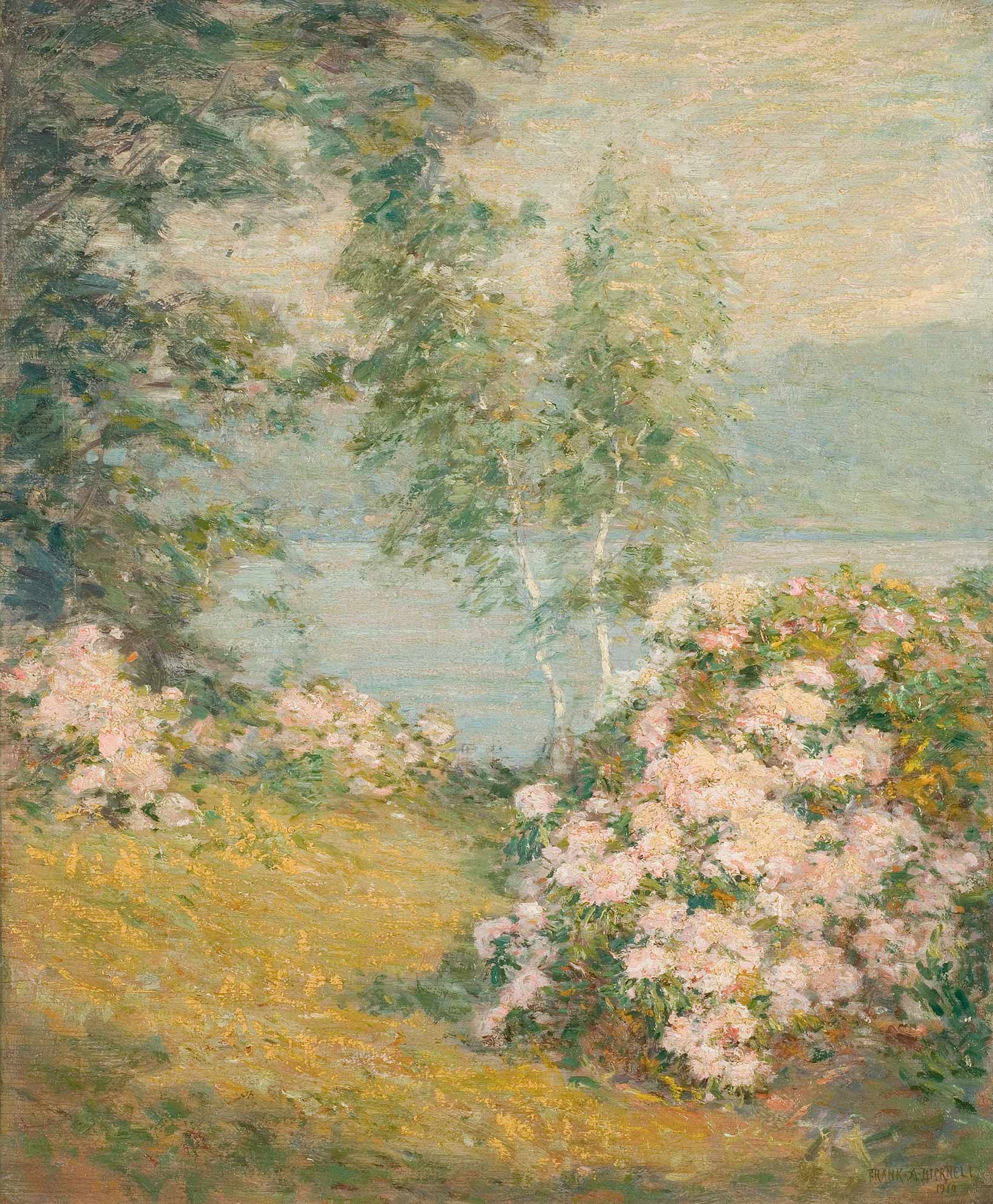
FRANK BICKNELL (1866–1943), "LAUREL AND BIRCHES BESIDE A LAKE", 1910. OIL ON WOOD PANEL. FLORENCE GRISWOLD MUSEUM, GIFT OF THE ARTIST
Here a laurel bush becomes an off-center focal point on the right, balanced by two small bushes and greenery on the left. A yellow sunlit area in the foreground anchors the composition, complements the blues in water and sky, and with the water forms a kind of circle around the laurels. Without the two birch trees at the center, one’s eye might be drawn to the distant shore. But the trees screen the background and help the painting retain its close viewpoint, while the foliage of the trees connects them visually with the tree branches at the left. An overall blurriness, soft colors, and the ambient light that suffuses the scene give it a sense of the ephemeral, and yet this painting also has a strong sense of place.
American Impressionists admired the asymmetric compositions and traditions of Japanese woodblock prints, but Bicknell visited Japan in 1895 and saw that country’s art at its source. A sophisticated man, he was equally at home presiding over a salon in his fashionable apartment in the Madison Square Garden Tower in New York City or painting laurel outdoors at Rogers Lake in Old Lyme, where this painting was probably done. His aim, he said, was to paint more realistically than most other artists.
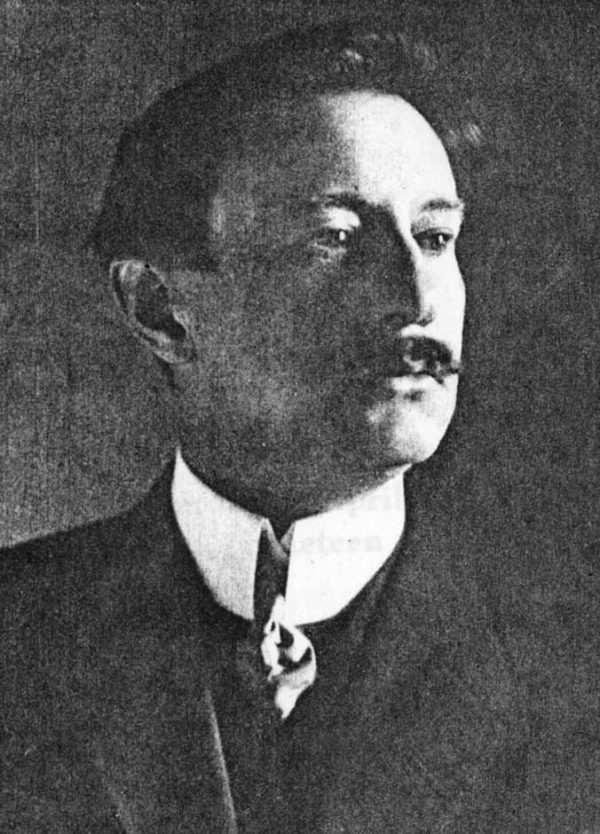
Portrait of Frank Bicknell
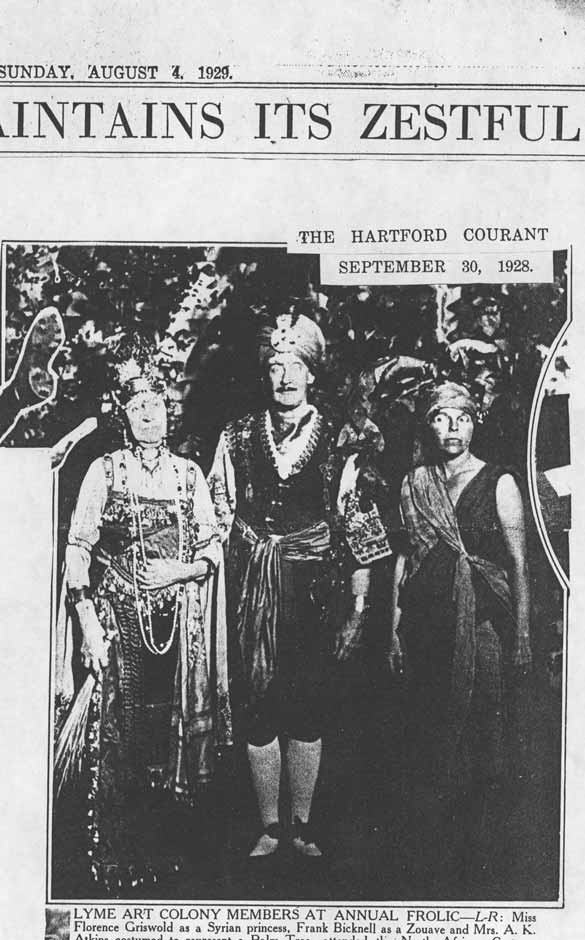
Frank Bicknell (center) and Florence Griswold (left) in costume at Lyme Art Association Frolic. The Hartford Courant, September 30, 1928
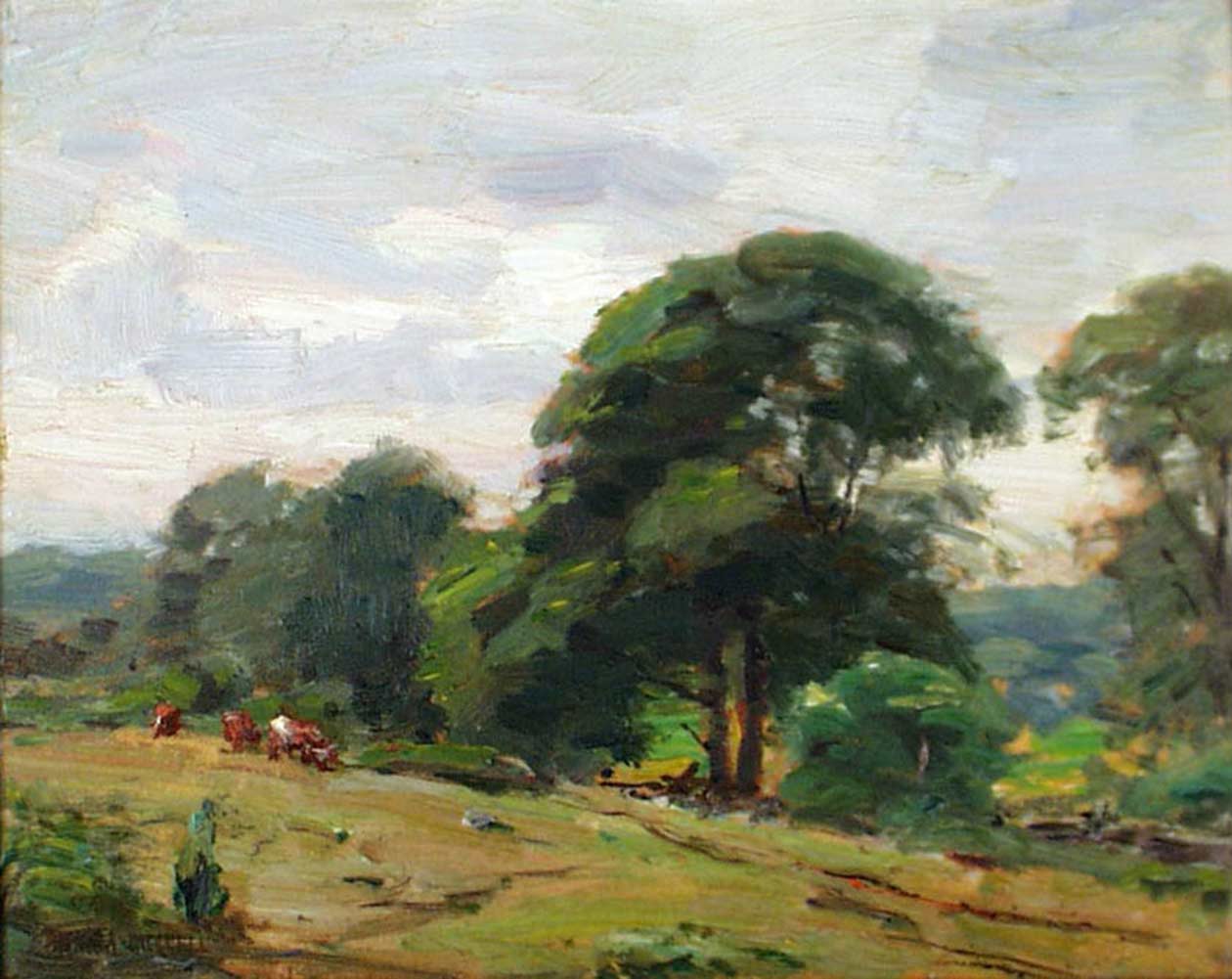
Frank A. Bicknell (1866–1943), Chestnut Trees, n.d. Oil on wood panel, 8 in. x 10 in. Florence Griswold Museum
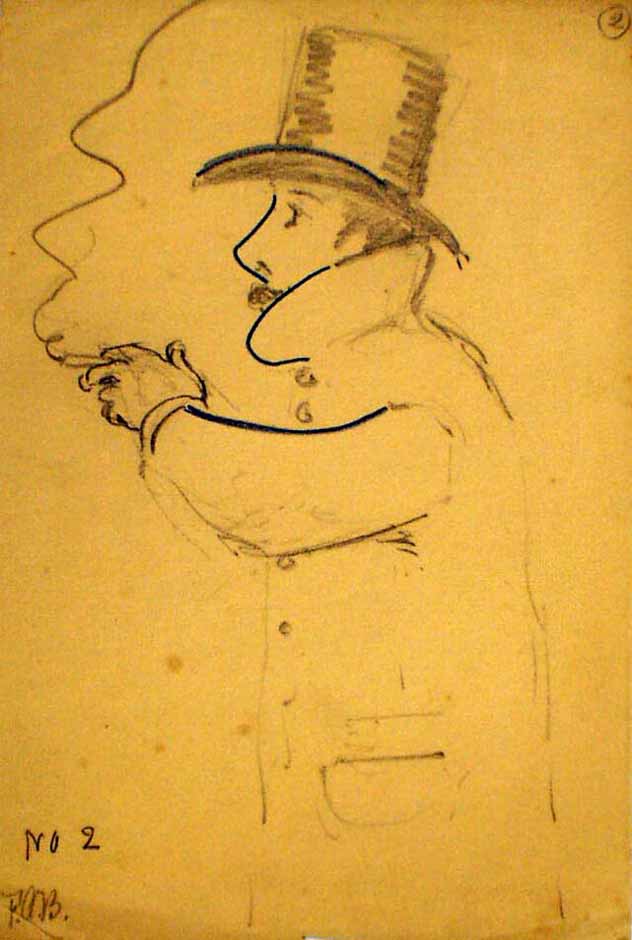
Frank Bicknell (1866-1943), Wiggle Drawing. Graphite on paper. Florence Griswold Museum