
Frederick Childe Hassam
(1859–1935)
HENRY RANKIN POORE (1859–1940)
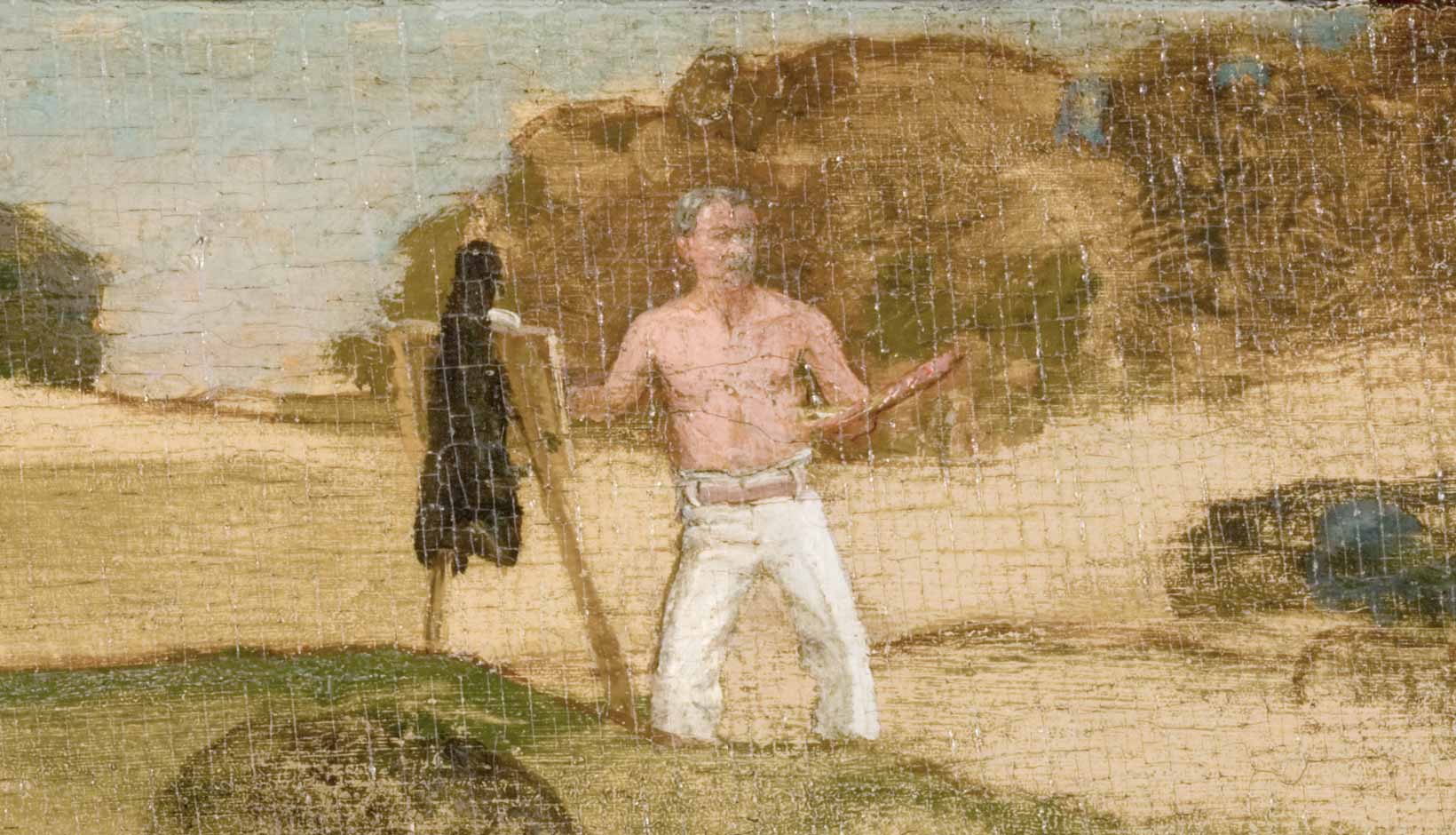
THE FOX CHASE (detail), 1901-1905; REVISED C. 1920
OIL ON WOOD PANEL
FLORENCE GRISWOLD MUSEUM
GIFT OF THE ARTIST
Born October 17, 1859, Dorchester, Massachusetts
Died August 27, 1935, Easthampton, New York
In Old Lyme, summers, 1903-c. 1907
A maverick in many ways, this charismatic artist is credited with bringing an American version of French Impressionism to Old Lyme in 1903. Hassam is probably the most famous artist affiliated with the Lyme Art Colony. Before Hassam, the Old Lyme artists painted in a style known as Tonalism. His multiple painted versions of the church at Old Lyme made it one of the most famous churches in New England. Hassam is depicted standing at his easel in The Fox Chase (detail above), painting en plein air with his shirt off, while the fox and pack of dogs rushes past.
His presence shifted the stylistic focus of the earlier colony away from the Tonalism of Henry Ward Ranger. Like Ranger, Hassam was immediately smitten with the Connecticut village. Hassam wrote to fellow painter J. Alden Weir about Old Lyme, “We are up here in another old corner of Connecticut . . . And it really is a pretty fine old town.” Hassam takes on the unofficial role of leader of the Colony as Ranger moves his base of operation to Noank, Connecticut, and he encourages younger artists to come to the colony to paint.
Called “Muley” by his friends (supposedly because of his strong opinions and his stubbornness in changing them), Hassam also enjoyed people thinking his name was Arabian, although he was born north of Boston to American parents. He dropped this first name of Frederick and began to sign his name preceded by a crescent moon, a symbol of his adopted Arab lineage. He began his art career as a wood engraver and was soon creating illustrations for popular magazines such as Harper’s and Scribner’s.
He studied art in Lowell and Boston before heading off to paint throughout Europe from Scotland to Spain. By 1886, he’s in Paris studying at the Académie Julian. It was in Europe that he met many of the friends he would chum around with in Connecticut art colonies in Cos Cob and Old Lyme.
When he arrived in Old Lyme in 1903, he was painting in a robust Impressionistic style, using bright, high-key colors and thick, short, staccato brushstrokes that seemed to flicker on the canvas. Years earlier he painted in more of a Tonalist style. The painting Across the Common on a Snowy Evening (1885-1886) is a perfect example of this earlier style. His painting style changed while he is in Europe, clearly converted by the work of Claude Monet and other French artists (he actually sublet a studio used by Auguste Renoir while in Paris). He took on all the stylistic characteristics of the French painters, but turned his attentions to subjects that are more American. Rather than painting modern nightlife in the Parisian cafes as they often did, Hassam painted New York (draped in American flags), as well as the flower-filled gardens and white churches that became synonymous with old New England.
In fact, Hassam painted the First Congregational Church of Old Lyme at least three times before it mysteriously burned to the ground in 1907. In a letter to Miss Florence he rants about the loss of one of his favorite subjects. “Who is the divil [sic] who did it? I was very disgusted with humanity when I heard of it, and I don’t need to say that I always had a real and pagan delight I the many and beautiful aspects of the old church.” Indeed, it was paintings like Hassam’s that helped the church fathers build a replica of the lost church that opened in 1910. “Childe Hassam who was not only a gifted painter, but also a man of glowing health, high spirits and boyish humor used to lead the assembled company into all sorts of pranks, practical jokes and good-humored teasing.” — Nelson White, the artist, who was a child when his artist father stayed with Miss Florence
Hassam seemed to thrive during his time in Old Lyme. He painted in one of the best studios on the property, located between the river and the gardens with excellent views of both. He nicknamed it “Bonero Terrace” and outfitted it with a large Victorian sofa. He is remembered for his colorful behavior, arriving at all hours, drinking with abandon, throwing an orange through the dining room window, and rummaging through old trunks in the attic for a flowered dressing gown to wear down into the village as a lark.
Hassam had a great friendship with Florence Griswold and would write letters to her before and after his many visits. An example from 1905: “I want to come to Lyme very soon. I wish I might have appeared with the first buds—but that was writ so I couldn’t you see. However if I may have my studio in the garden (that I had before) and a room I will be happy. Of course I should like my old room as Mrs. Hassam will come along too very soon.”
For Miss Florence’s dining room he painted a panel with a floral scene, a door with nude bathers in the Lieutenant River, and he collaborated with Walter Griffin and Henry Rankin Poore on a landscape with a reclining cow. While in Old Lyme he painted the river (sometimes with bathers and mountain laurel), the rocky uplands, as well as the church. His vibrant paintings would influence the next generation of Lyme painters, even after 1909, when he no longer stopped at the boardinghouse in Old Lyme.
Hassam is perhaps best known as the founder of The Ten, a group of American painters, many of whom had studied in Paris, who banded together in 1897 to show their work after deciding that the Society of American Painters was too conservative. Upon his death in 1935, Hassam bequeathed the complete contents of his studio (nearly 450 paintings, pastels, and decorative panels) to the American Academy of Arts and Letters in New York. According to Hassam’s wishes, the collection was sold at auction and the proceeds used to purchase contemporary art for American museums.
“But Mr. Hassam’s gifts are no hidden secret, and the brilliant ringing poetry of The Ledges ranks with that of his Appledore pictures of a few years ago. Perhaps there is no contemporary artist who can render with greater distinction the sharp joyousness of the Autumn color and the Autumn air.”— Unidentified writer in the New York Times, 1906
Despite snipes at his brightly-hued art, Hassam was treated like a star in Old Lyme, a setting he decided was “just the place for high thinking and low living.” He was given the best studio and was invited to paint the panels of a door in the Griswold House (below), a tradition Henry Ward Ranger began in 1900.
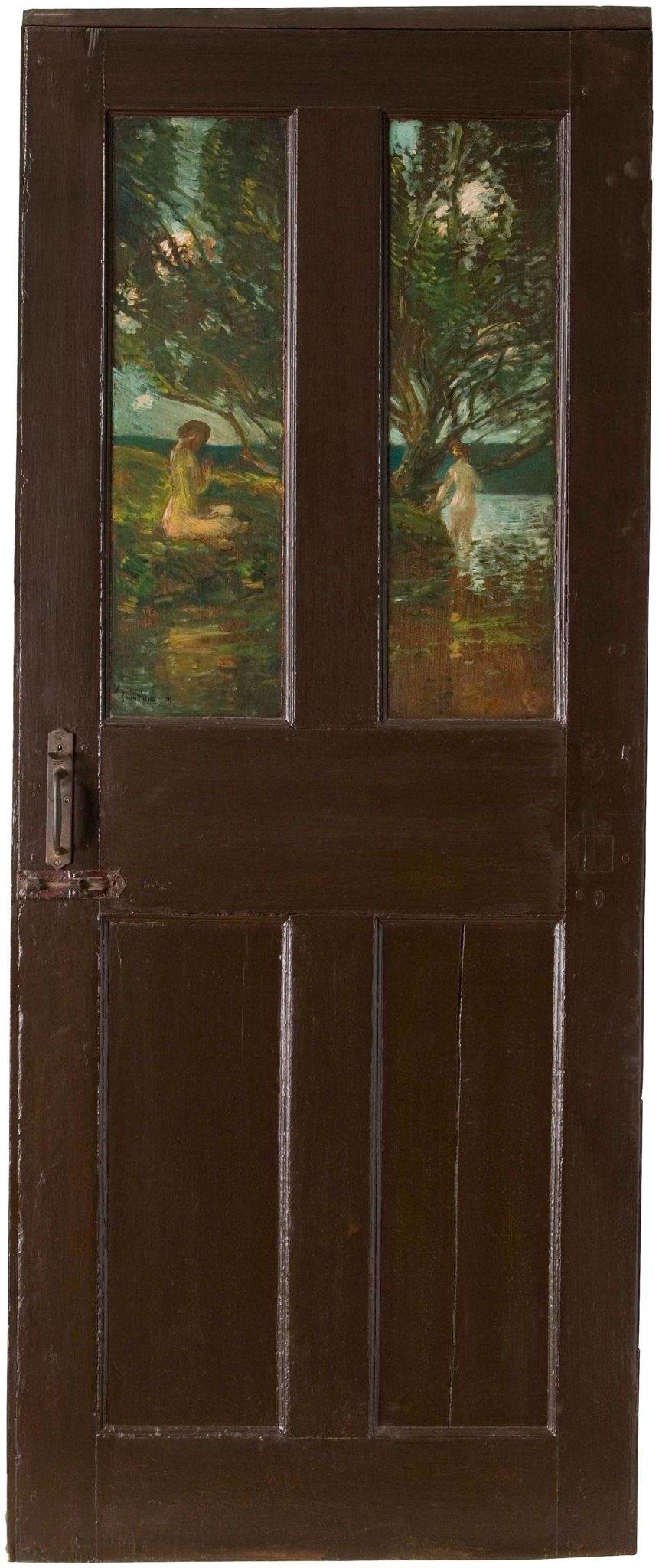
CHILDE HASSAM (1859–1935), "THE BATHERS," 1903. OIL ON WOOD PANEL, 31 IN. x 9 IN. FLORENCE GRISWOLD MUSEUM, GIFT OF THE ARTIST
Hassam not only obliged but grayed his normally bright colors as effectively as any Tonalist. The nude females he portrayed may have caught his fellow artists off guard, for most thought that being informal meant rolling up one’s shirtsleeves at dinner on hot summer days. These nudes, however, are chaste, dreamy nymphs, at their ease in the landscape of Old Lyme.
Neoclassicism had made a comeback in American art and architecture as a result of the World’s Columbian Exposition in 1893, where the classicism of the fair’s “White City” had enthralled the crowds. By the 1900s Hassam had developed an absorbing interest in incorporating Neoclassic figures into an Impressionist landscape.
Perhaps he thought thereby to transport Impressionism itself beyond the fad some thought it was and make it “classic” and timeless. Two years later he created a work he thought of as his masterpiece: June, a seven-foot-square painting of three female nudes bathing at the Lieutenant River.
Some time after his arrival in Old Lyme in 1903, Childe Hassam decorated a panel in the dining room with a floral still life (below).
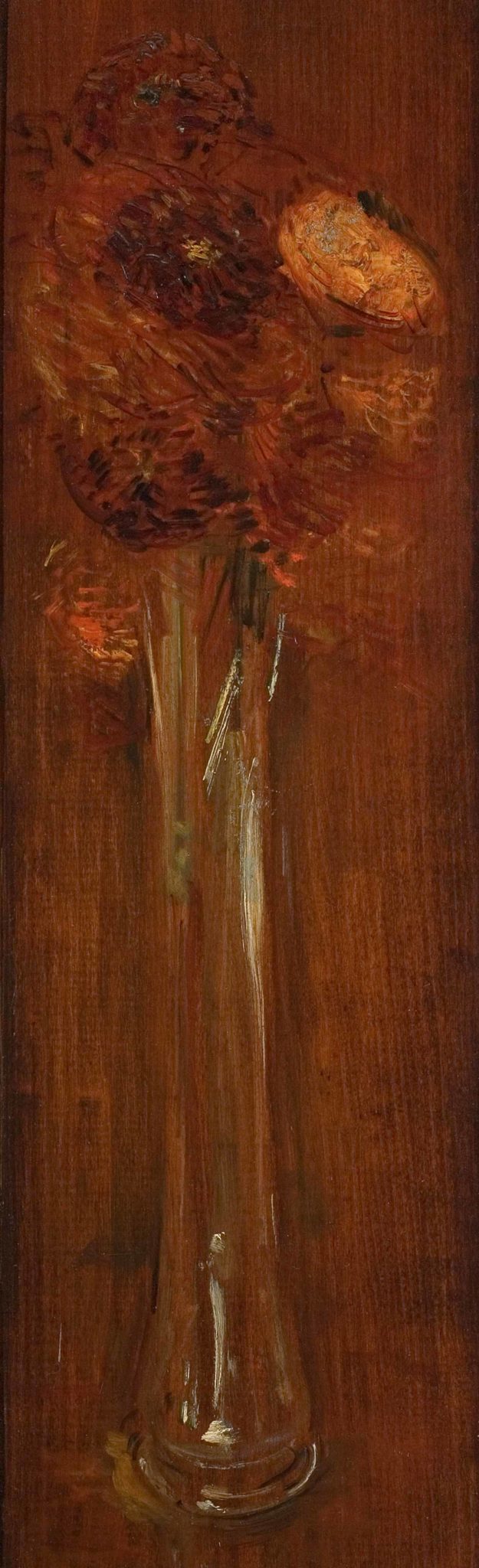
CHILDE HASSAM (1859–1935), "FLORAL STILL LIFE," N.D. OIL ON WOOD PANEL, 32 IN. X 8 1/4 IN. FLORENCE GRISWOLD MUSEUM, GIFT OF THE ARTIST
Tucked between the left side of the fireplace and the busy door to the back kitchen, the narrow strip of wood had to be carved at the top to fit snugly around the curving edge of the mantel. This must have been a challenging panel to paint, not only because of its odd shape but because Henry Rankin Poore’s mural The Fox Chase over the fireplace is a major attraction, as is the brighter marsh scene by Beal just to the left. Hassam, who had brought the bright light, vibrant color, and loose brushwork of Impressionism to Old Lyme, may have decided not to compete with Poore and Beal but rather complement their panels with a painting uncharacteristic for him in color and composition, although not in technique.
Flowers are an important subject in Hassam’s art, from colorful gardens and flower shops in France, to the sun drenched island gardens that surrounded his dear friend the poet Cecelia Thaxter’s home on the Isles of Shoals off the coast of New Hampshire. His paintings such as the Museum’s Summer Evening featured potted flowers and fresh bouquets to enliven rooms in New York and Cos Cob. On this panel, however, he not only jammed some lanky flowers into a skinny vase but limited their colors to earthy tones that nearly blend into the background, which he appears to have painted to look like wood. The tall glass vase floats rather than sits on anything within its niche – his good friend and colleague Willard Metcalf does the same with a spherical vase of cosmos around the corner.
Unlike other panels in the Florence Griswold House, Hassam worked collaboratively with Henry Rankin Poore and Walter Griffin on an unusual piece, Landscape with Cow. This is the only panel to be created by more than one artist (below) and diplomatically combines the talents of two staunch impressionists and one tonalist. The panel features a brown cow reclining in a field on the edge of a forest and shallow pond, but the specific authorship of any of the elements is undetermined.
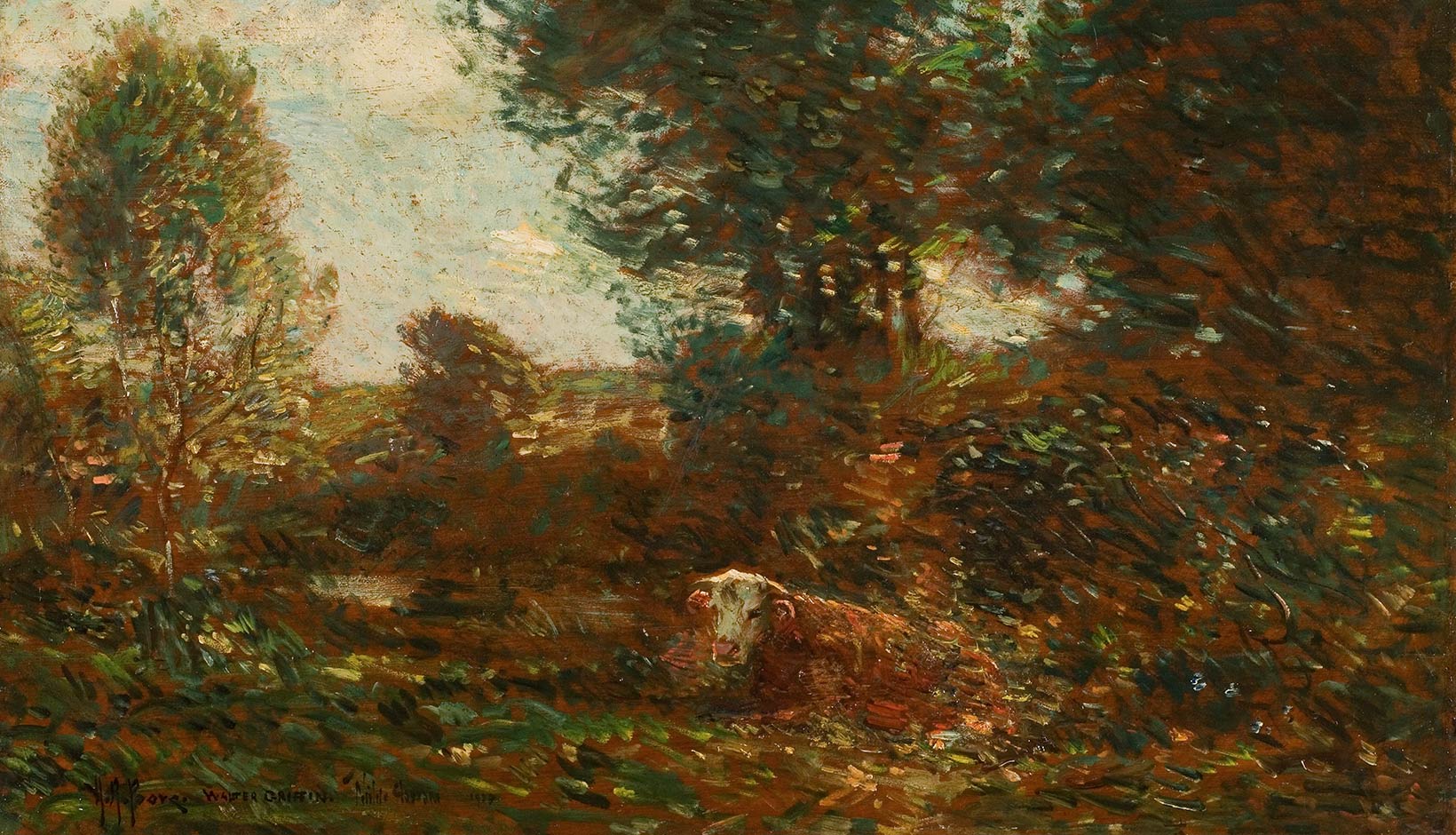
WALTER GRIFFIN (1861–1935), CHILDE HASSAM (1859–1935), HENRY RANKIN POORE (1859–1940), "LANDSCAPE WITH COW," 1907. OIL ON WOOD PANEL. FLORENCE GRISWOLD MUSEUM, GIFT OF THE ARTISTS
One of the great pleasures and benefits of an art colony, American artists discovered when they became acquainted with some in Europe, was the opportunity to discuss and exchange artistic ideas on a daily basis and to see the stages by which colleagues created works of art. It was serious business.
This panel, however, the collaboration of three men whose distinctive styles are not generally compatible, may have been done as a lark.
Surely it was the Tonalist Henry Rankin Poore who painted the reclining cow. His images of animals were well known; a number grace his Fox Chase mural over the dining room fireplace.
Was Poore mimicking Glenn Newell’s cow on a nearby panel – a cow of a different color but otherwise very much the same? This one lies not in a Dutch landscape, however, but in Old Lyme, where trees are all around as Walter Griffin found to his joy when he arrived in 1904. Griffin liked tall, thin trees with sinuous trunks and limbs, and in his hands tree leaves can seem to shimmer, partly because of his trick of shaping and modeling foliage with a brush loaded with two colors of paint. The tree at the left is surely one of his and so, probably, are the others.
The overlay of short, often parallel strokes in much of the rest of the painting looks like the work of Hassam, a more daring Impressionist than Griffin, and thus the more compelling foil to Poore’s Tonalism. Hassam brushed dashes of sunlight into this scene, most cleverly above, over, and below the body of the cow, so that they highlight the animal like a spotlight. All three artists used the “baked apple” colors that Old Lyme Tonalists like Poore and Henry Ward Ranger were fond of, but sunny highlights, vibrant greens, and lively brushwork by Griffin and Hassam transport this Tonalist cow into an Impressionist landscape.
The “clash” of two popular ways of painting in Old Lyme and in America at the turn of the 20th century may be overdone here for a humorous effect, but many of the Old Lyme art colonists developed a subtle blend of Tonalism and Impressionism.
“Hassam, Poore and Walter Griffin painted the middle panel on the inside wall. It was started as a wedding present for a young about-to-be-bride in Old Lyme. One morning she happened to drop in and found the three of them munching cream cheese and chives in the dining room. She was quite disgusted and did not hesitate to tell them so. Provoked, they decided the painting was far too good for her and gave it to Miss Florence instead.” — Artist Harry Hoffman, 1954
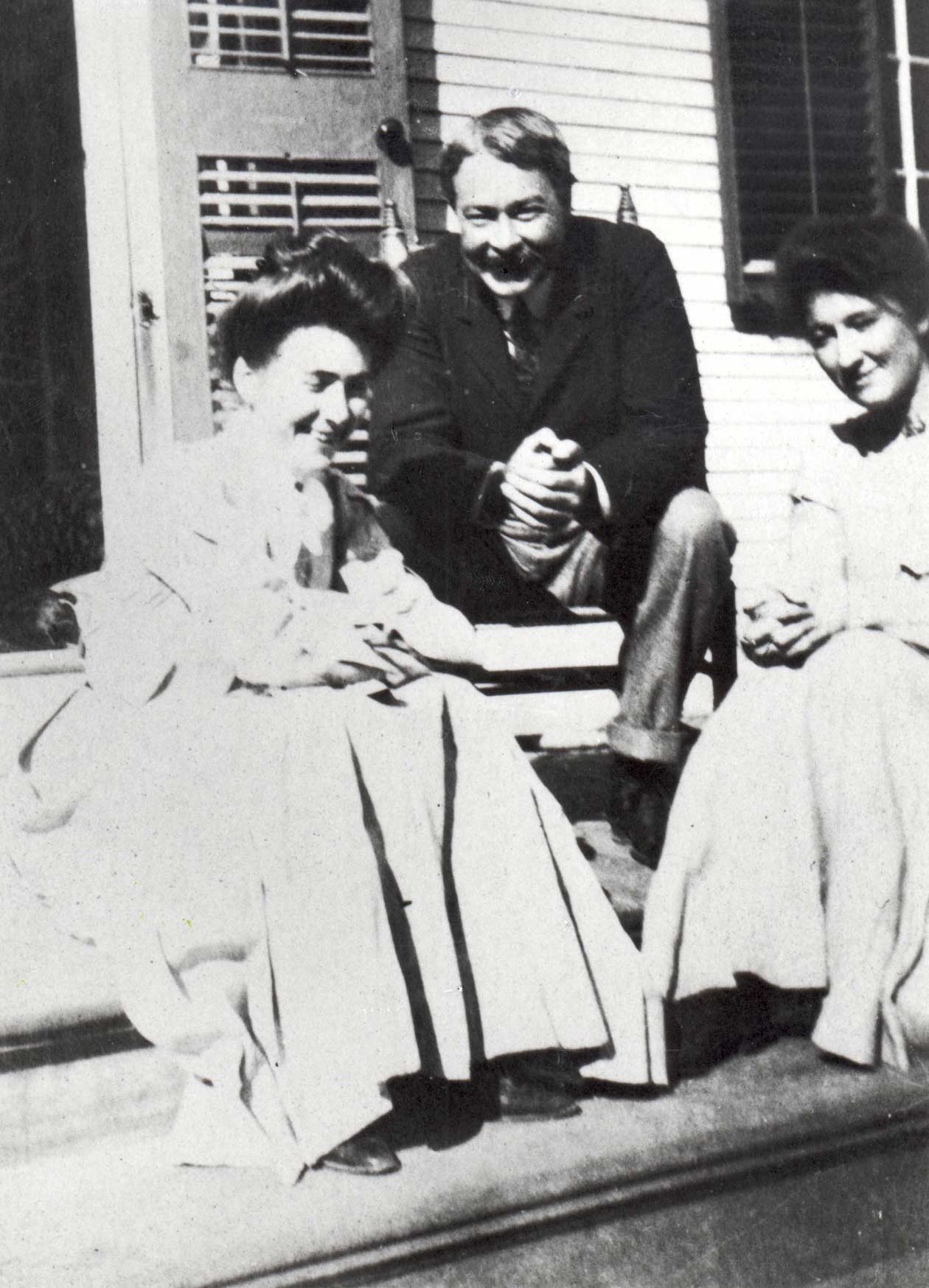
Childe Hassam (center) on the front steps of the Florence Griswold House
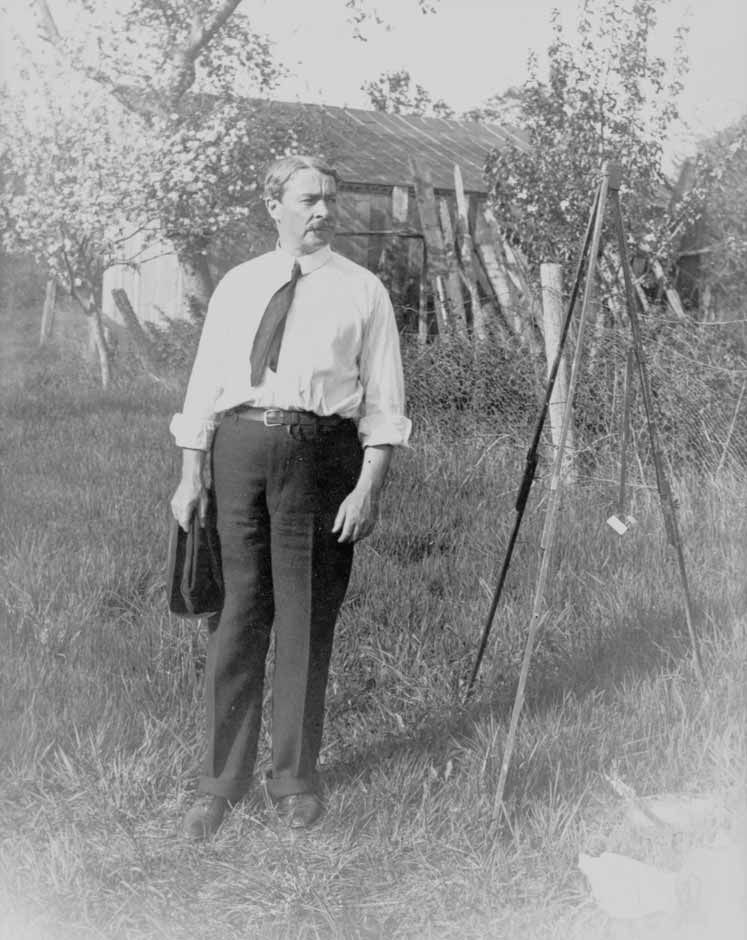
Childe Hassam near his Old Lyme studio, c. 1903
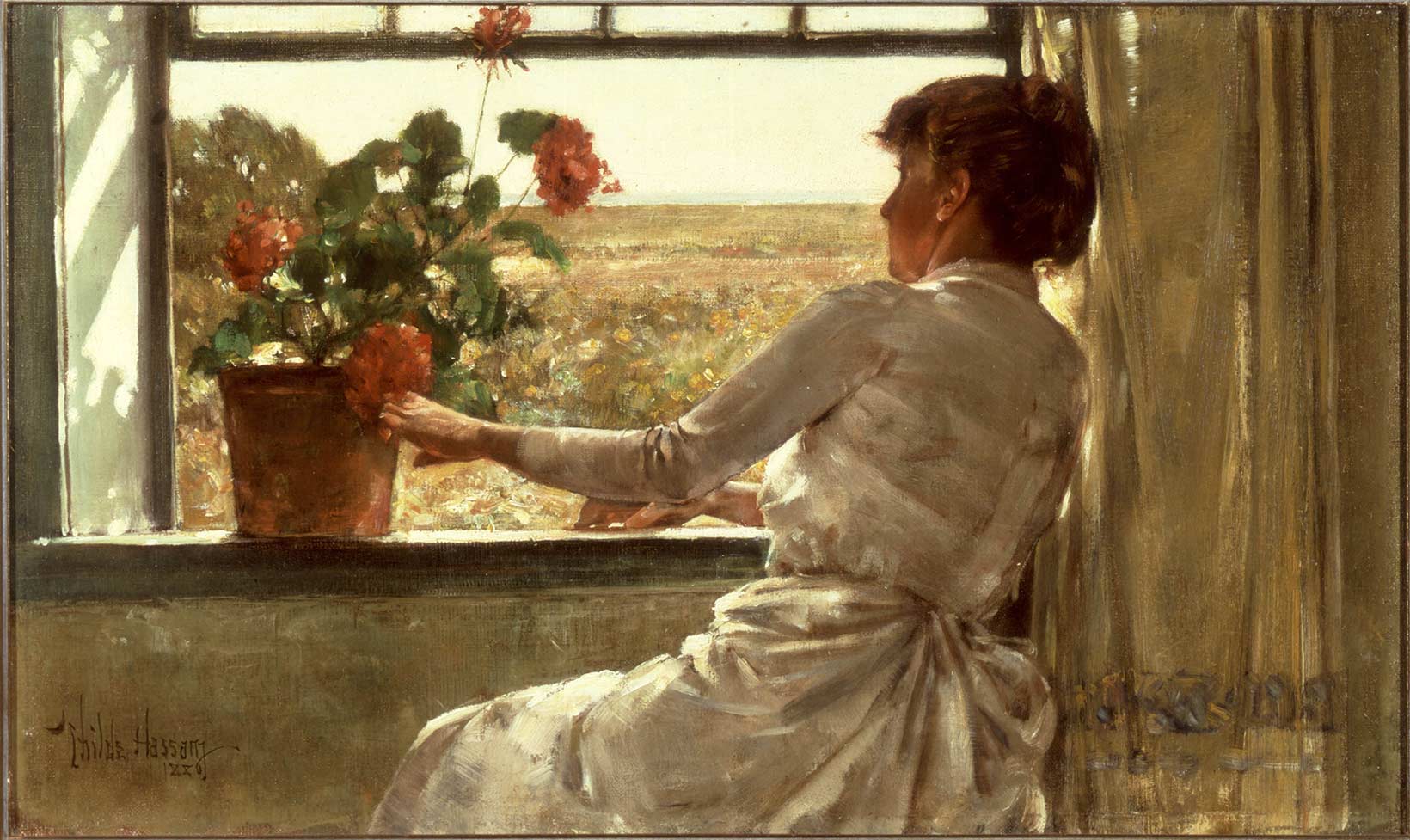
Frederick Childe Hassam (1859–1935), Summer Evening, 1886. Oil on canvas, 12 1/8 in. x 20 3/8 in. Florence Griswold Museum, Gift of The Hartford Steam Boiler Inspection and Insurance Company
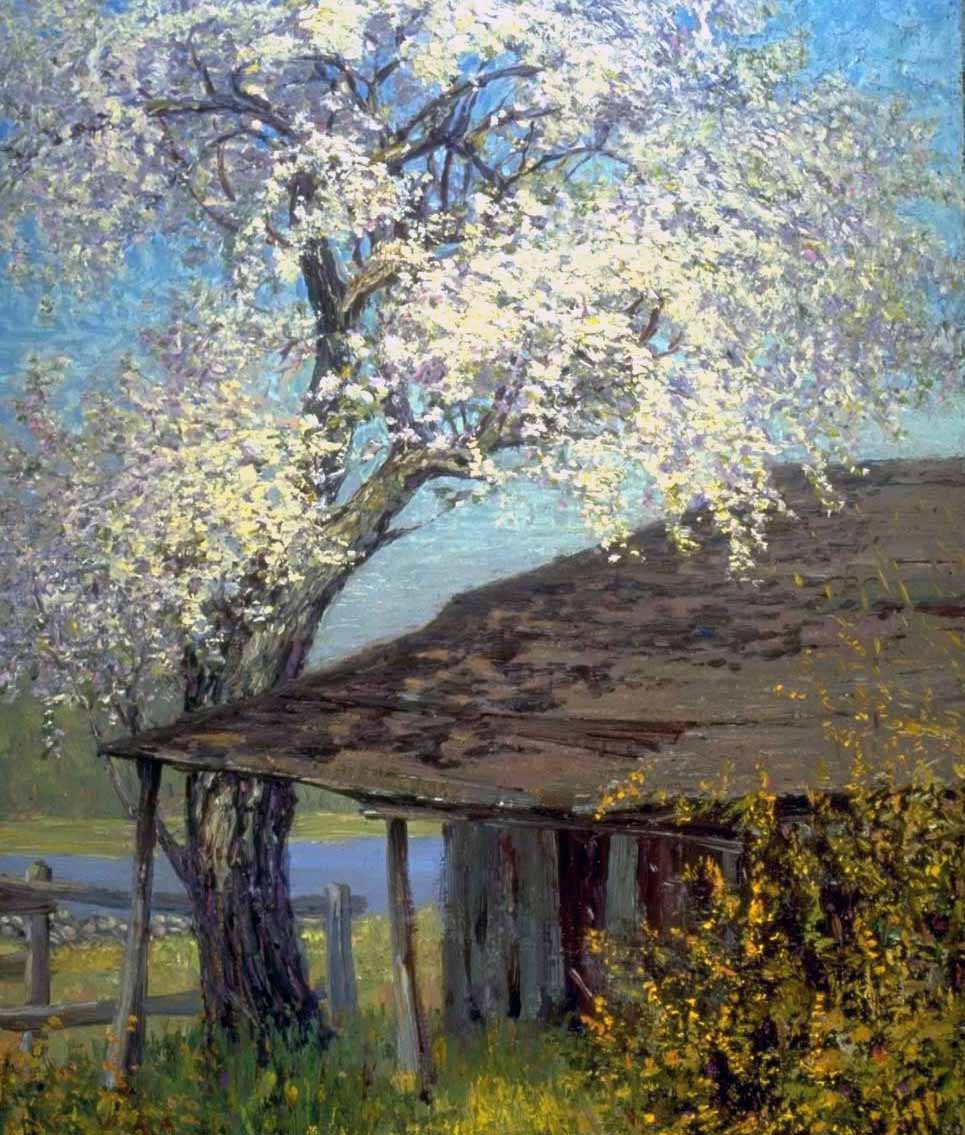
Harry Hoffman (1874–1966), Childe Hassam’s Studio, 1909. Oil on canvas. Florence Griswold Museum, Gift of the artists
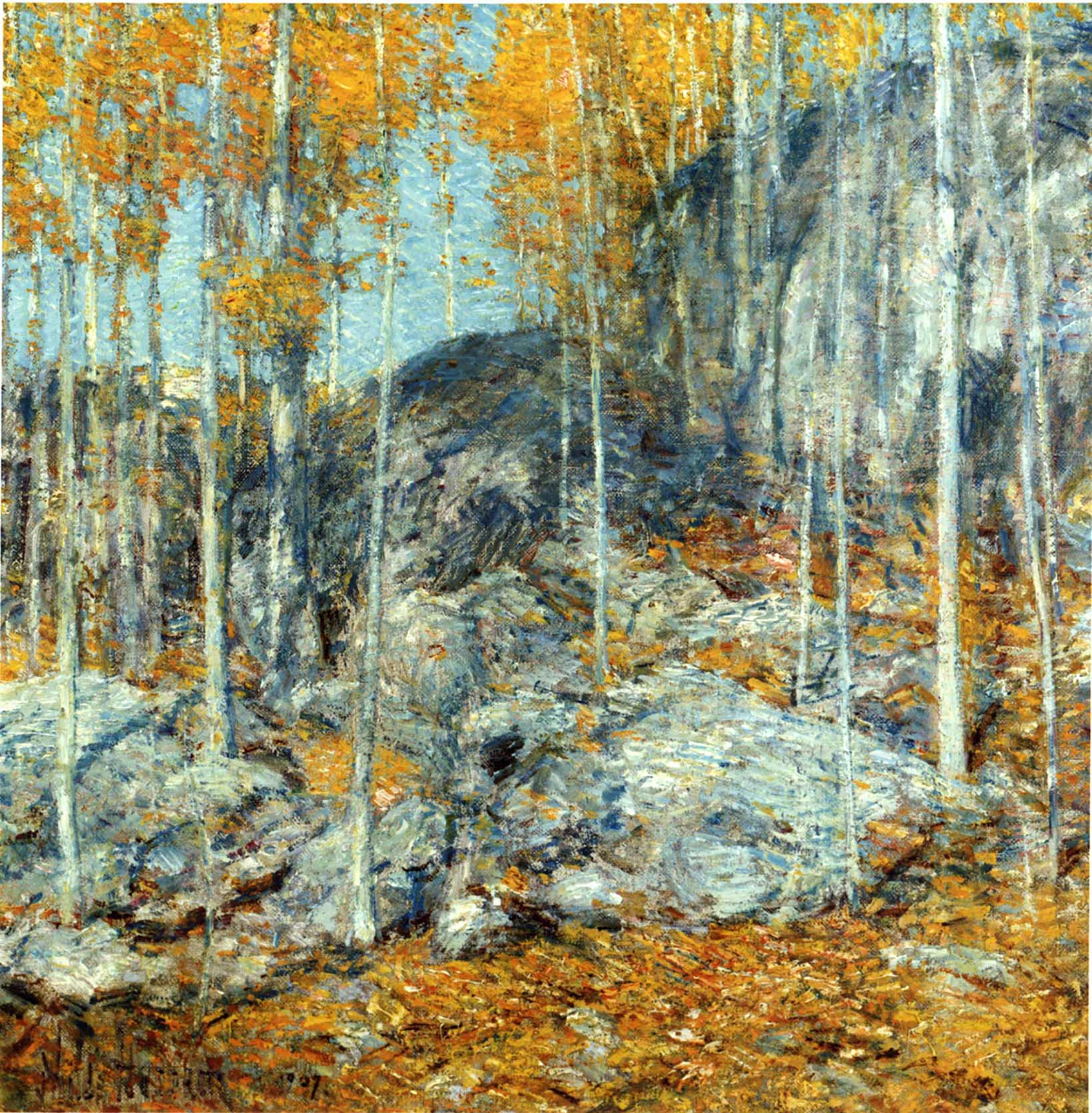
Frederick Childe Hassam (1859–1935), The Ledges, October in Old Lyme, Connecticut, 1907. Oil on canvas, 18 in. x 18 in. Florence Griswold Museum, Gift of The Hartford Steam Boiler Inspection and Insurance Company