Henry Rankin Poore
(1859 – 1940)
HENRY RANKIN POORE (1859–1940)
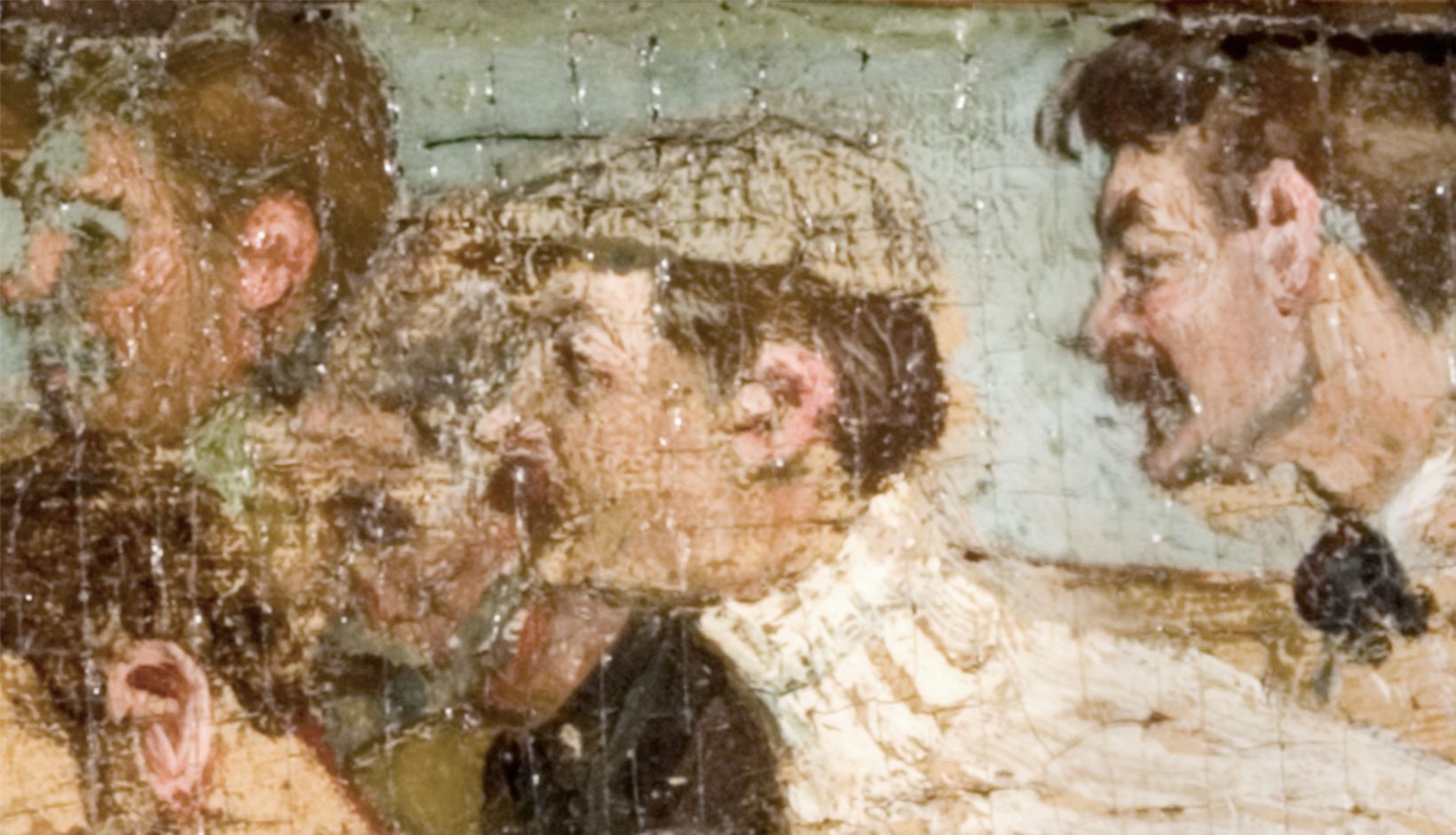
THE FOX CHASE (detail), 1901-1905; REVISED C. 1920
OIL ON WOOD PANEL
FLORENCE GRISWOLD MUSEUM
GIFT OF THE ARTIST
Born March 21, 1859, Newark, New Jersey
Died August 15, 1940, Orange, New Jersey
In Old Lyme, periodically, 1900 – c. 1935
Henry Rankin Poore paints himself in the center of the pack of artists running after the fox in his The Fox Chase (detail above), stylishly dressed in a striped suit and checkered knickers. “Here, in wild chase over the hills, are depicted all the members of the Holy House contingent, where some fifteen of our best artists, each recognizable at a glance, are shown, each in characteristic action. Some with lusty strides, kits on their backs, follow the chase,” wrote journalist Anthony H. Euwer in 1904.
The son of a prominent clergyman, Poore was converted to the world of art after seeing a painting in the Centennial Exposition in Philadelphia in 1876. After studying art in New York and Philadelphia, Poore traveled to the American southwest to illustrate Pueblo Indians for the government. He later traveled to France and England to round out his artistic studies. It was in England that Poore began his lifelong interested in fox hunting, a sport that would inspire much of his painting and writing. Interestingly, by the time Poore arrived in Old Lyme and began his comical version of a fox chase over the dining room fireplace, there was already a set of English prints depicting a foxhunt hanging on the wall. Poore began The Fox Chase in 1901, and continued painting it through 1905, with minor additions years later. It quickly became emblematic of the exuberant camaraderie enjoyed by the Lyme colony artists and was a draw for tourists and visitors to Old Lyme.
Poore was one of the first artists to come to the Griswold boardinghouse in 1900. Both he and Henry Ward Ranger began to leave their mark by painting pictures on the door panels — a practice inspired by the country inns of Europe where artists often stayed. The first of the painted doors was actually a collaboration between the two. Ranger painted a scene of the wooden Bow Bridge behind the Griswold House and challenged Poore to complete the scene. Poore matched the style and color perfectly in a painting showing his dog howling at the moon.
He painted the Lyme landscape with year-round passion. In order to paint comfortably in winter, Poore constructed a portable studio set on runners that could be pulled by four oxen (less if there was snow) to the desired spot in the landscape. The studio had a plate-glass window on each side and double floors that were covered with heavy woolen rugs. Designed by Poore, the studio featured an oil stove, hinged seats, and built-in racks and shelves for drying paintings and storing artist materials. A true animal lover, Poore was always accompanied by his faithful hound dog, and often a woolly sheep that could serve as a ready-made model.
Unlike the other panels, Poore worked collaboratively with Walter Griffin and Childe Hassam on Landscape with Cow (below).This is the only panel to be created by more than one artist and diplomatically combines the talents of two staunch impressionists and one tonalist. The panel features a brown cow reclining in a field on the edge of a forest and shallow pond, but the specific authorship of any of the elements is undetermined.
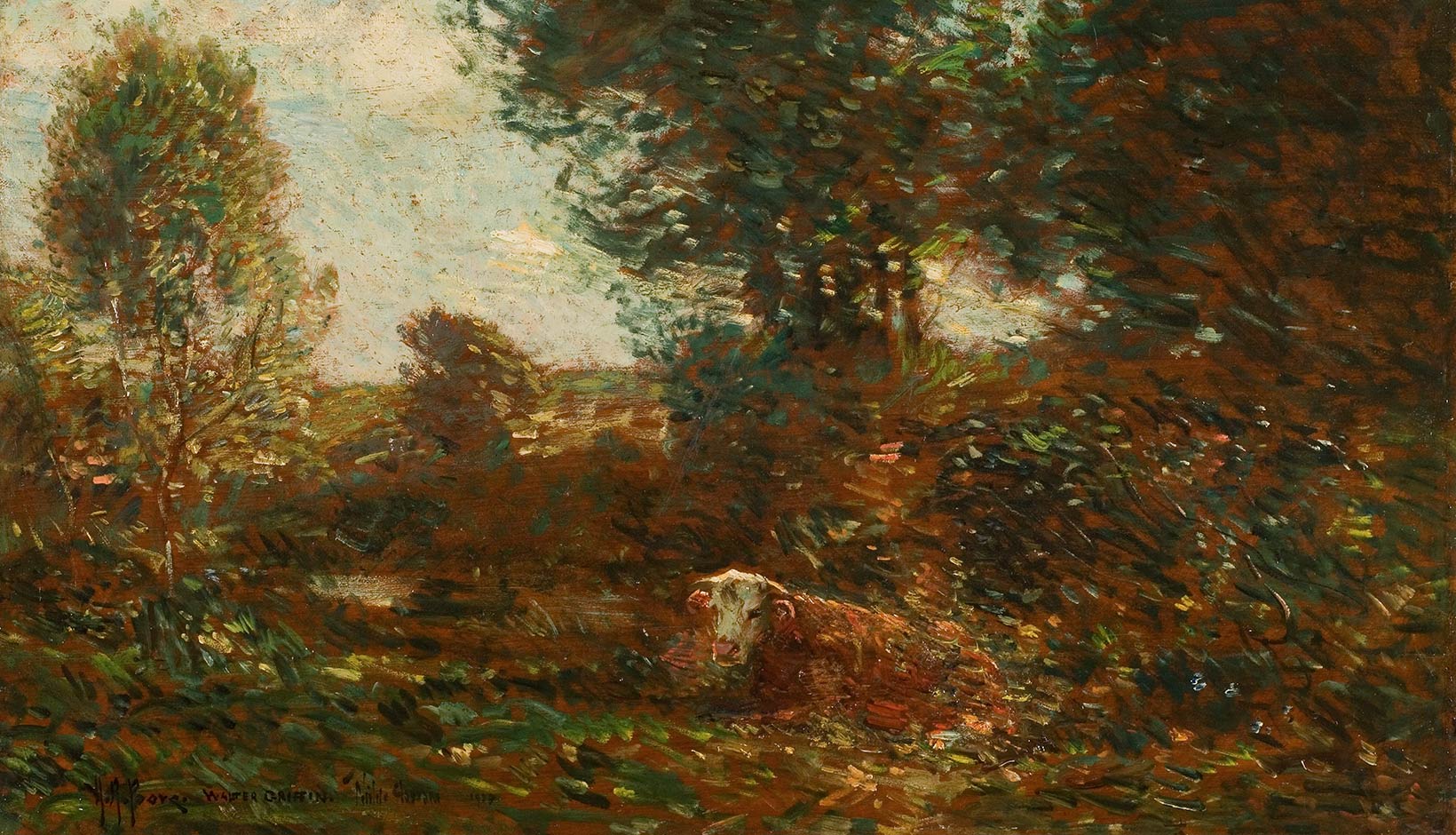
WALTER GRIFFIN (1861–1935), CHILDE HASSAM (1859–1935), HENRY RANKIN POORE (1859–1940), "LANDSCAPE WITH COW," 1907. OIL ON WOOD PANEL. FLORENCE GRISWOLD MUSEUM, GIFT OF THE ARTISTS
One of the great pleasures and benefits of an art colony, American artists discovered when they became acquainted with some in Europe, was the opportunity to discuss and exchange artistic ideas on a daily basis and to see the stages by which colleagues created works of art. It was serious business.
This panel, however, the collaboration of three men whose distinctive styles are not generally compatible, may have been done as a lark.
Surely it was the Tonalist Henry Rankin Poore who painted the reclining cow. His images of animals were well known; a number grace his Fox Chase mural over the dining room fireplace.
Was Poore mimicking Glenn Newell’s cow on a nearby panel – a cow of a different color but otherwise very much the same? This one lies not in a Dutch landscape, however, but in Old Lyme, where trees are all around as Walter Griffin found to his joy when he arrived in 1904. Griffin liked tall, thin trees with sinuous trunks and limbs, and in his hands tree leaves can seem to shimmer, partly because of his trick of shaping and modeling foliage with a brush loaded with two colors of paint. The tree at the left is surely one of his and so, probably, are the others.
The overlay of short, often parallel strokes in much of the rest of the painting looks like the work of Childe Hassam, a more daring Impressionist than Griffin, and thus the more compelling foil to Poore’s Tonalism. Hassam brushed dashes of sunlight into this scene, most cleverly above, over, and below the body of the cow, so that they highlight the animal like a spotlight. All three artists used the “baked apple” colors that Old Lyme Tonalists like Poore and Henry Ward Ranger were fond of, but sunny highlights, vibrant greens, and lively brushwork by Griffin and Hassam transport this Tonalist cow into an Impressionist landscape.
The “clash” of two popular ways of painting in Old Lyme and in America at the turn of the 20th century may be overdone here for a humorous effect, but many of the Old Lyme art colonists developed a subtle blend of Tonalism and Impressionism.
“Hassam, Poore and Walter Griffin painted the middle panel on the inside wall. It was started as a wedding present for a young about-to-be-bride in Old Lyme. One morning she happened to drop in and found the three of them munching cream cheese and chives in the dining room. She was quite disgusted and did not hesitate to tell them so. Provoked, they decided the painting was far too good for her and gave it to Miss Florence instead.” — Artist Harry Hoffman, 1954
Henry Ward Ranger was delighted with the Griswold House and Old Lyme as a place for a summer art colony like those he had known in France. So when he wanted to do something special for Florence Griswold in 1900, the first summer that he and his friends were together in her home, he decorated a door panel – something he had seen artists do abroad – and he challenged his friend Henry Rankin Poore to complete the picture on the adjacent panel (below).
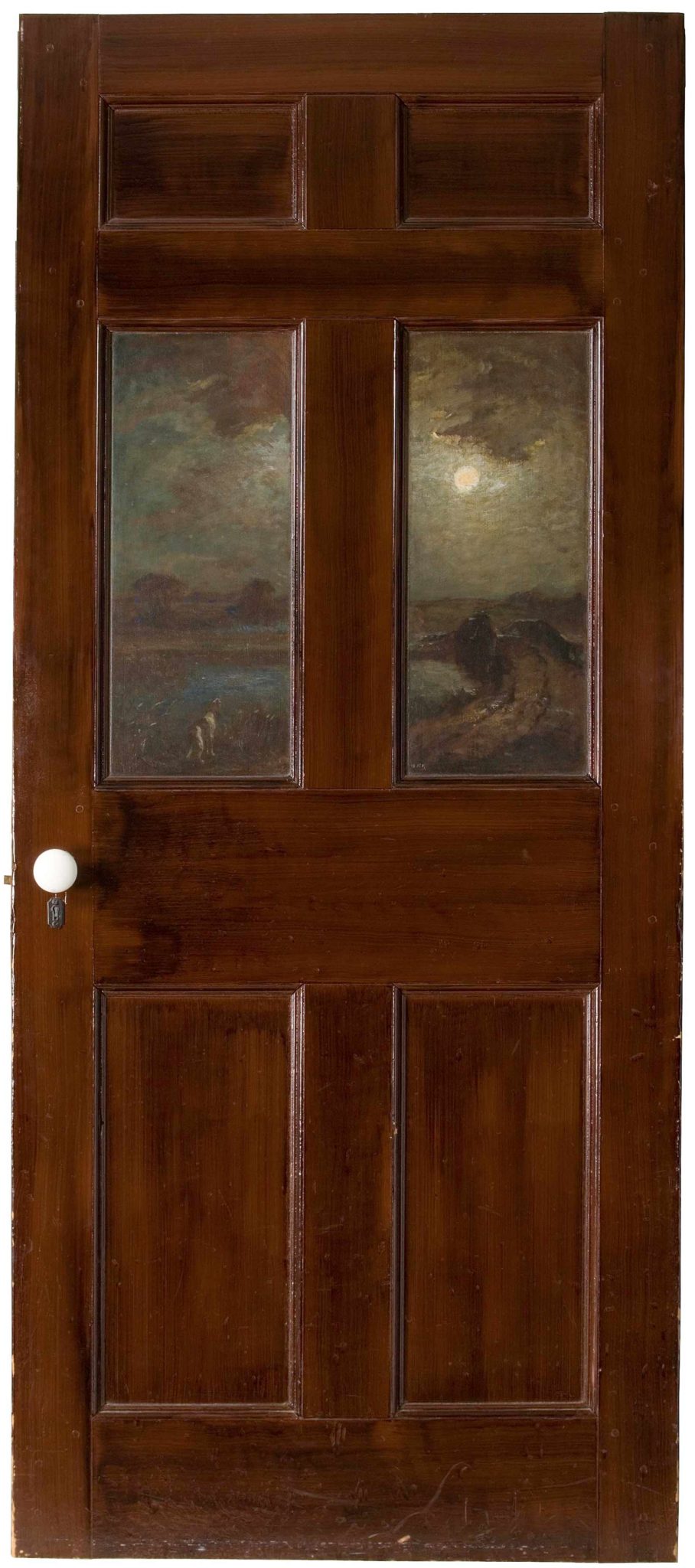
HENRY RANKIN POORE (1859–1940) & HENRY WARD RANGER (1858–1916), "HOUND DOG BAYING AT THE MOON & BOW BRIDGE BY MOONLIGHT," C. 1901. OIL ON WOOD PANEL. FLORENCE GRISWOLD MUSEUM, GIFT OF THE ARTISTS
This was rather like an elaborate version of the wiggle game that the Old Lyme art colonists played, where one artist drew a couple of lines on some paper, then passed it to another, who was expected to turn it into a picture. Since Ranger and Poore aimed at uniting two images into one for this door decoration, we should look at their panels as a pair.
His moonlit scene is of Bow Bridge, the quaint-looking arched bridge over the Lieutenant River that could be seen from Miss Florence’s house. The scene well represents the Tonalism that Ranger promoted, where subdued colors and an often “heavy” atmosphere create an aura of mystery or inspire dreamy feelings.
He stands on another part of the road to the bridge and bays at the full moon. Poore seamlessly matched Ranger’s brushwork and his tones in land, water, and sky. Surely only their artist colleagues would have been able to identify which artist did which panel. Poore was known for his images of animals, Ranger for his landscape views and an often dramatic central light.
These two panels, the first on any Griswold House doors, established a tradition among the colony artists. They are also the only ones not painted directly on a door but on canvas attached to the wood. Perhaps that was done so that Florence Griswold could remove them if she did not want a baying hound dog in her house, but the artists need not have worried. She cherished the gift.
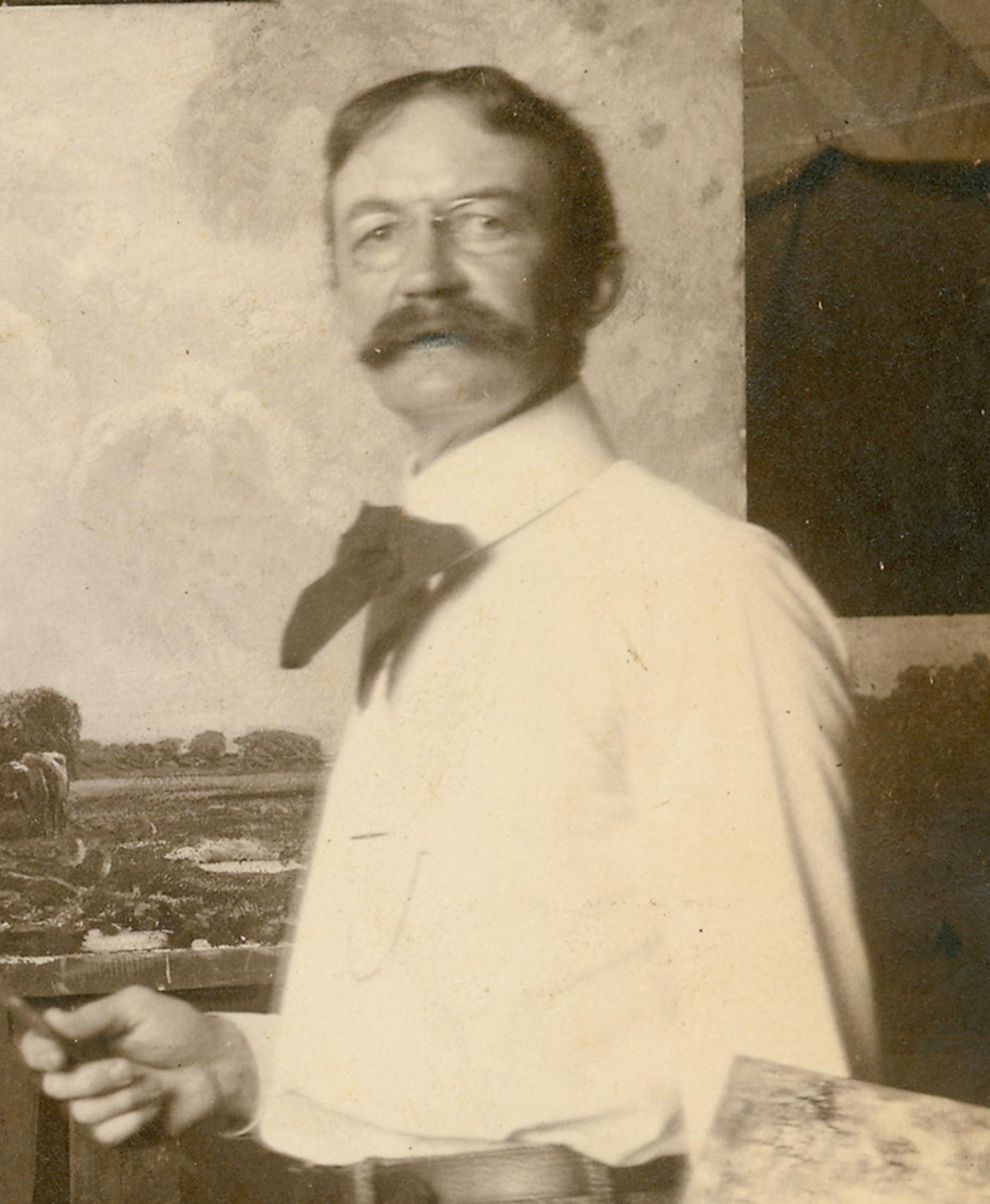
Henry Rankin Poore in studio
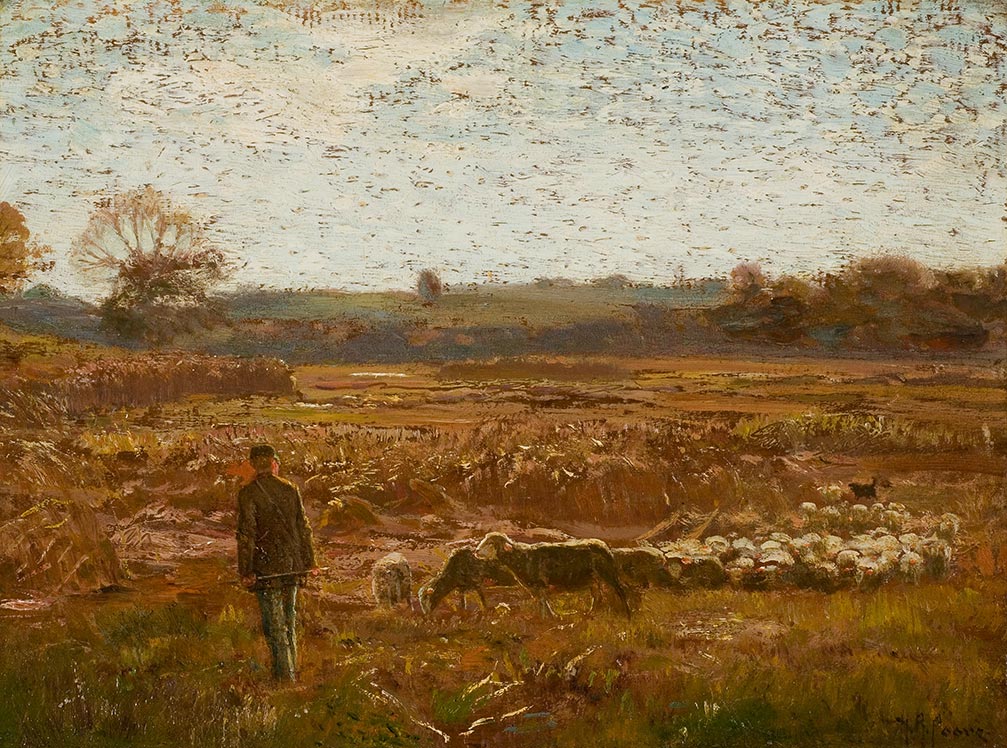
Henry Rankin Poore (1859–1940), Marshland Flock, n.d. Oil on wood panel, 12 in. x 16 in. Florence Griswold Museum, Gift of Mrs. James Dyson
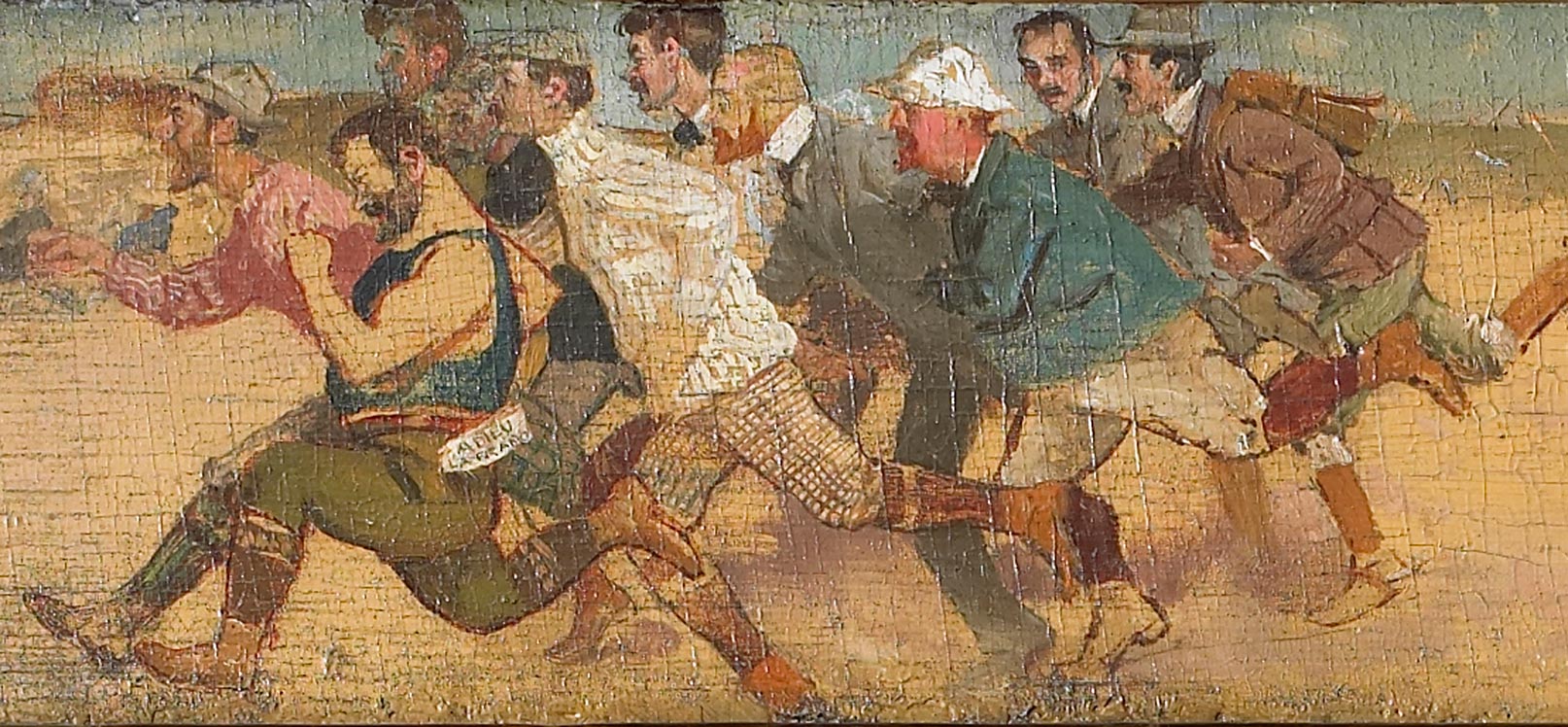
Henry Rankin Poore (1859–1940), The Fox Chase (detail), 1901-1905; revised ca. 1920. Oil on wood panel, 5 3/4 in. x 105 in. Florence Griswold Museum, Gift of the artist
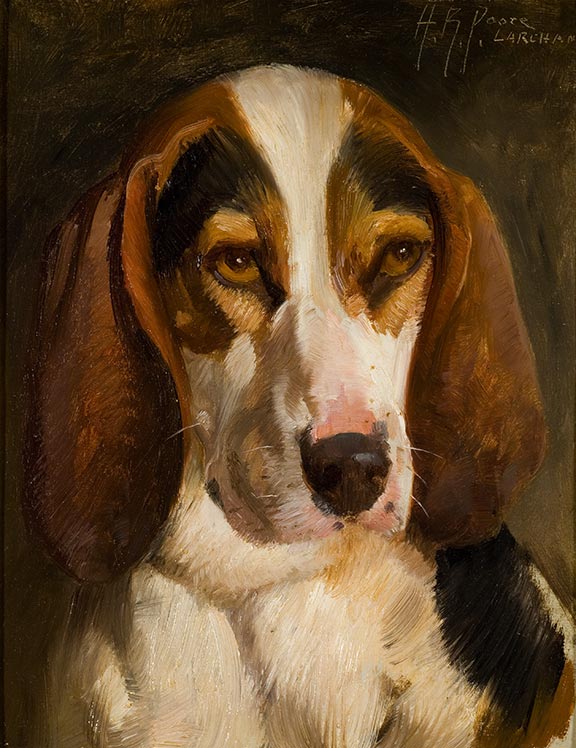
Henry Rankin Poore (1859–1940), Beagle Hound, n.d. Oil on artist board, 13 1/2 in. x 10 1/2 in. Florence Griswold Museum, Gift of Mr. and Mrs. Nathan Shippee
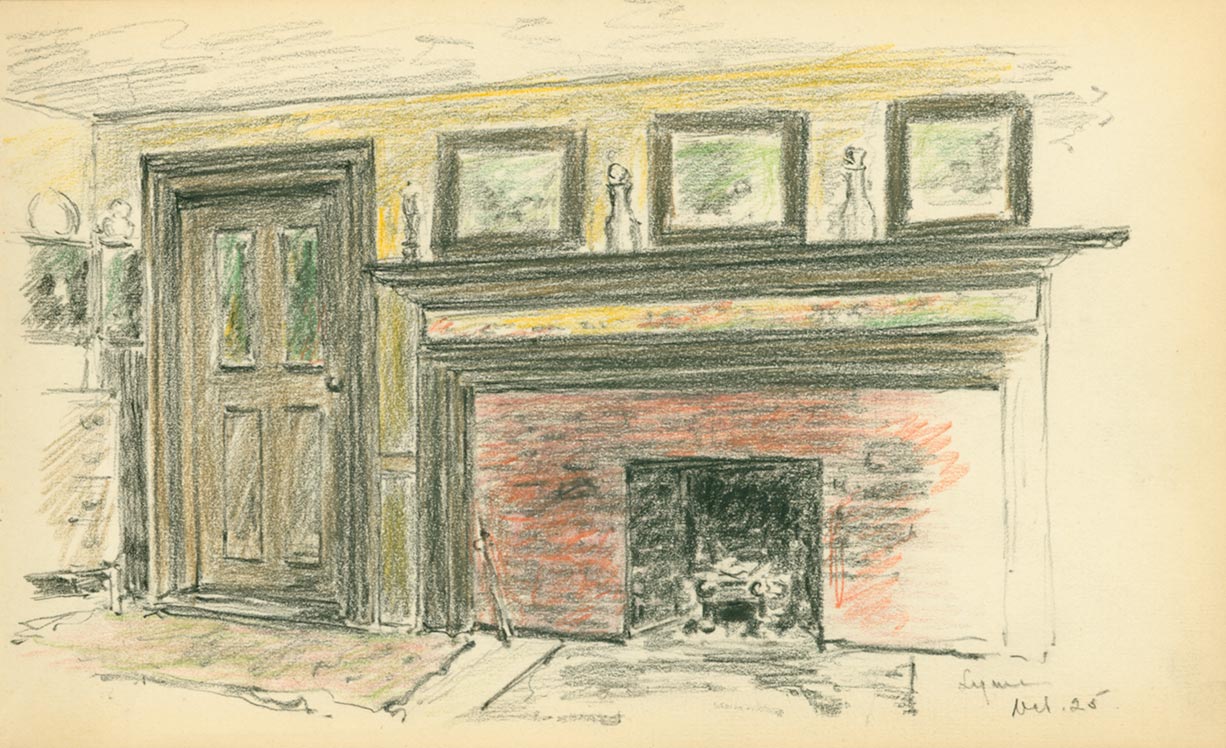
Margaret Hardon Wright (aka Mrs. James H. Wright), (1869–1936), Sketchbook, 1907–1921. Graphite on paper. Florence Griswold Museum, Gift of Dr. & Mrs. James H. Wright