
Henry Ward Ranger
(1858 – 1916)
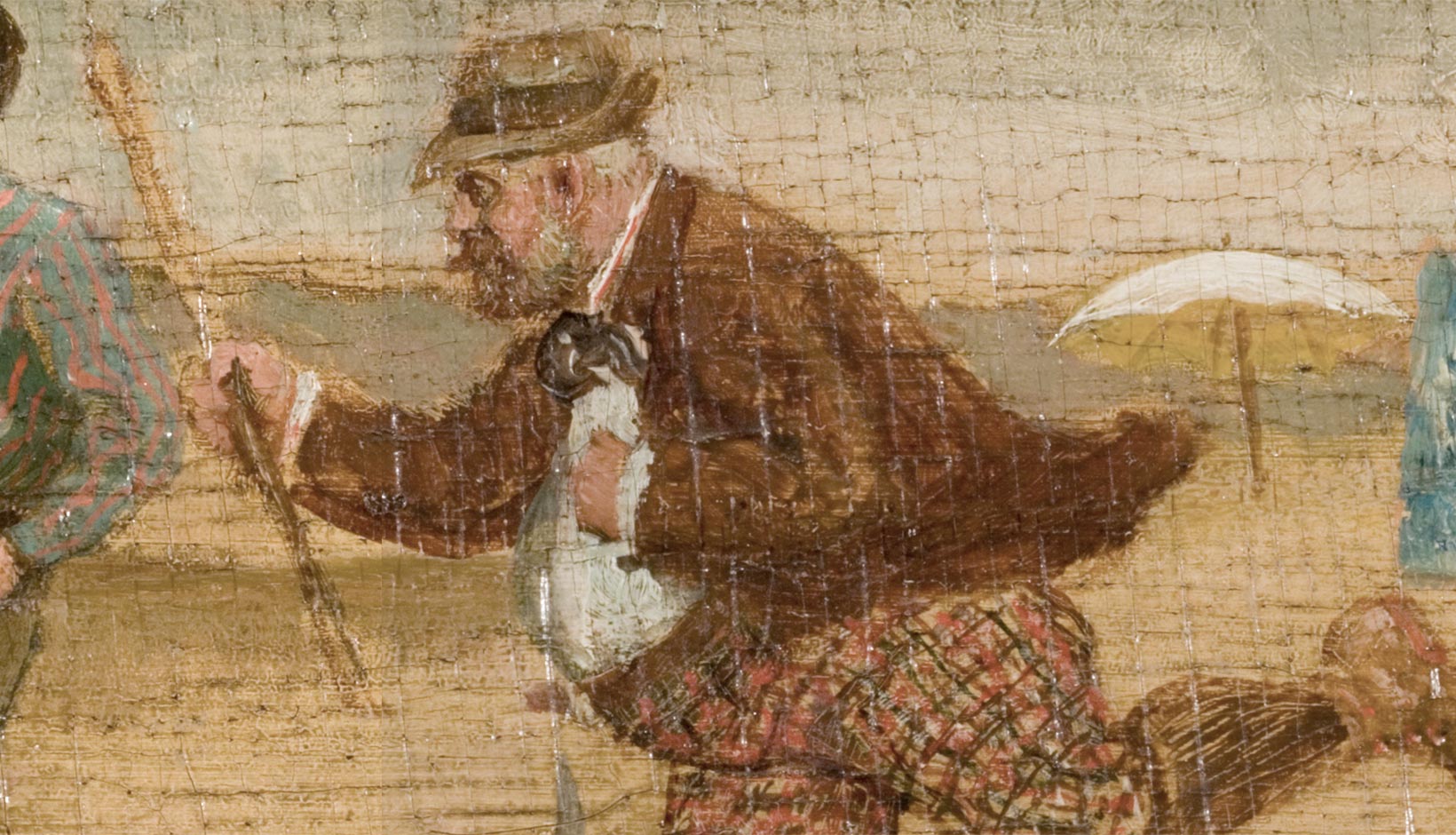
HENRY RANKIN POORE (1859–1940)
THE FOX CHASE (detail), 1901-1905; REVISED C. 1920
OIL ON WOOD PANEL
FLORENCE GRISWOLD MUSEUM
GIFT OF THE ARTIST
Born January 29, 1858, Syracuse, New York
Died November 7, 1916, New York City
In Old Lyme, 1899-1904; in Noank, c. 1902-1914
The story of the Lyme Art Colony began in 1899, when the New York artist Henry Ward Ranger stopped by the Griswold boardinghouse to meet Florence Griswold.
Ranger was searching for a suitable location to establish an American art colony, fashioned after his favorite painting haunts in Europe. Artist friends encouraged him to investigate the quiet town of Old Lyme, Connecticut. Immediately smitten, Ranger soon wrote to his New York dealer: “I want to drive you around & see a little bit of this beautiful country, where pictures are made – your station is Lyme.”
As promised, Ranger returned the following summer, bringing other artists with him. That first summer included Lewis Cohen, Alphonse Jongers, Henry Rankin Poore, Louis Paul Dessar and William Howe, the true pioneers of the Lyme Art Colony. Like-minded, these artists were called Tonalists because of their use of limited colors (often browns and greens) and delicate modulations of light to create effects of mood. Later, these artists would be teased for their dark and moody paintings and nicknamed both “the baked apple” and “brown gravy” schools of painting.
“In appearance he was a man of full weight, dressed carelessly for the most part, loved big, loose clothes of English or Scotch tweeds. He slouched in his big easychairs and talked in a rather suppressed tone and often most entertainingly, the voice coming past the cigarette which was forever literally on his lip.” — Artist Elliott Daingerfield, 1918
Ranger was an imposing figure with a husky frame and a scruffy bearded face, most often enshrined in a cloud of smoke issuing from the ever-present cigar or cigarette clasped between his lips. He would freely dispense his opinions on everything from painting to ping-pong (he brought his own table). He enjoyed pitching horseshoes behind the Griswold boardinghouse as well as playing the organ at night in the parlor.
Although credited with founding the art colony and successfully attracting a bevy of artistic talent out to the country, his leadership was questioned by the arrival of Childe Hassam in 1903. Hassam brought with him younger artists and the intrigue of the new painting style known as Impressionism. These bright paintings offended Ranger who, after another year at the colony, moved eastward along the coast to settle in the seaside village of Noank, close to his beloved Mason’s Island, with its towering ancient oaks. He continued to be friendly with the Old Lyme artists, especially in New York, but his time at Miss Florence’s ended after only five years under her roof.
“There, of a summer night, one may see, smoking his cigar, the bulky form of Henry Ranger, one of our greatest living landscape painters, and one of the first to make famous with splendid canvases the extraordinary beauty of the Lyme country.” — Journalist Anthony H. Euwer, 1904
Henry Ward Ranger was delighted with the Griswold House and Old Lyme as a place for a summer art colony like those he had known in France. So when he wanted to do something special for Florence Griswold in 1900, the first summer that he and his friends were together in her home, Ranger decorated a door panel (below) – something he had seen artists do abroad – and he challenged his friend Henry Rankin Poore to complete the picture on the adjacent panel.
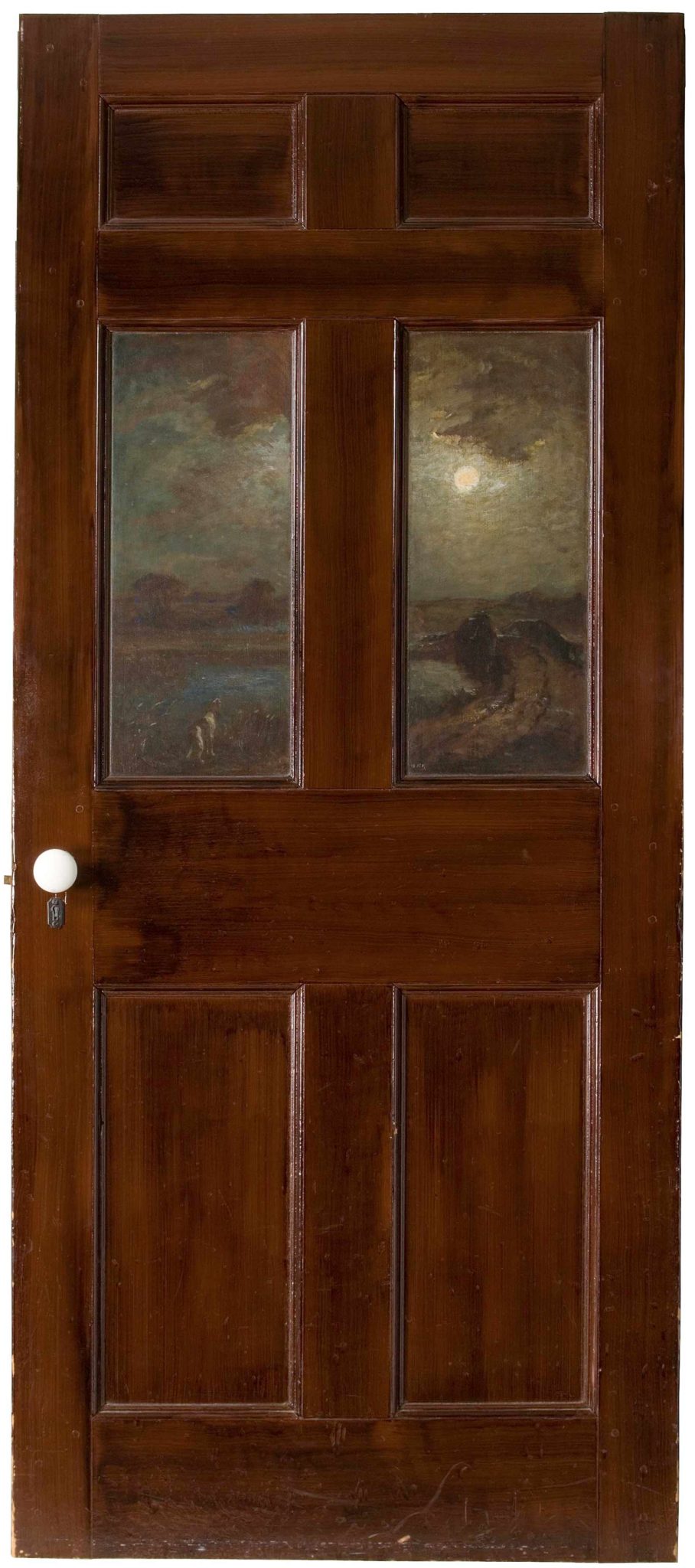
HENRY RANKIN POORE (1859–1940) & HENRY WARD RANGER (1858–1916), "HOUND DOG BAYING AT THE MOON & BOW BRIDGE BY MOONLIGHT," C. 1901. OIL ON WOOD PANEL. FLORENCE GRISWOLD MUSEUM, GIFT OF THE ARTISTS
This was rather like an elaborate version of the wiggle game that the Old Lyme art colonists played, where one artist drew a couple of lines on some paper, then passed it to another, who was expected to turn it into a picture. Since Ranger and Poore aimed at uniting two images into one for this door decoration, we should look at their panels as a pair.
His moonlit scene is of Bow Bridge, the quaint-looking arched bridge over the Lieutenant River that could be seen from Miss Florence’s house. The scene well represents the Tonalism that Ranger promoted, where subdued colors and an often “heavy” atmosphere create an aura of mystery or inspire dreamy feelings.
He stands on another part of the road to the bridge and bays at the full moon. Poore seamlessly matched Ranger’s brushwork and his tones in land, water, and sky. Surely only their artist colleagues would have been able to identify which artist did which panel. Poore was known for his images of animals, Ranger for his landscape views and an often dramatic central light.
These two panels, the first on any Griswold House doors, established a tradition among the colony artists. They are also the only ones not painted directly on a door but on canvas attached to the wood. Perhaps that was done so that Florence Griswold could remove them if she did not want a baying hound dog in her house, but the artists need not have worried. She cherished the gift.
“I would like to get into my pictures of this region a little of the love I feel for those who made it. As for me, a landscape to be paintable must be humanized. All landscapes that have been well painted are those in which the painter feels the influence of the hand of man and generations of labour.” — Henry Ward Ranger, 1914
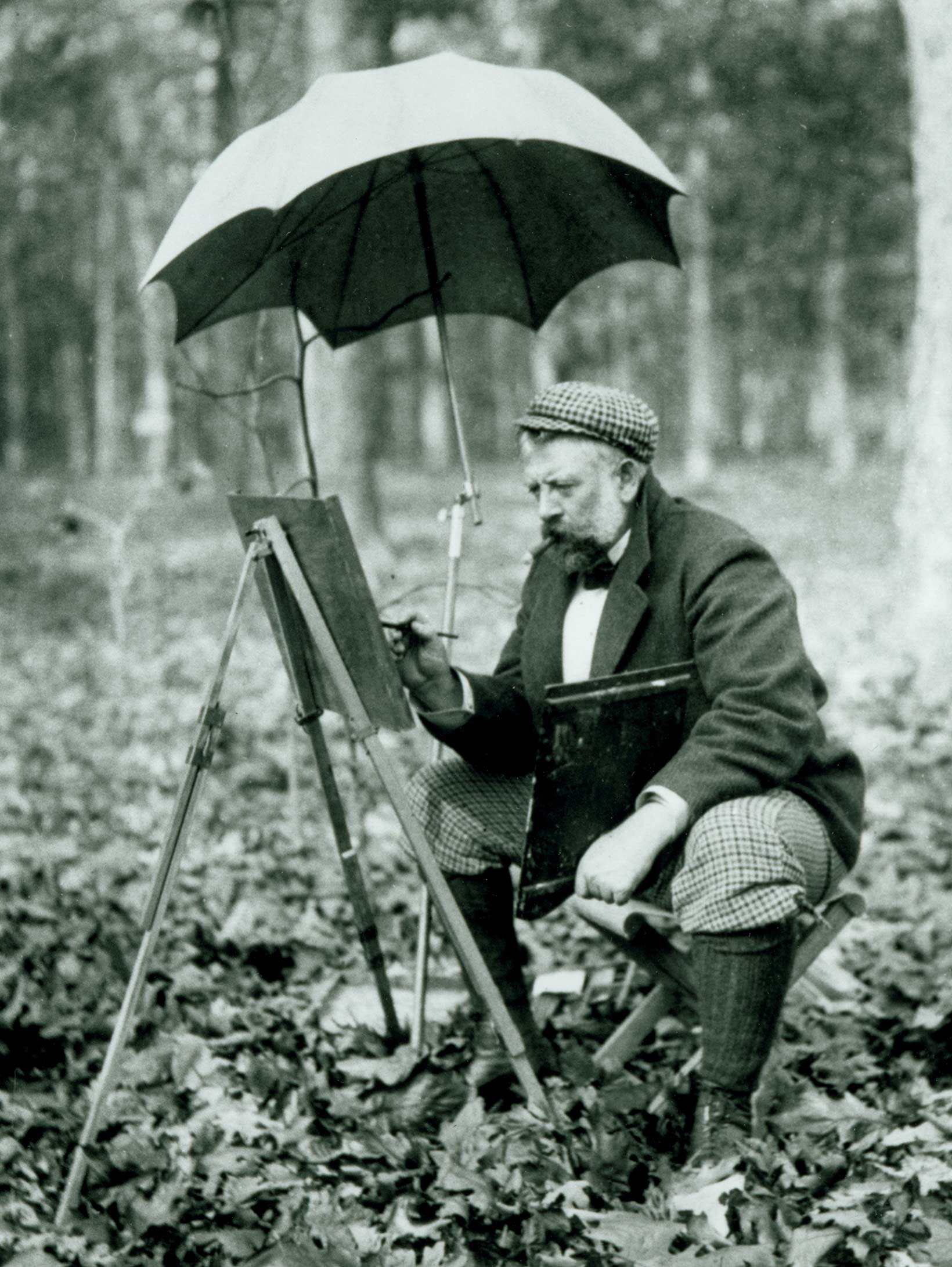
Henry Ward Ranger painting on Mason’s Island (near Mystic, Connecticut)
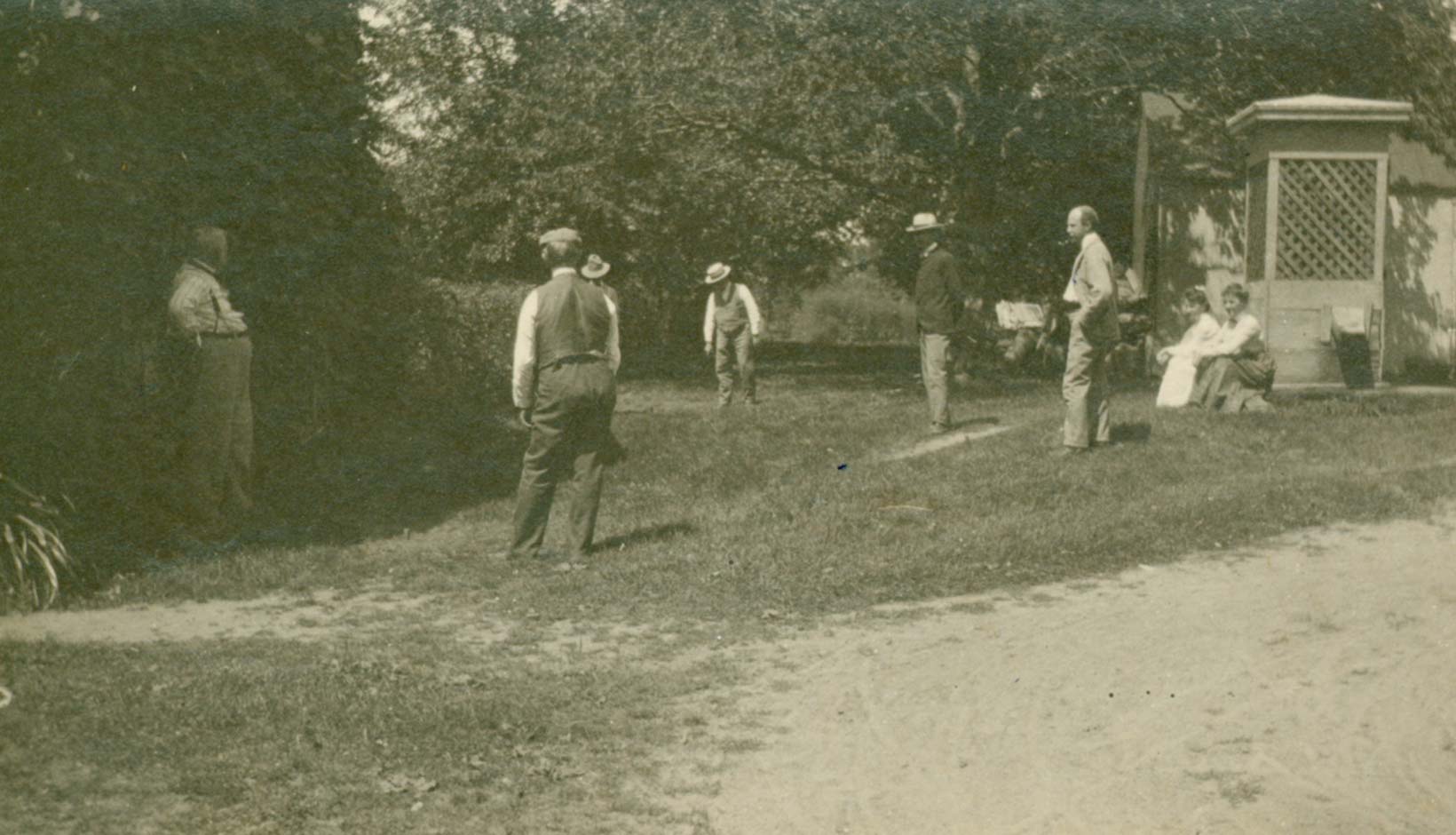
Artists pitching horseshoes behind the Griswold House
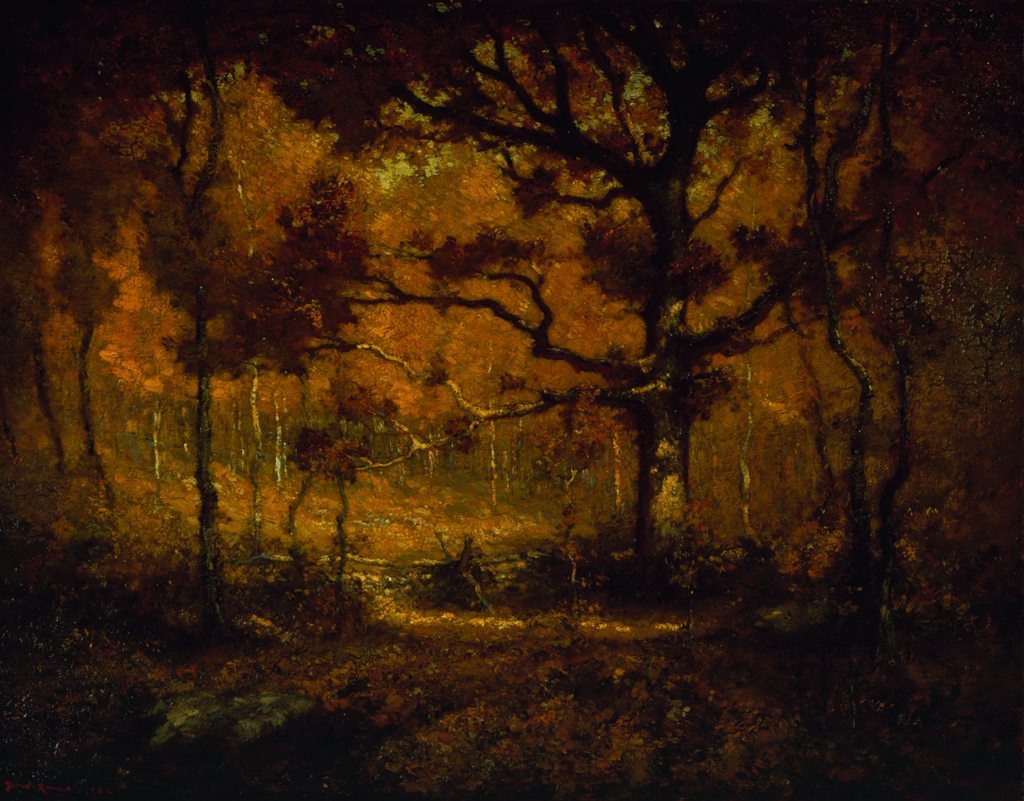
Henry Ward Ranger (1858–1916), Autumn Woodlands, 1902. Oil on canvas. Florence Griswold Museum, Gift of Mr. Israel Liverant