
Robert H. Nisbet
(1879 – 1961)
ROBERT H. NISBET (1879-1961)
VENETIAN NIGHT, 1905-1906
OIL ON WOOD PANEL
GIFT OF THE ARTIST
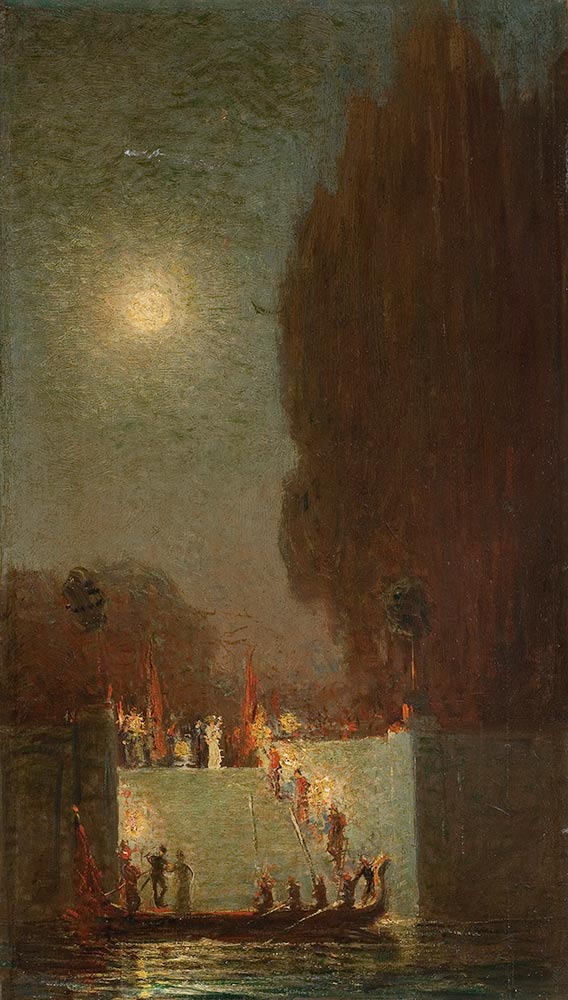
Robert Nisbet’s Venetian scene is a striking contrast to the many panels in the Griswold House dining room that portray the landscape of Old Lyme or other bucolic places – and, indeed, it is a departure from the kind of painting Nisbet himself was known for. He had been to Europe, perhaps even seen Venice, but at Old Lyme, and later in Kent, Connecticut, he depicted the local landscape, imbuing it with sunlight and a strong sense of place. His exotic Venetian scene looks more theatrical than real. The design, however, makes good use of a challenging vertical format that is almost twice as high as it is wide.
The richly textured moonlit sky on the left side and dark trees on the right are heavily atmospheric, creating a mood that enhances the sense of mystery in the scene below. A gondola has come to an elaborate dock. Its occupants are disembarking to join elegantly dressed people who have apparently gathered for a fête, as the orange flags imply. We see it all from a distance, can make out little detail, and are mostly affected by the lighting, only some of which can be attributed to the full moon. One can almost hear the music that would surely accompany such a scene. Fellow art colonist George Bogert also was a fan of Venice. The Museum owns one of his renderings of that city draped in mist done in tones of blue (pictured in the gallery below).
A prodigy who entered the Rhode Island School of Design when he was only eight, Robert Nisbet came to Old Lyme in 1903 to study with Frank DuMond, whose classes attracted many students. He returned in 1905 as a private student of Willard Metcalf, who was new to Old Lyme but had been his instructor in Providence the previous fall.
Both returned the next two summers, but Nisbet left abruptly in July 1907 – with Metcalf’s wife! The two married and settled in Kent, where Nisbet founded the Kent Art Association. He became a well-known painter and etcher of landscape, figural, and genre subjects, was honored with prizes, and was active in several important art organizations. He was also an avid bibliophile, fisherman, sharpshooter, gun collector, and Mason.
Judging by the two panels he did for the dining room (Venetian Night and the one below), Robert Nisbet was in a romantic mood at Old Lyme, and, indeed, he was then romancing, as he should not have been, the young wife of his teacher Willard Metcalf.
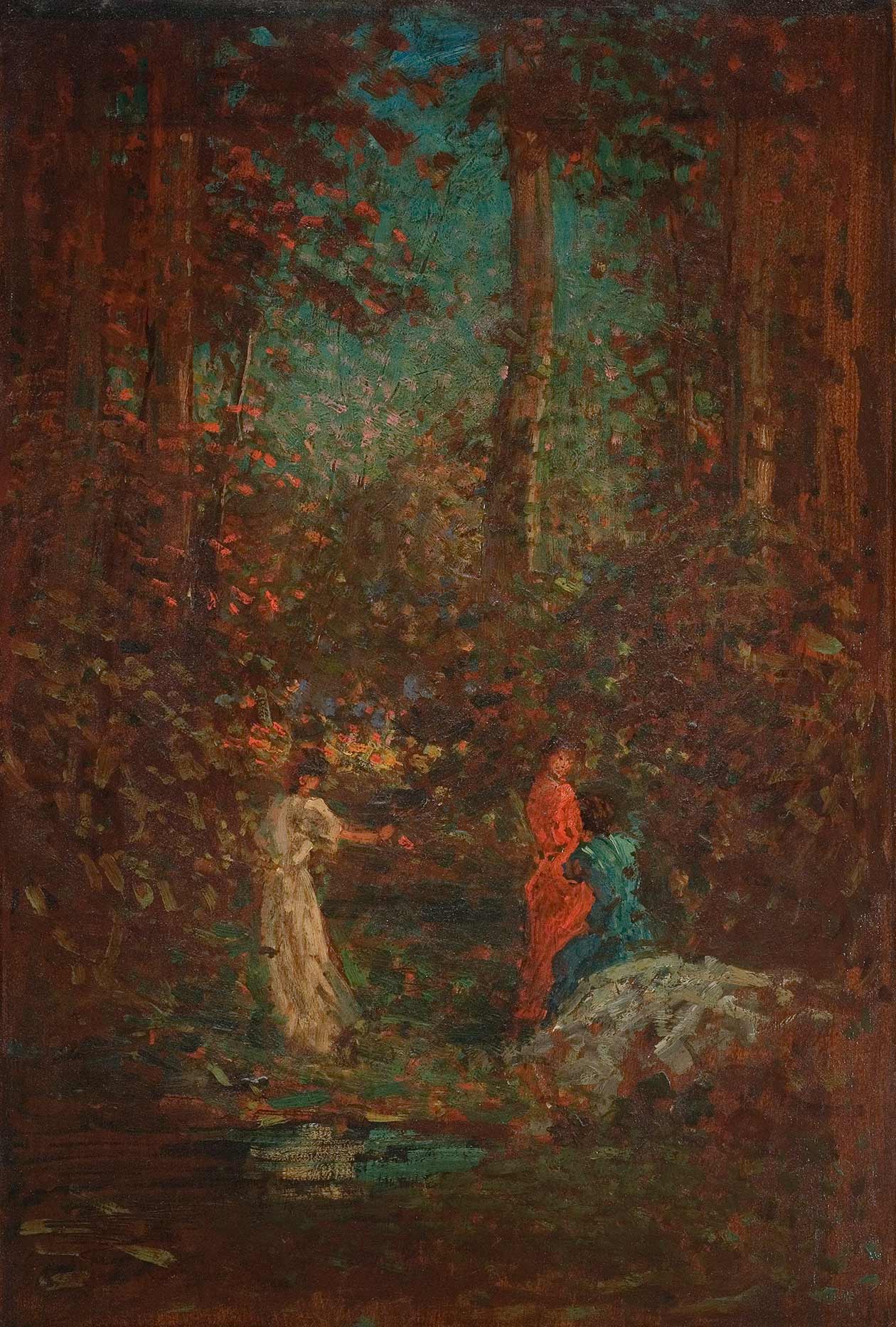
ROBERT H. NISBET (1879–1961), "THREE YOUNG WOMEN IN A WOOD," N.D. OIL ON PANEL. FLORENCE GRISWOLD MUSEUM, GIFT OF THE ARTIST
Nisbet was at the Griswold House again in 1906 and 1907. Students were not usually welcome there, but Nisbet was seen as remarkably gifted and was soon considered a fellow professional. That he was asked to do not one but two panels for the dining room is evidence of his acceptance. Of course, he did not return to Old Lyme after running off with Metcalf’s wife in 1907.
That women and nature – the peaceful pleasant face of nature – are profoundly connected is a very old idea in Western thought, which came to the fore again in late 19th-century America. It was a time when wives kept home and family together while men went off each day to deal with business, technology, and other challenges of the industrial age. As a result, artists portrayed women in gardens, meadows, and woodlands, clad in flowing Goddess-like gowns or, like the nymphs of classical myth, without any clothes at all. Here the three ladies, two standing and one seated on a large boulder, dressed in gowns of white, blue, and red appear to be enjoying a conversation in this richly textured woodland. A prismatic blue twilight sky flecked with purple shimmers through the trees and is reflected in a small pool beside the rock. What these women might be saying is anybody’s guess. This is an other-worldly, midsummer night’s dream sort of scene, even though Nisbet may have had Old Lyme and some of the artists’ wives he met there in mind.
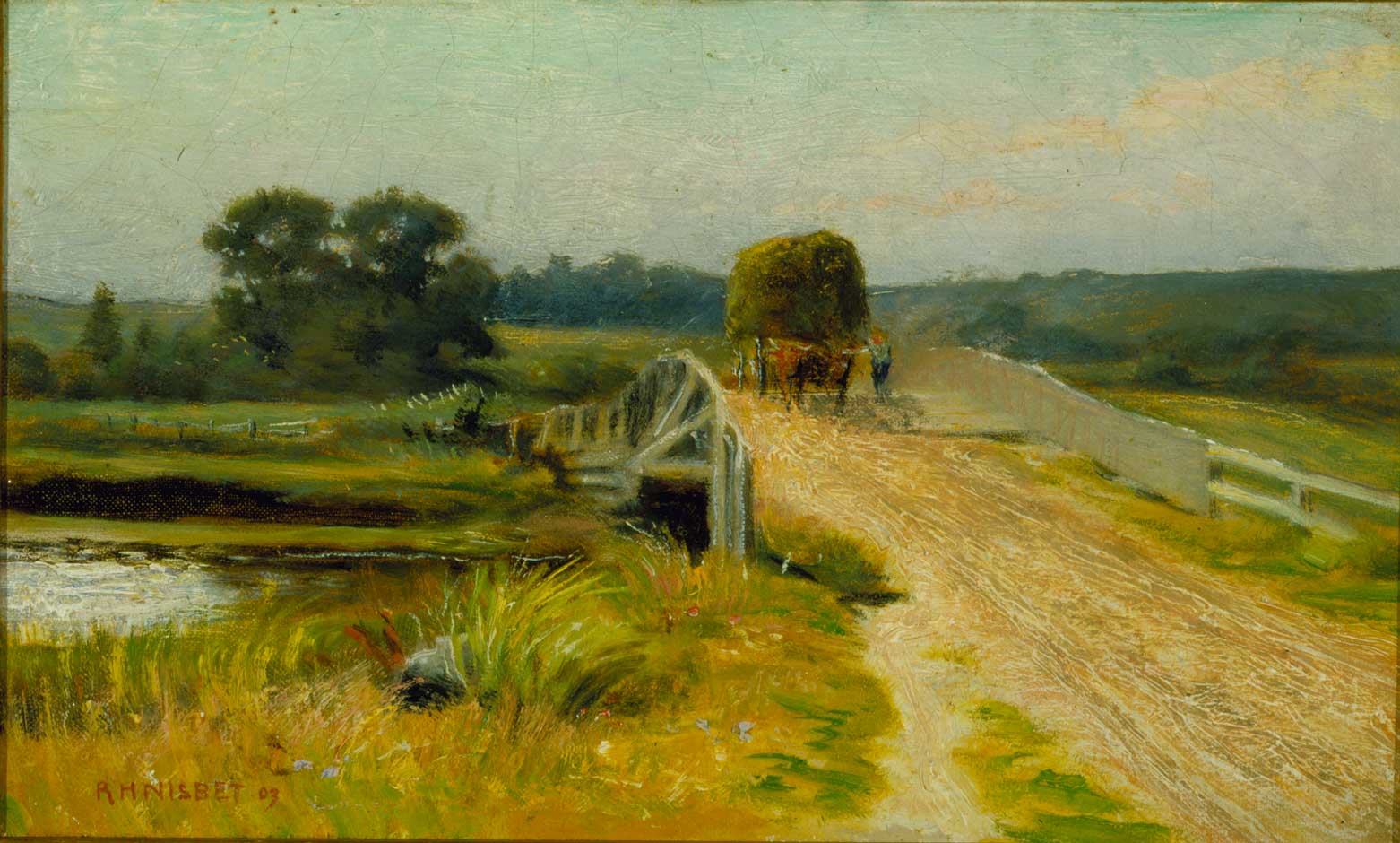
Robert Nisbet (1879–1961), Bow Bridge, 1903. Oil on canvas, 9 in. x 15 in. Florence Griswold Museum, Gift of Mr. and Mrs. George Page Ely
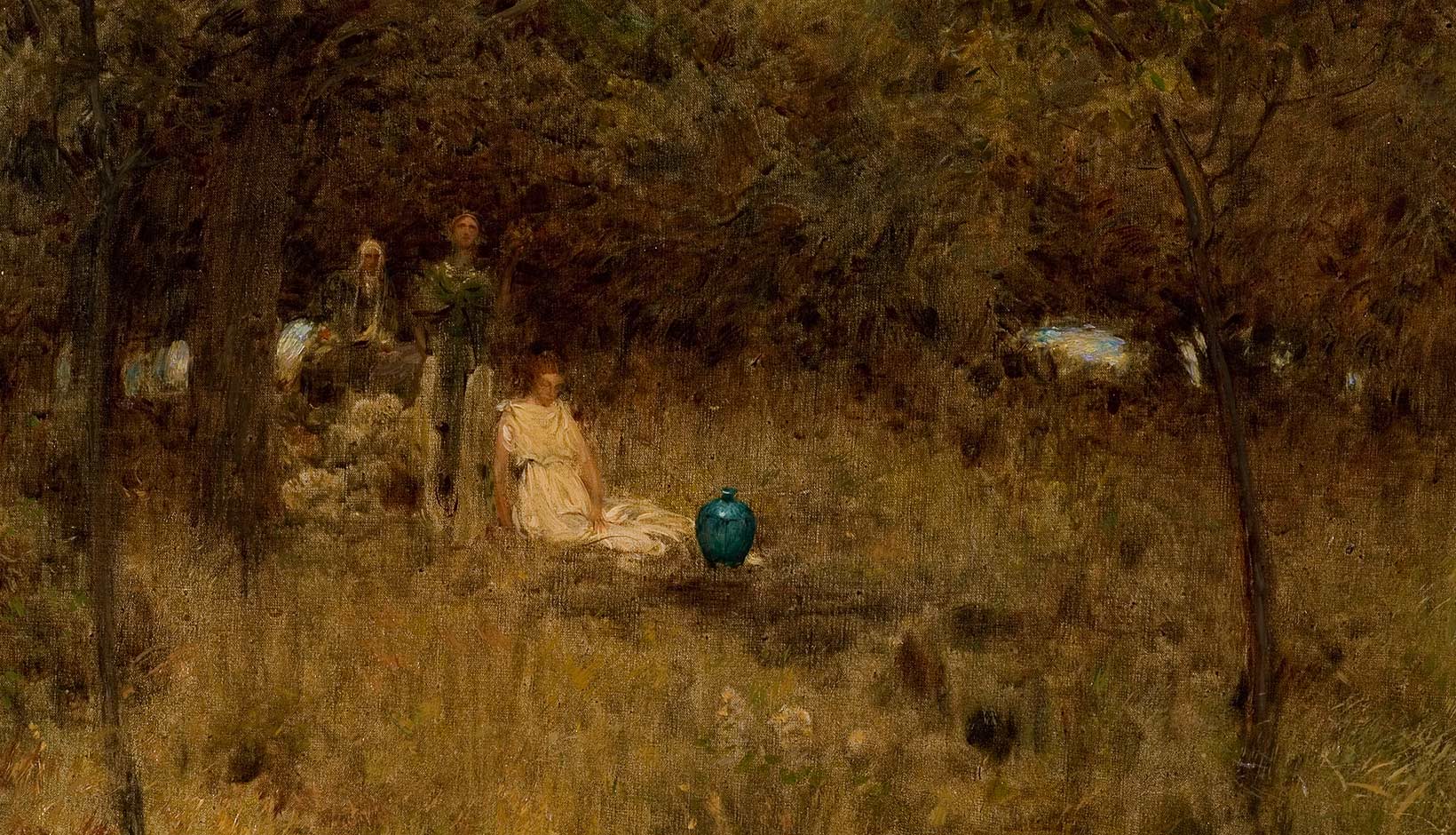
Frank Vincent DuMond (1865–1951), Figures in a Landscape, 1902. Oil in canvas, 16 in. x 22 in. Florence Griswold Museum, Gift of Mrs. Roger Griswold
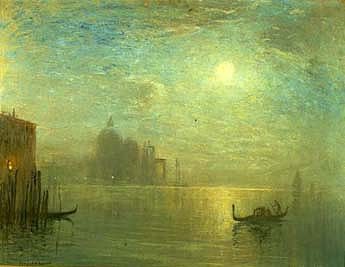
George Bogert (1864–1944), Venice in the Mist, n.d. Oil on canvas, 27 1/2 in. x 35 1/2 in. Florence Griswold Museum, Gift of Mr and Mrs Gordon Harris
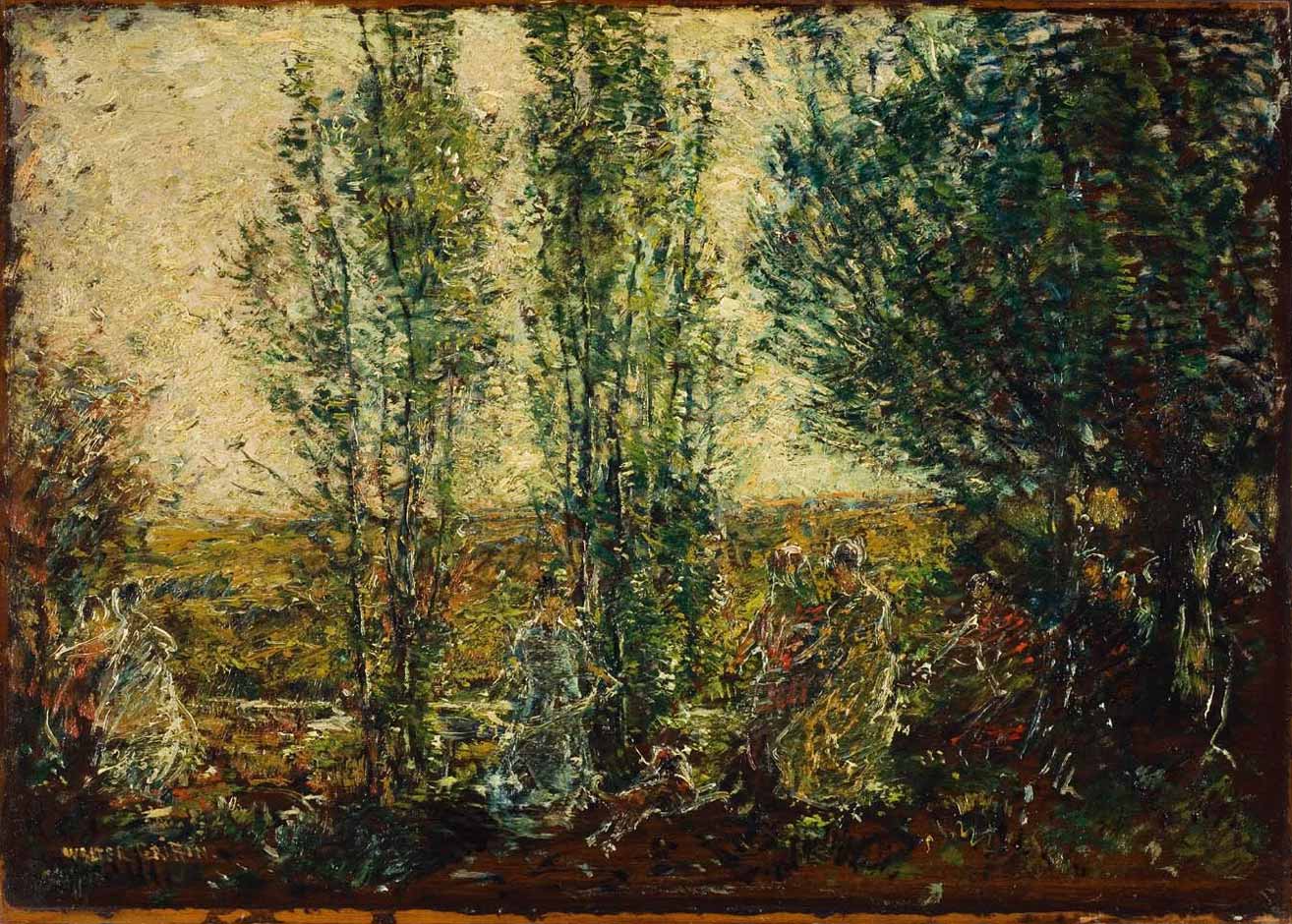
Walter Griffin (1861–1935), Ladies in the Woods , n.d. Oil on wood panel. Florence Griswold Museum, Gift of the artist
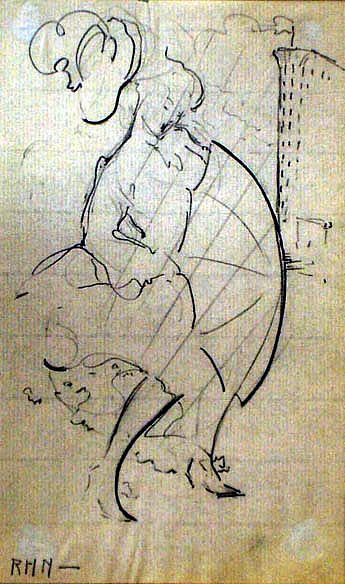
Robert H. Nisbet (1879–1961), Wiggle Drawing, n.d. Graphite on paper, 9 x 5 3/8 in. Florence Griswold Museum, Gift of the artist