
Willard Leroy Metcalf
(1858 – 1925)
HENRY RANKIN POORE (1859–1940)
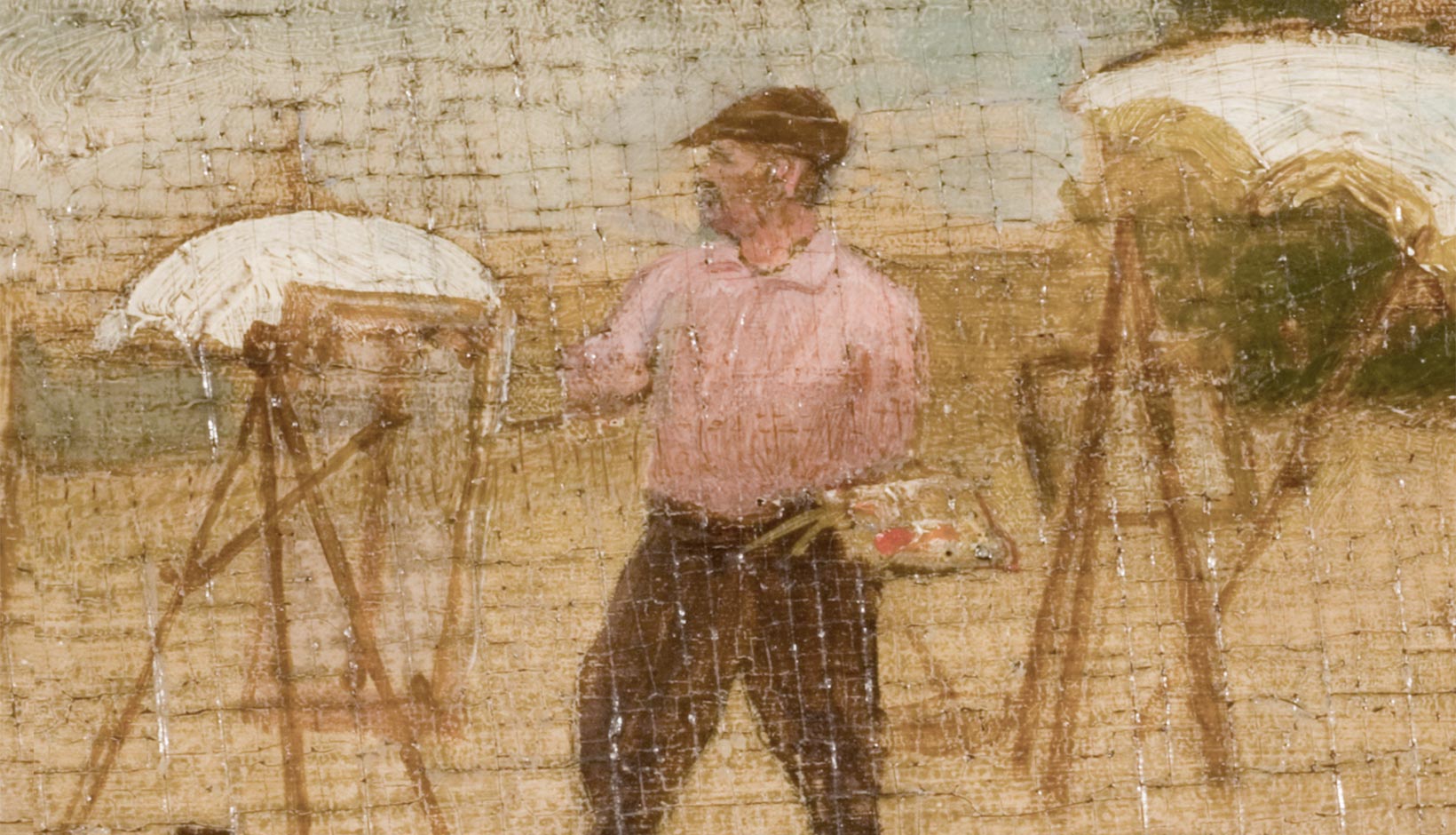
THE FOX CHASE (detail), 1901-1905; REVISED C. 1920
OIL ON WOOD PANEL
FLORENCE GRISWOLD MUSEUM
GIFT OF THE ARTIST
Born July 1, 1858, Lowell, Massachusetts
Died March 9, 1925, New York City
In Old Lyme, 1905-1907
Willard Metcalf, or “Metty” as he was called by his artist friends, found his artistic voice while staying with Miss Florence in Old Lyme. His painting May Night (1906), that shows the front of Miss Florence’s house on a starry spring night, won him prizes and fame when it was exhibited in Washington, D.C. in 1907. He had tried to give the painting to Miss Florence in order to repay some of the debt he had incurred while staying with her. Despite her own money woes, she refused, saying, “I won’t take it, it’s the best thing you’ve ever done. When you show it in New York, they’ll snap it up at once, and everything will be lovely.” (The painting later won the first prize of $1,000 and was the first contemporary painting purchased by The Corcoran Gallery in Washington, D.C.).
Metcalf followed his New York friend Childe Hassam to Old Lyme as early as 1905 for a summer devoted to painting en plein air, or painting outdoors. For Metcalf, this direct study of nature was part of both his painting technique and his hobby of collecting natural specimens. In 1906, one critic said that Metcalf “connives to translate into paint the freshness and fragrance of fields, gardens and evening air. It is nature, rather than the studio, of which he apprises us.” It was in his paintings of the New England landscape that Metcalf truly excelled, capturing the colors and atmosphere of a crisp fall day and prompting his designation as the Poet Laureate of the New England hills. He was masterful at depicting the seasons when the trees change colors or when winter ice thaws into spring.
Metcalf was a keen observer of nature as the pages in his many sketchbooks reveal, telling his students, “paint what you see and forget your theories.” He is given credit for the idea to line the walls of the Griswold dining room with painted panels. Like Henry Ward Ranger, Metcalf had traveled to Europe before coming to Old Lyme. When in France, he traveled to Giverny (the village where the famous Impressionist Claude Monet lived) and stayed in the Hôtel Baudy, a country inn that catered to artists.
This inn was famous for the painted panels in its dining room. During his stay, Metcalf painted In the Café (Au café) in 1888, a busy French café scene on a 14 x 6 inch panel for Gaston and Clarisse Baudy. It remained in the Baudy family until about 1990. Metcalf later shared this idea of painting panels for a dining room with his friends in Old Lyme. He painted four panels in the dining room – perhaps it was because he was the one to suggest that the artists add painted panels to the dining room that he led by example. In the one corner of the room he arranged three panels side by side: a seascape, a woodland interior, and a spherical vase of flowers (his only known floral still life!). Diagonally across the room he painted his sarcastic ode to female student painters.
As a teenager, Metcalf was already fascinated with nature and drawing. While wandering the woods in search of birds’ eggs and nests, he filled his notebooks with sketches of trees, plants, and landscapes. He even tried pastoral genre scenes. After several years in art school, Metcalf began illustrating for major magazines such as Harper’s Monthly. This practice of working for magazines was common among artists of his generation as a way to make money while working on their art.
The prints and drawings in the collection of the Florence Griswold Museum range from personal observations of nature to lovingly rendered portraits of family members in the exceedingly difficult medium of silverpoint. They also include a single wiggle drawing that was most likely created at one of the wiggle game challenges that would help fill the evenings at the Griswold boardinghouse.
In 1993 the Museum acquired an extraordinary collection of seven sketchbooks and a diary from 1876 that belonged to Willard Metcalf. The sketchbooks range from 1875 to 1914, before and after he was involved with the Lyme Art Colony. Three of the sketchbooks are from the early 1880s when Metcalf accompanied the famed Smithsonian ethnologist Frank Hamilton Cushing to New Mexico to prepare illustrations for an article on the Zuni for Harper’s Magazine.
The Museum’s collection of Metcalf’s natural materials are contained in a single cabinet that was donated by his wife in 1971. The tall wooden cabinet has 28 drawers, holding birds’ nests and eggs, and 65 butterflies and moths. Some of the earliest specimens are dated from 1885, when the artist was in France. A number of eggs were collected in the village of Giverny, where the Impressionist artist Claude Monet lived and worked. Although the two artists did not become friends, Metcalf did tutor Monet’s son and stepson in botany and ornithology.
Metcalf is credited with proposing that the Griswold House dining room be studded with painted panels like those at the Hôtel Baudy in Giverny, France. A floral still life is not what one expects to see from the brush of Willard Metcalf. Indeed, this panel in the dining room (below) is the only known example of a still-life painting by this noted landscape artist.
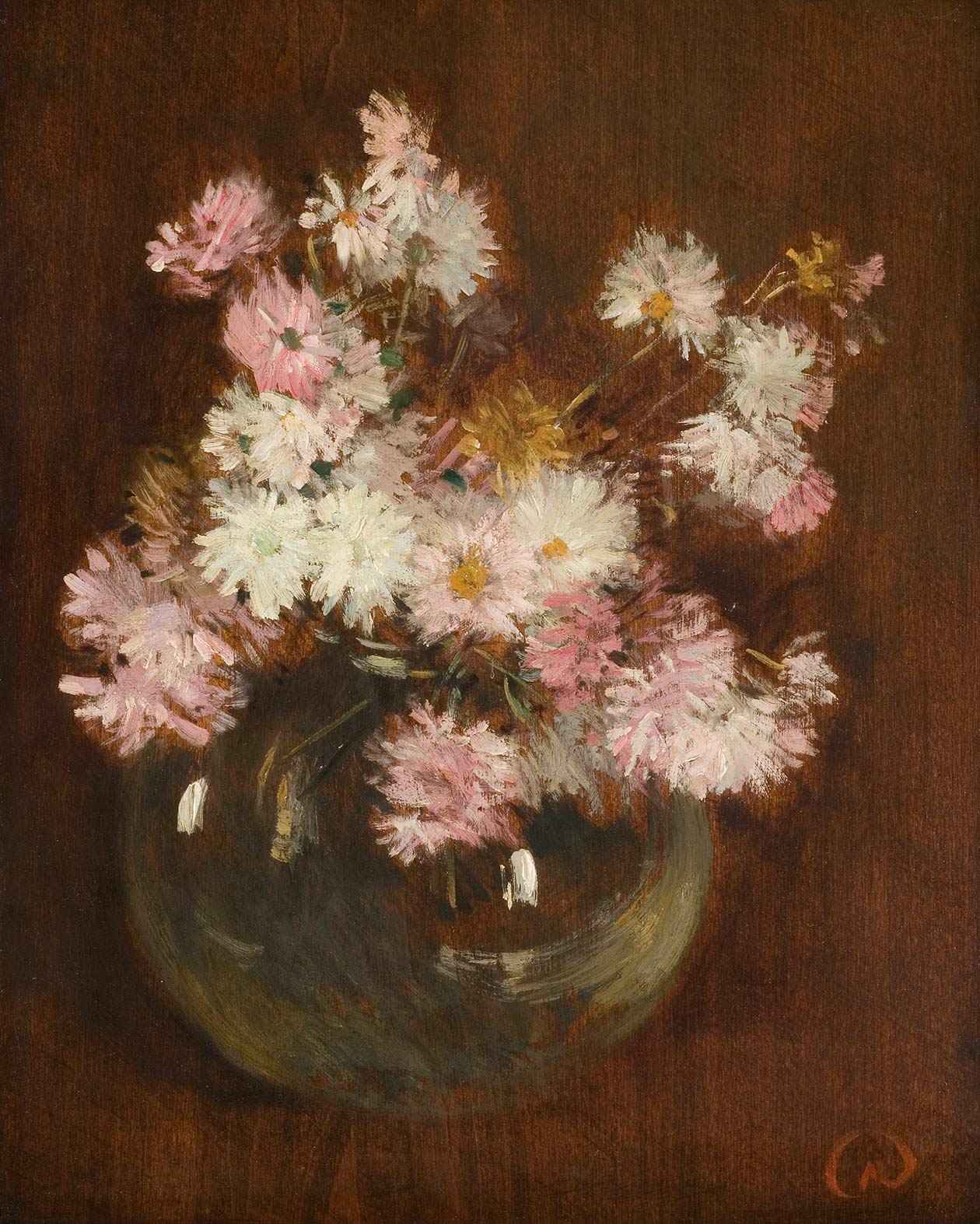
WILLARD LEROY METCALF (1858–1925), "FLORAL STILL LIFE," 1907-08. OIL ON WOOD PANEL. FLORENCE GRISWOLD MUSEUM, GIFT OF THE ARTIST
It is one of three Metcalf panels installed as a group by 1908 in a prime spot in the dining room, set off from all others. A landscape is to the left of the bouquet, and a seascape is above them both. A fourth panel by Metcalf is installed diagonally across the dining room.
Metcalf chose to present these cosmos casually, arranged without apparent care as to how each one might be shown to its best advantage. The off-center position of the vase and the asymmetry of the various white, pink, and gold blooms moves one’s eye about and keeps the bouquet from appearing static. Perhaps the flowers were selected from Miss Florence’s gardens behind the house which have been recently replanted. The white highlights on the glass bowl – a rather larger bowl than one might expect – as well as the sweeps of grays and tans tease that a reflection of the room might be discernable on its surface. An unusual artistic choice is that the bouquet rests on no table or ledge but appears to float against a background painted to look like wood. Metcalf’s friend Childe Hassam also “floated” a floral still life in a similar manner on one of his own dining room panels.
“We have,” Metcalf assured Miss Florence in a letter, “started to complete the panels that we brought down with us…we’ll have them done soon and shall forward them to you.” The edges of the panel are left unpainted suggesting that Metcalf knew the intended placement of the panel in the room and how much of the surface would have been covered with the wood strapping.
Birch Trees Beside a Lake (below) is thickly painted, strongly colored, and mostly made up of very short brushstrokes. The effect is a slight twittering of stiff autumn leaves, and there is more movement in the painting besides. The white slender birch trees insistently lead one’s eye from bottom to top. Broad bands of land, trees, and sky counteract that vertical thrust with a strong horizontality, and the stippling that represents leaves moves the eye all around. For this and one other panel, Metcalf chose to use his monogram signature which is a red M in a circle seemingly done with one continuous movement.
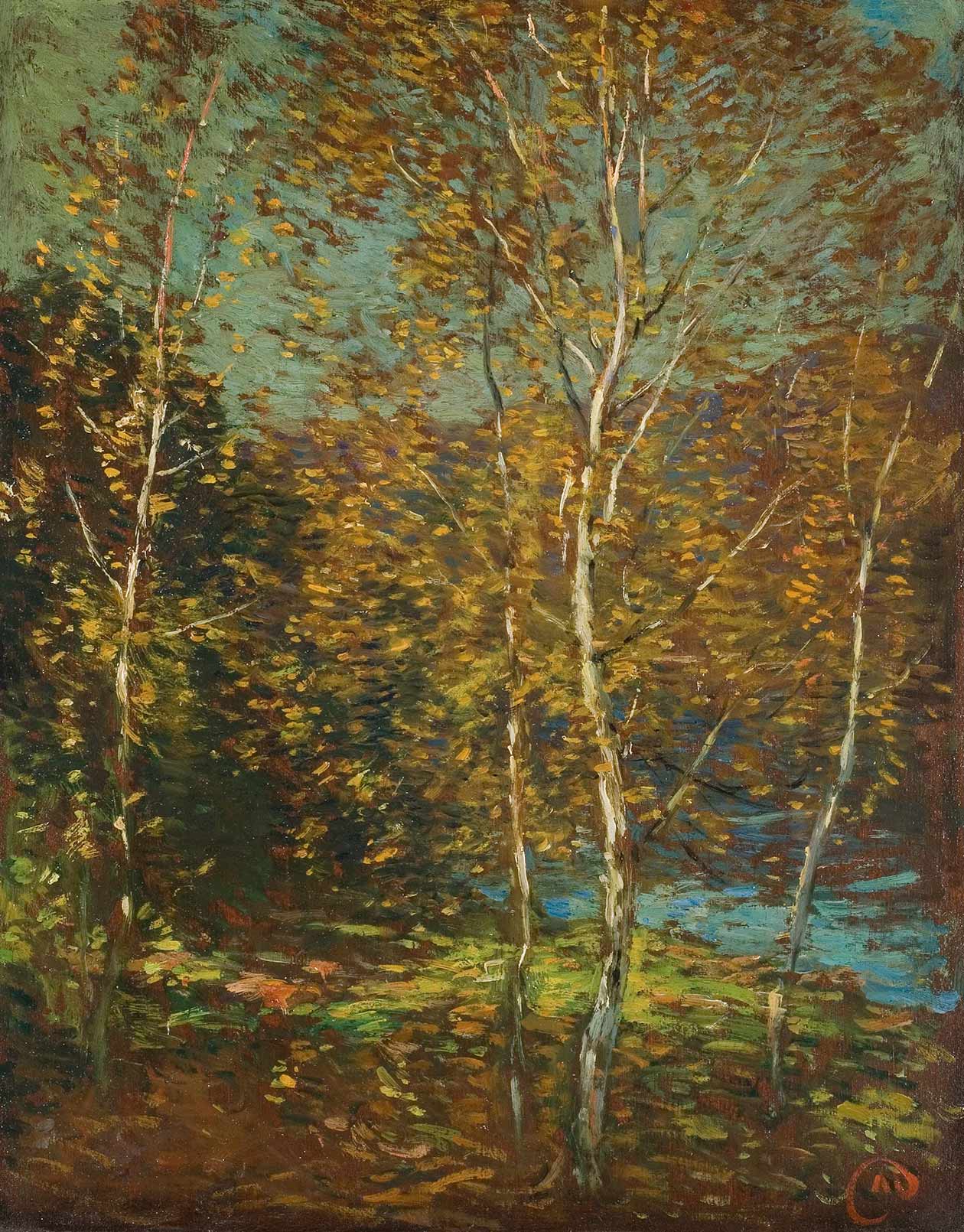
WILLARD LEROY METCALF (1858–1925), "BIRCH TREES BESIDE A LAKE," 1907-08. OIL ON WOOD PANEL. FLORENCE GRISWOLD MUSEUM, GIFT OF THE ARTIST
Metcalf made a similar study of birch trees and water while visiting his artist friend Frank Benson at North Haven, Maine, in late August and early September 1907. His painting of that same year, A Family of Birches (in the collection of the Smithsonian American Art Museum in Washington, D.C.), shows a group of birches still in their summer greens, with a river or lake beyond. Moreover, he had that same year painted a large work (36 inches square) called Trembling Leaves, which is referred to in his cashbook (and mentioned by an artist friend) but which has never surfaced. At least one Metcalf scholar theorizes that this dining room panel was either a study for Trembling Leaves or a replication of it. Metcalf said he thought he had painted Trembling Leaves in Old Lyme, but his friend Arthur Hoeber believed the site was East Boothbay Harbor, Maine.
The summer of 1907 had been a bitter one for the artist because Robert Nisbet, a fellow Old Lyme colonist, former student, and contributor of two panels to the dining room, had run off with Metcalf’s wife. With the help of such friends as the Bensons and Florence Griswold, Metcalf eventually pulled himself together and went on to become one of his era’s leading landscape painters.
While he continued to be in touch with Florence Griswold, Metcalf’s return to Old Lyme in the fall of 1907 was his last visit there. He never forgot that Old Lyme had given him the boost to his career that had made all the difference. May Night, his moonlit view of the Griswold House, painted in 1906, won a gold medal at the Corcoran Gallery of Art in Washington and was bought for its permanent collection. His career took off after that.
Twice the size of the landscape and the floral still life beneath it, this scene is a near twin to a painting Ebbing Tide, Version 2 (currently in the collection of the Farnsworth Museum in Rockport, Maine and pictured in the gallery below) that Metcalf did in Maine during the late summer of 1907 and gave to artist Frank Benson.
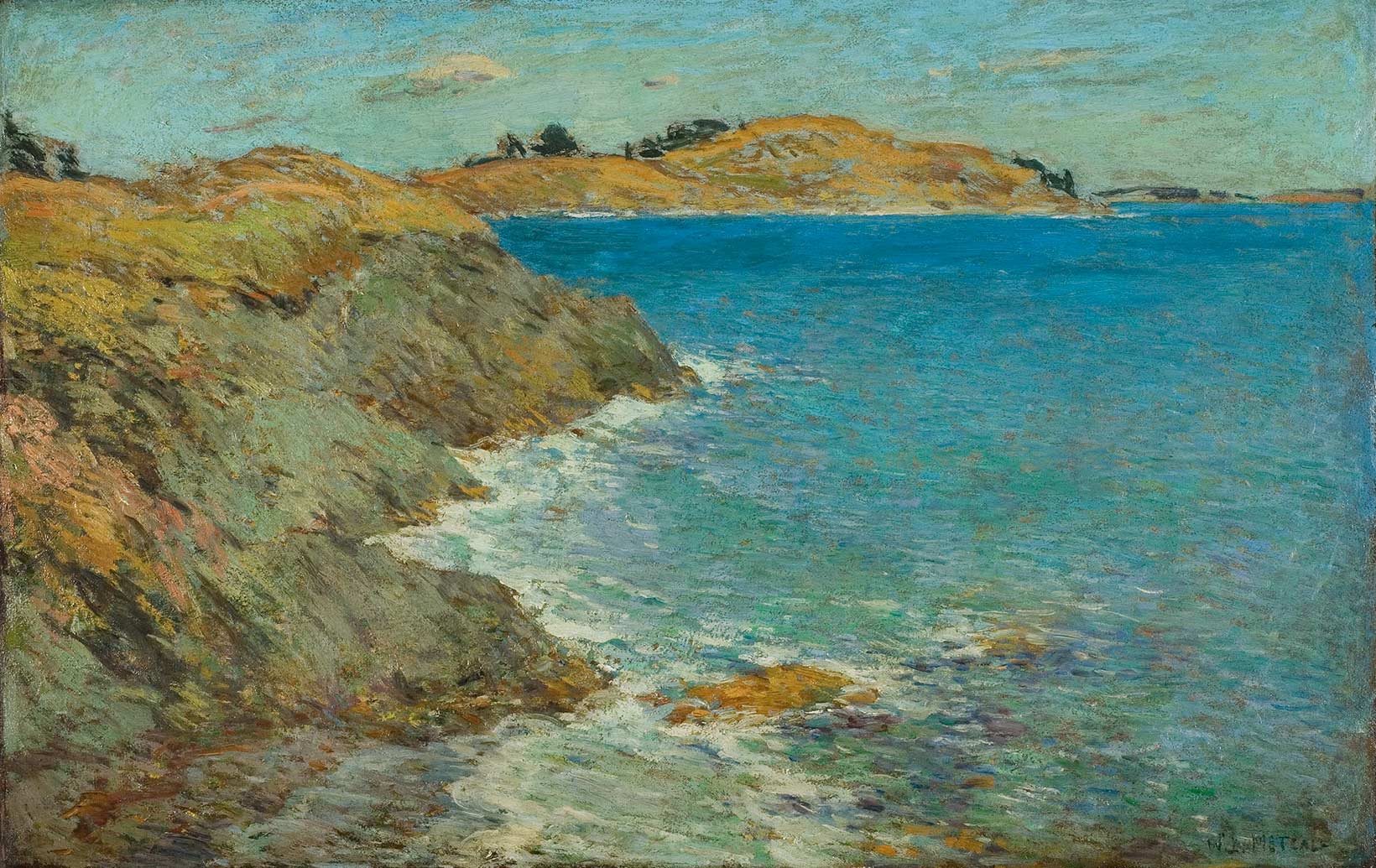
WILLARD LEROY METCALF (1858–1925), "BEACH AND HEADLANDS," 1907-08. OIL ON WOOD PANEL. FLORENCE GRISWOLD MUSEUM, GIFT OF THE ARTIST
It is possible, then, to approximate a date for the panel. Metcalf arrived at the Griswold House for his third season on September 11, 1907, was there through at least October, and never stayed there again. He could have painted the panel in New York afterwards, but the panels that artists took to the city to work on in 1907 would have been finished by the following spring.
The panel has lighter colors than does Version 2, and there are more of them, as in the touches of violet, green, and gold in the water. The surf is also whiter on the panel. The rocky headland is less clearly defined, however, and Metcalf eliminated some small boats that were near the far shore in the easel painting. Both paintings are compelling portrayals of the meeting of land, sea, and sky that humans often sense as elemental and profound. (A painting of another island in Maine by Old Lyme artist Charles Ebert of Monhegan Headlands in the Museum’s collection is another variation on the theme.)
Poor Little Bloticelli (below) portrays Willard Metcalf’s 15-year-old student, Lois Wilcox, who had come to Old Lyme to study with him and with Frank DuMond. Hard at work in her no-nonsense painting outfit, she offers an interesting contrast to the fashionable lady of leisure portrayed by Alonzo Kimball on a panel nearby.
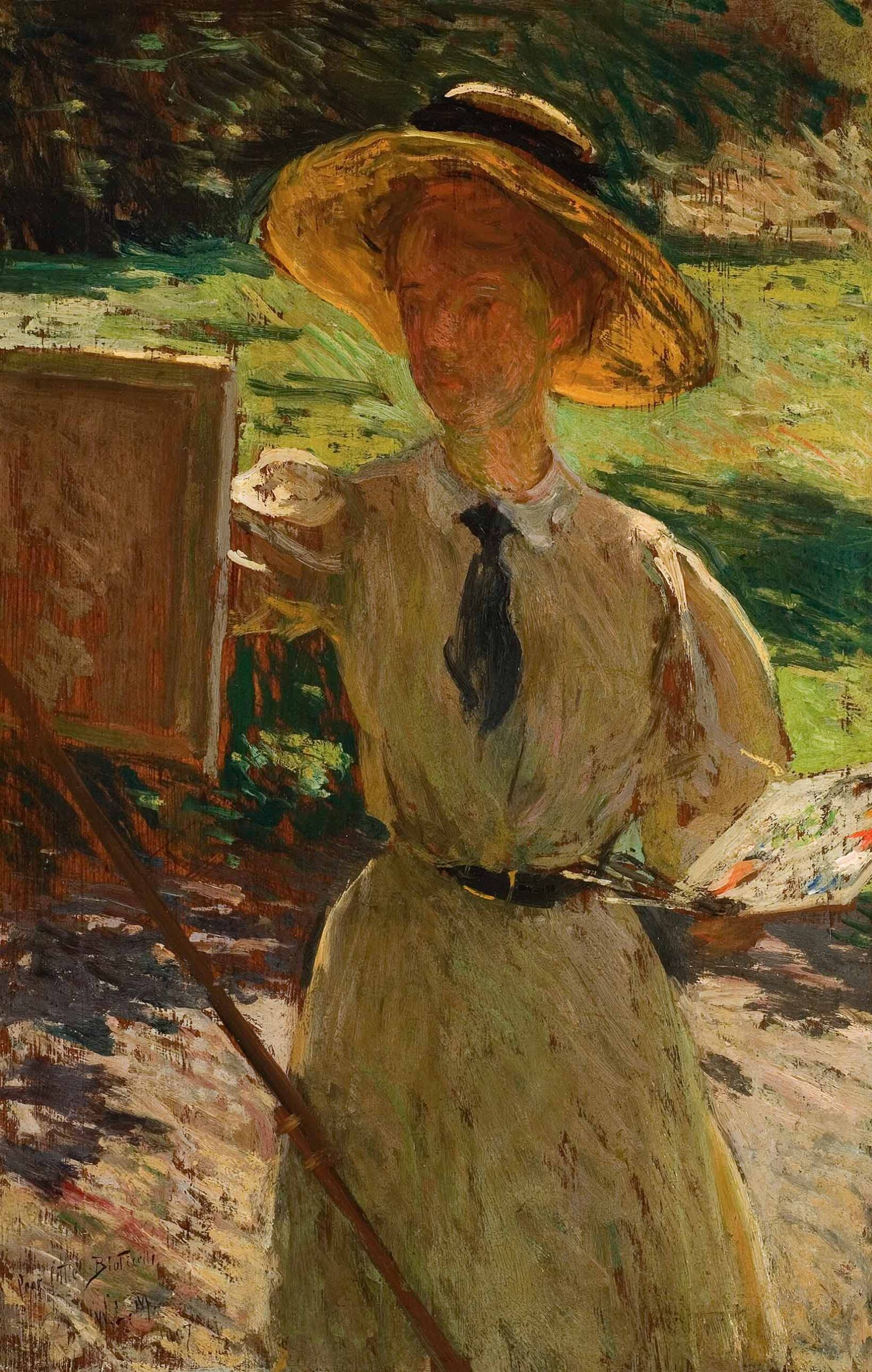
WILLARD LEROY METCALF (1858–1925), "POOR LITTLE BLOTICELLI," 1907. OIL ON WOOD PANEL. FLORENCE GRISWOLD MUSEUM, GIFT OF THE ARTIST
Metcalf may actually have thought well of Wilcox, for he painted her as a young woman who faced her canvas with confidence.
Perhaps he chose to do little more than hint at her features because he wanted to depict a type of woman artist rather than a particular woman. Noteworthy here are Metcalf’s treatment of light and shade, the many color tones, and the animated brushwork that together convey a sense of the energy this artist is putting into her work. Note the bits of orange color that seem to be dripping off the young lady’s brush or canvas like a sign of her zeal.
As a mere student she was not allowed to stay in the house, but it would surely not have surprised her. Women were studying art in large numbers in the late 19th century, but professional artists generally regarded all art students and amateurs as annoying “blots.” Women students were especially troublesome because there were suddenly so many of them and because it was assumed their “careers” would end when they married. Many male art teachers had no qualms about charging women more than men and teaching them less. Lois Wilcox, however, already knew about artists and art colonies. She had grown up in Tryon, North Carolina, where an art colony had developed in the 1890s. She was an active member.
Lois Wilcox went on to have an active career, juggling roles as a painter, lithographer, cartoonist, craftsperson, teacher, and writer. She continued her studies at the Boston Museum School with Philip Hale and studied privately with Charles Hawthorne. In 1913 she had a solo exhibition at the Detroit Institute of Arts. In the 1920s she exhibited at the Whitney Museum of American Art and studied with Galemberti and Venturini-Papari in Italy. (There she probably saw Sandro Botticelli’s – the source for the pun Bloticelli – famous Venus, painted in about 1485.) She also participated in many national exhibitions of lithography, including Fifty Prints of the Year in 1939. From 1933 to 1946 she taught drawing and painting at Sweetbriar College in Virginia. She also excelled at bridge, acting, singing, playing piano, and public speaking. Not bad for a blot.
“The artists had long considered her one of the most objectionable ‘Blots’ among the numerous would-be-landscapists that came to Old [Lyme] every summer. A ‘Blot’ was the term used by professional artists to designate a female art student, the word being derived from the fact that the female art student is usually such a slovenly creature that she forms but a blot upon the landscape,” wrote artist and author Arthur Heming in the unpublished novel The Lions in the Lady’s Den, c. 1920s.
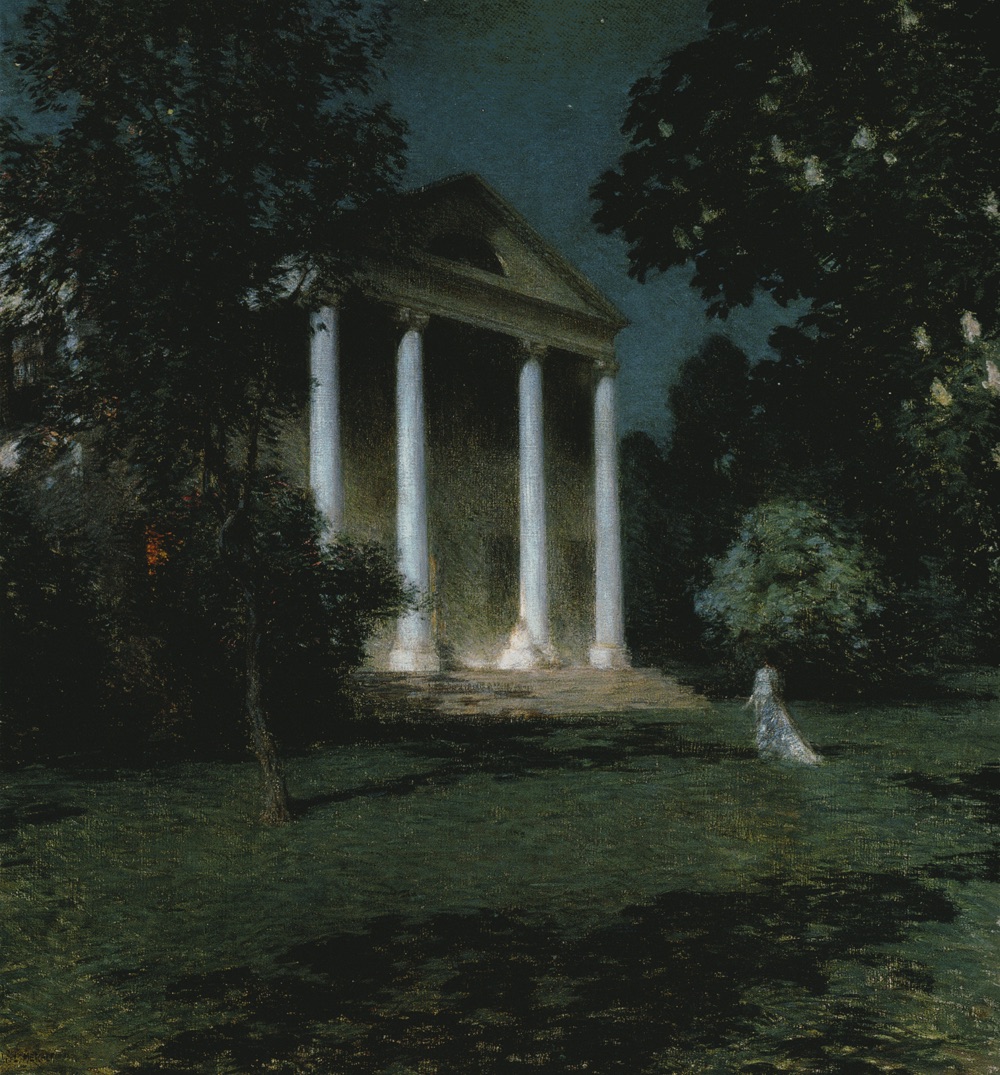
Willard Leroy Metcalf (1858–1925), May Night, 1906. Oil on canvas, 39 3/16 × 36 1/8 in. Corcoran Collection, Museum Purchase, Gallery Fund
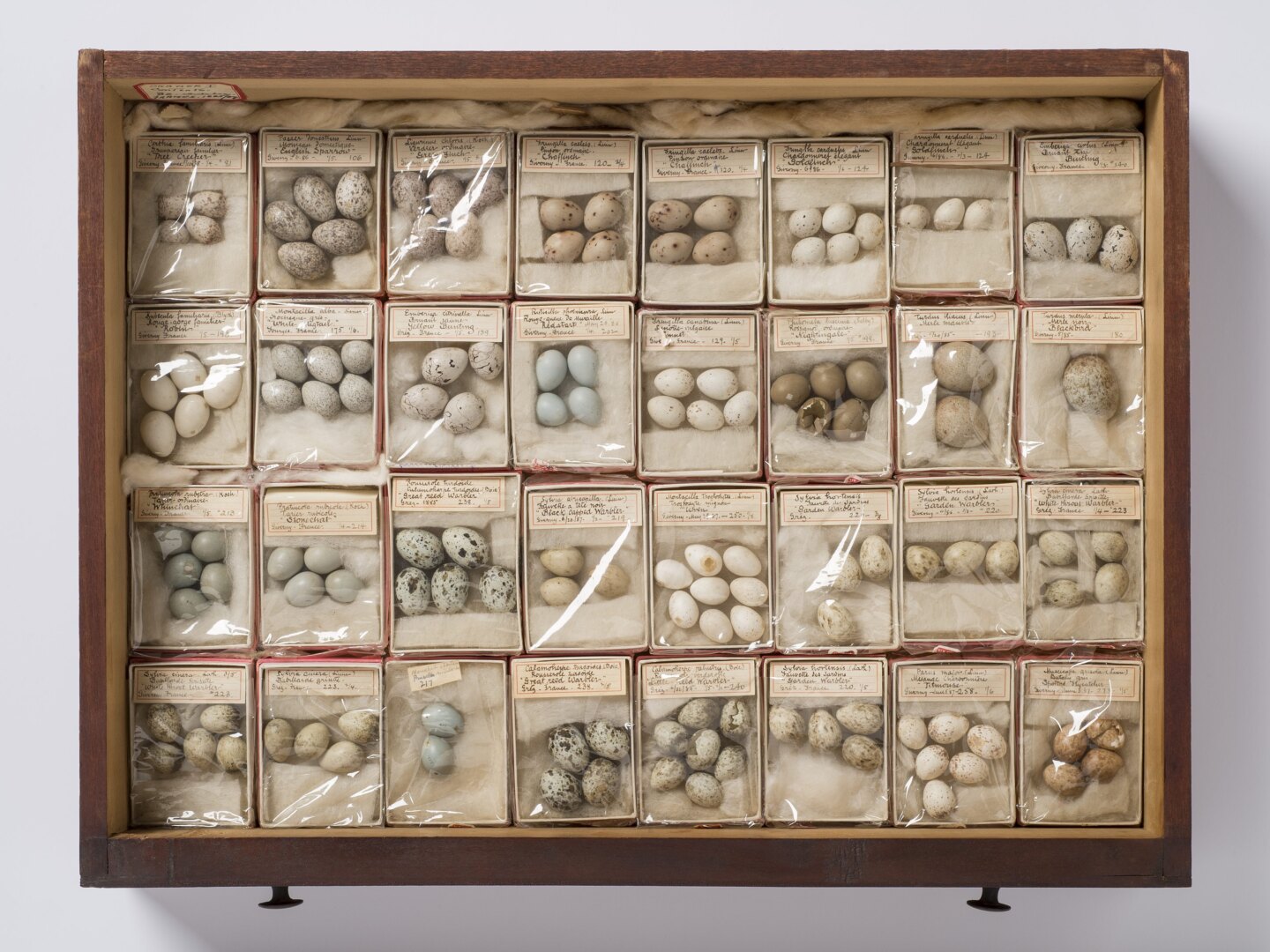
Drawer from Naturalist Collection once belonging to Willard Metcalf, 1885. Florence Griswold Museum, Gift of Mrs. Henriette A. Metcalf
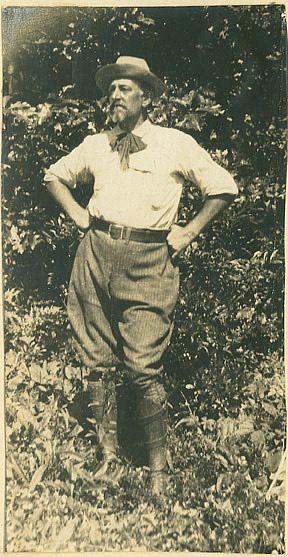
Willard Metcalf
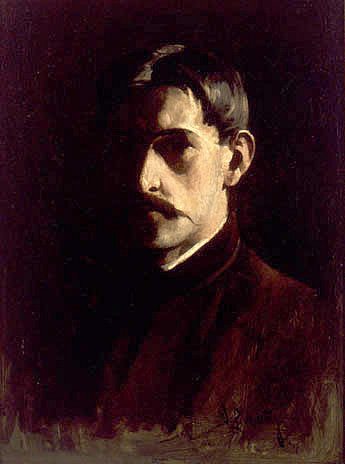
Willard Leroy Metcalf (1858–1925), Self Portrait, c. 1890. Oil on canvas, 23 3/4 in. x 17 3/4 in. Florence Griswold Museum, Gift of Mrs. Henriette Metcalf
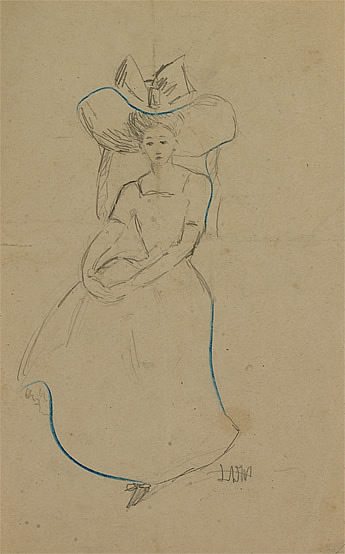
Willard Leroy Metcalf (1858–1925), Wiggle Drawing, n.d. Graphite on paper, 5 in. x 8 in. Florence Griswold Museum, Gift of the artist
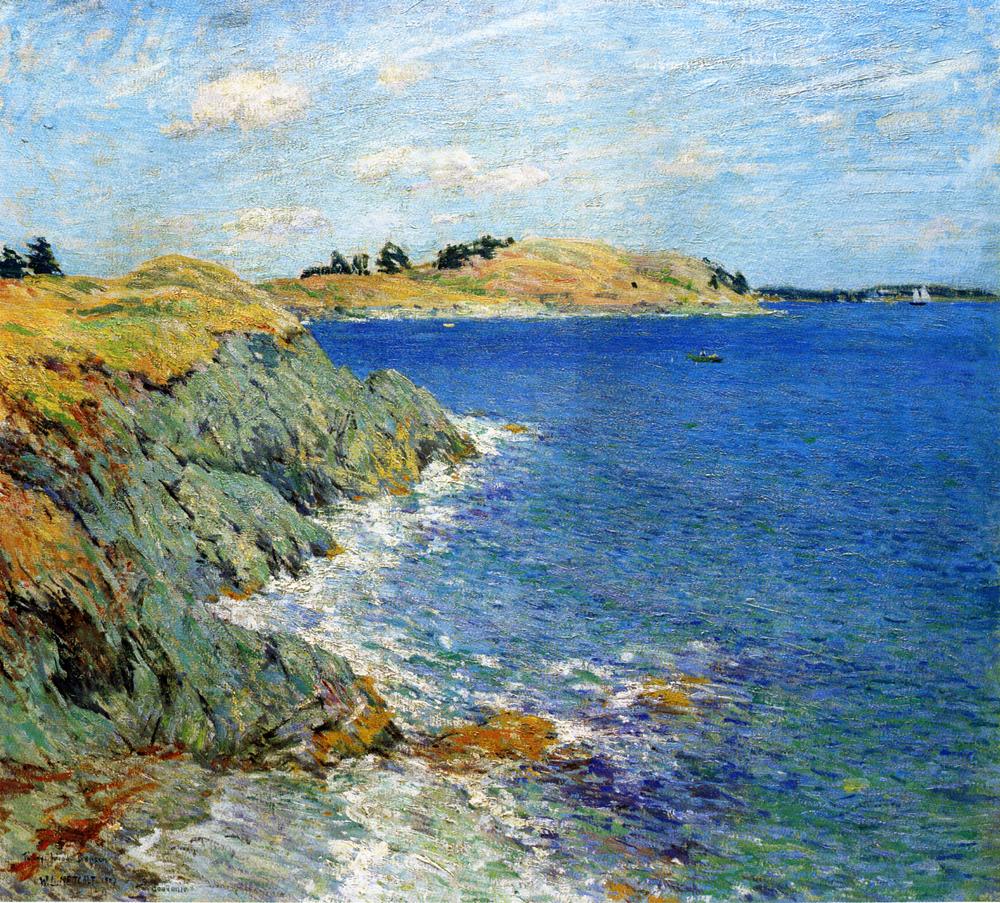
Willard Leroy Metcalf (1858–1925), Ebbing Tide, Version 2, 1907. Oil on canvas, Collection of Farnsworth Museum, Rockland, Maine, Gift of the Estate of Mrs. Sylvania Benson Lawson, 1982.