Glimpse:
Tea Boxes at the Florence Griswold Museum
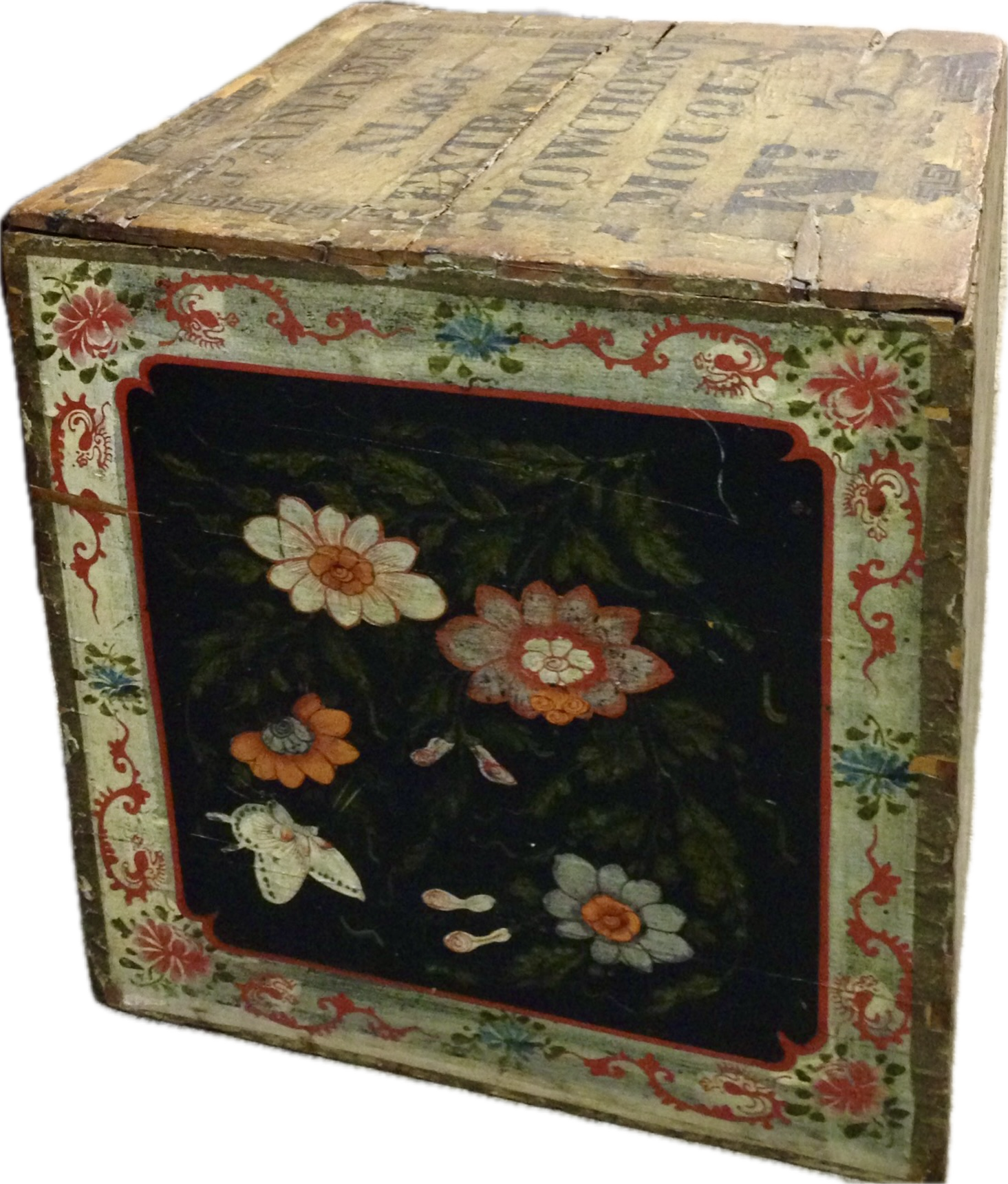
Featured image: Tea chest from N.L.G.G. Featured image: Panama tea, Florence Griswold Museum, X1972.244
by Patricia Devoe
Among the 19th century merchant families from the Northeast engaged in the importation of tea from China can be counted the Griswolds of Old Lyme. Nathaniel Lynde and George Griswold were referred to as “merchant princes,” their fame oft repeated in period publications that claimed “there was probably not a grocery store in the country in which the tea packages marked ‘Ship Panama N.L. & G. Griswold’ were not a staple article.”[1] Two tea chests, one labeled Panama and the other Cohota, have survived over almost two centuries and are in the collection of the Florence Griswold Museum. Each tea chest displays the name of the ship onto which it was loaded and the initials “NL&GG,” designating the N. L. & G. Griswold firm founded by Nathaniel Lynde and George.
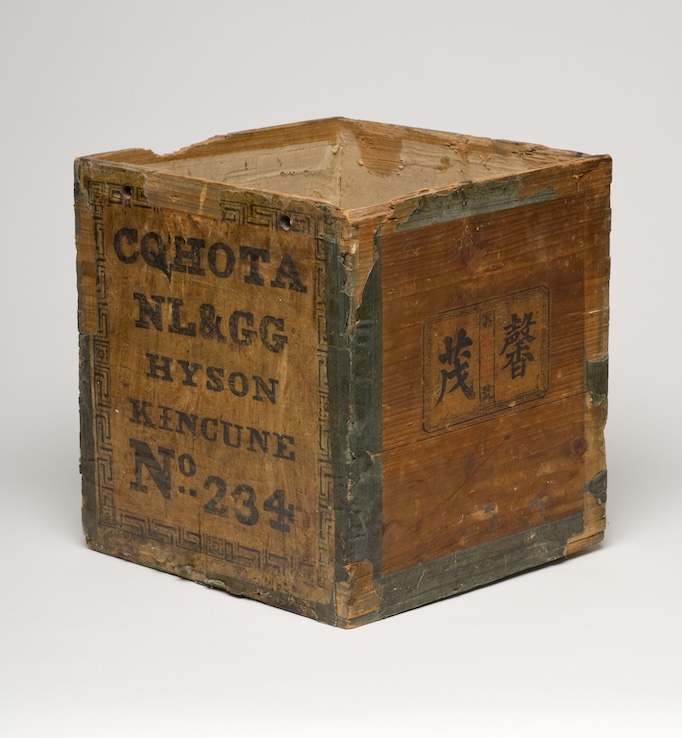
N.L.G.G. Cohota tea chest, ca. 1844. Florence Griswold Museum, Gift of Mr. and Mrs. David J. Powell, 2015.15
The 1840’s were an especially robust time in maritime merchant activity that brought ships from East Coast ports around Cape Horn, across the Pacific Ocean, and back. Both the third ship named Panama and the Cohota were built by William H. Webb (1819-1899), sometimes considered the first professional American naval architect. The quicker the delivery of goods, the better the return on investments, and the Cohota, built for N.L. & G. Griswold in 1843 and designed explicitly for speed in the China trade, clocked the trip from Canton to New York in a mere 100 days, rather than the usual four to five months. In total, five ships named Panama were built for the Griswolds (1825, 1834, 1844, 1853, 1868). Maritime historian Thomas Stevens states that Captain Israel Champlin of Lyme returned from Canton on the first Panama with “one of the finest lot of teas.”[2] Thus began the exuberant reputation of “Panama” tea.
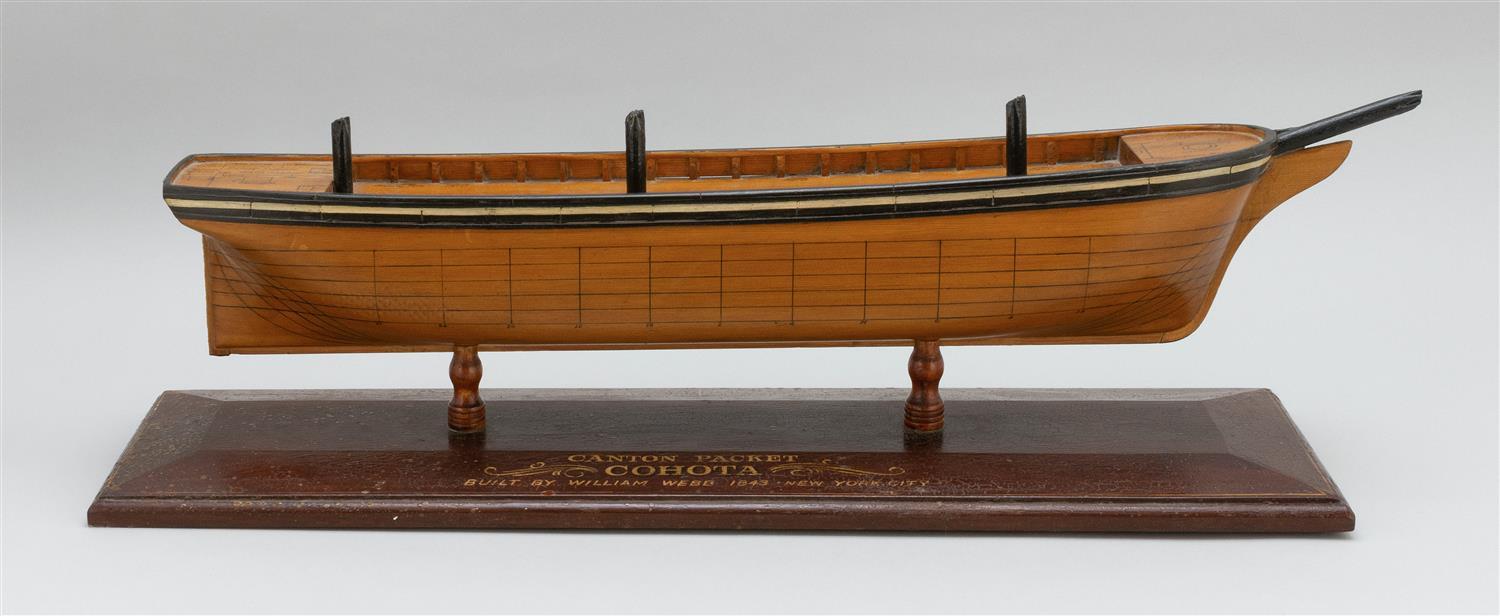
Unidentified maker, Plating hull model of packet ship Cohota, ca. 1843. Private Collection, Courtesy Eldred’s
Tea chests were the equivalent of today’s cardboard or plastic containers and discarded as trash after use, but they are now precious artifacts of the 19th century tea business. The two surviving Griswold chests are “quarter chests” that held one-quarter the amount of the “whole” chests that were phased out in the late 18th century. Quarter chests were the preferred size for export from their point of origin, and their smaller size also helped maintain the quality of their contents. The Cohota chest held Hyson tea, “hyson” being an anglicization of the Chinese character for “flourishing spring.” Hyson was a high-grade green tea harvested early in a season, and every leaf was hand rolled and twisted to protect its fragrance and desirability.
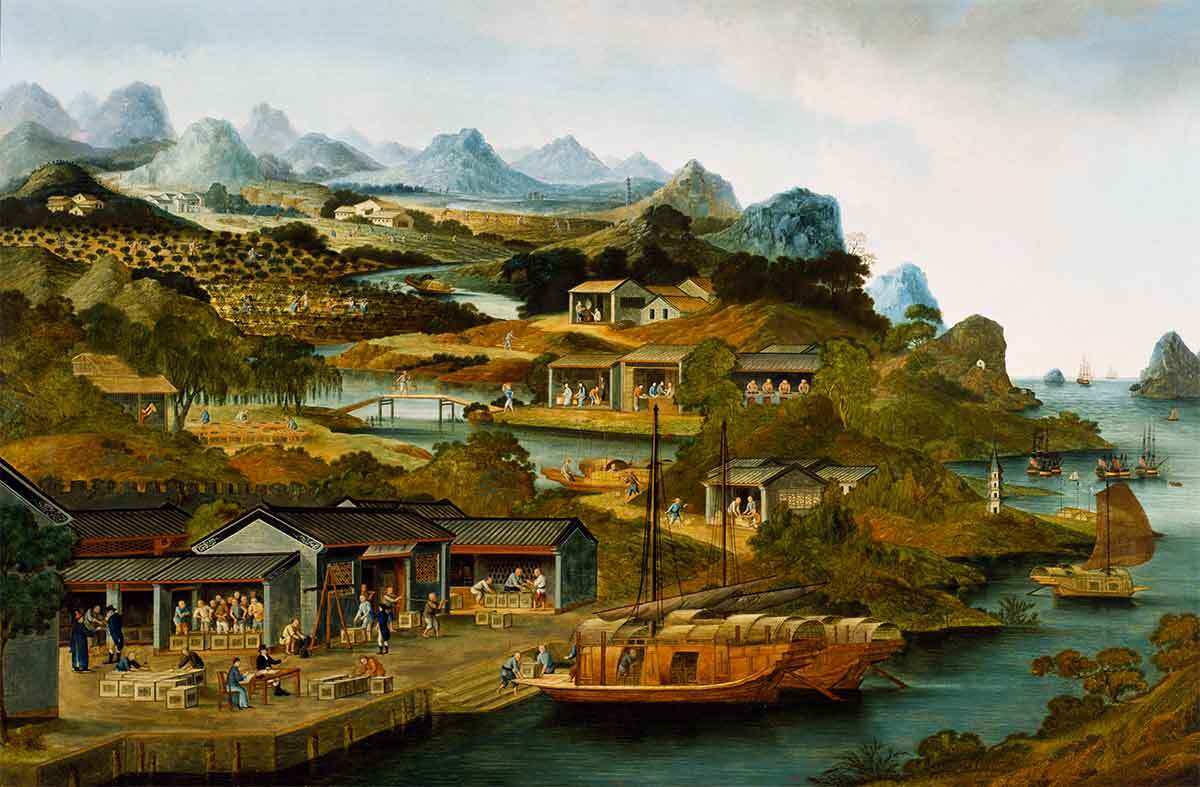
Artists in Guangzhou, China, Tea Production in China, about 1800. Oil on canvas. Peabody Essex Museum, Purchase, made possible by an anonymous donor, 1993.M25794
The harvesting of tea was labor-intensive and carefully planned, with the day, time of day, and weather critical considerations since rain affected taste. Tea leaves were picked and placed in baskets, then packed by other laborers into chests. Green teas were shaken into chests whereas lower quality black teas were stamped into chests by foot. The careful handling of a quality green tea such as Hyson made it an expensive but highly sought after commodity for merchants like the Griswolds.
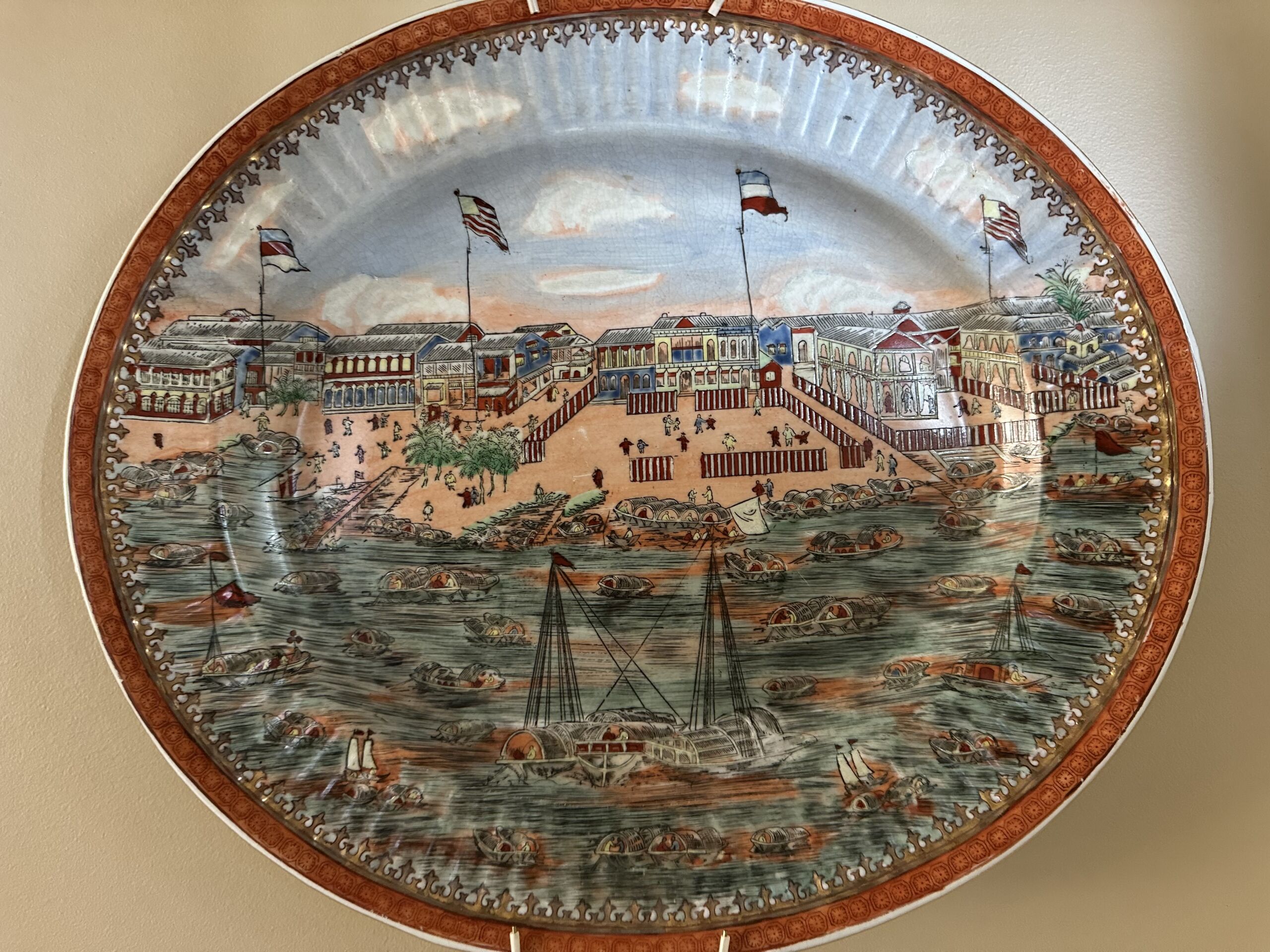
A recent commemorative plate showing the 13 factories along the Pearl River in Canton where foreign merchants conducted trade with China (United Wilson Porcelain Company, ca. 1978). Private collection.
Tea chests had a lead or tin lining that was typically removed and reused. Thin sheets of lead or tin would be soldered together inside a wooden box, and once the chest was loaded, a sheet of the metal would be placed on top and soldered to the sidewalls to form an airtight container. As ships returning to New York crossed the equator and experienced significant fluctuations in temperature and humidity, the metal lining was essential to preserve the contents. Merchants tried to protect the delicate flavor from any contamination, moisture being one of the most damaging to the quality of the tea. The wooden box was not reused as it was marked for a specific tea harvest, a batch, a supplier, and a ship and therefore not suitable for continuing use. The tea chests at the Florence Griswold Museum are without their metal linings.
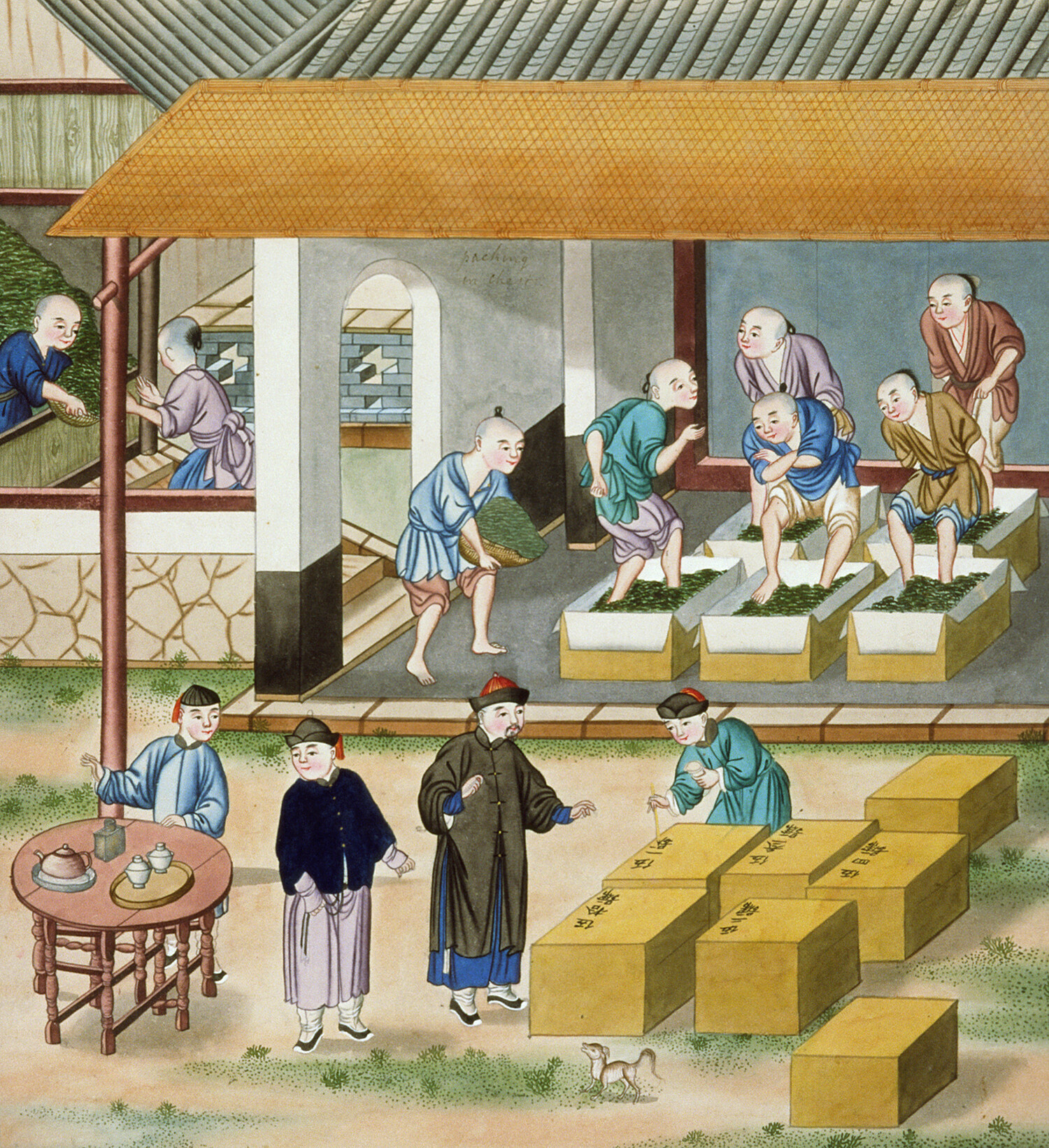
Detail of packing tea in chests, from Unidentified artist, Canton, China, Tea Production, ca. 1790. Gouache, watercolor, ink, paper, silk, 13 ½ x 12 1/8 x in. Historic Deerfield, Gift of Helen Geier Flynt, HD56.428
Dr. Paul Van Dyke of Sun Yat-Sen University in Guangzhou provided other valuable details that identify the Cohota tea chest. The stenciled word “Kincune” is a batch name and indicates that the tea was picked from the same region on the same day at the same time to ensure quality and consistent flavor. The number “234” refers to the number of the chest in the lot that was purchased. Such precise markings kept a company’s inventory and bookkeeping ledgers accurate, an important factor for any merchant. There is a record of the Cohota sailing into Canton in 1844, [3] and the tea chest at the Museum perhaps dates from that sailing.
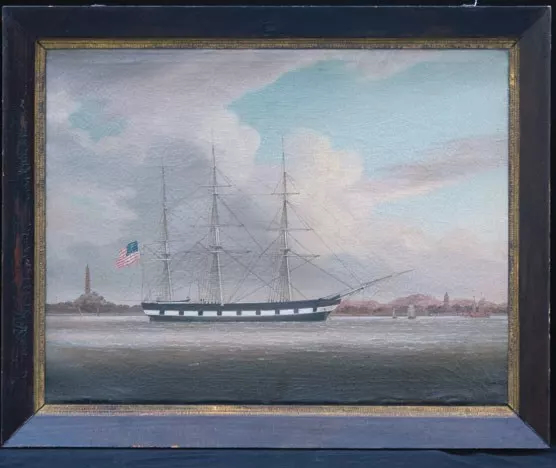
Unidentified artist, China, N. L. & G. Griswold’s ship Niantic in port at Ningpo, ca. 1838. Oil on canvas, 22 x 27 in. NPS Photo, SAFR 22386
The colorful floral design on the Panama tea chest suggests a later sailing date when tea chests included embellishments to attract the eye of buyers. Other details noted on the Museum’s Panama chest include the name “Mouqua,” a possible reference to a “hong” merchant of that name. Hong merchants were the exclusive Chinese agents allowed to engage in commercial transactions with foreigners. The word “Powchong” on the Panama box refers to the type of black tea contained within the quarter chest, and “No. 3” is an inventory mark noting the lot and batch that was purchased.
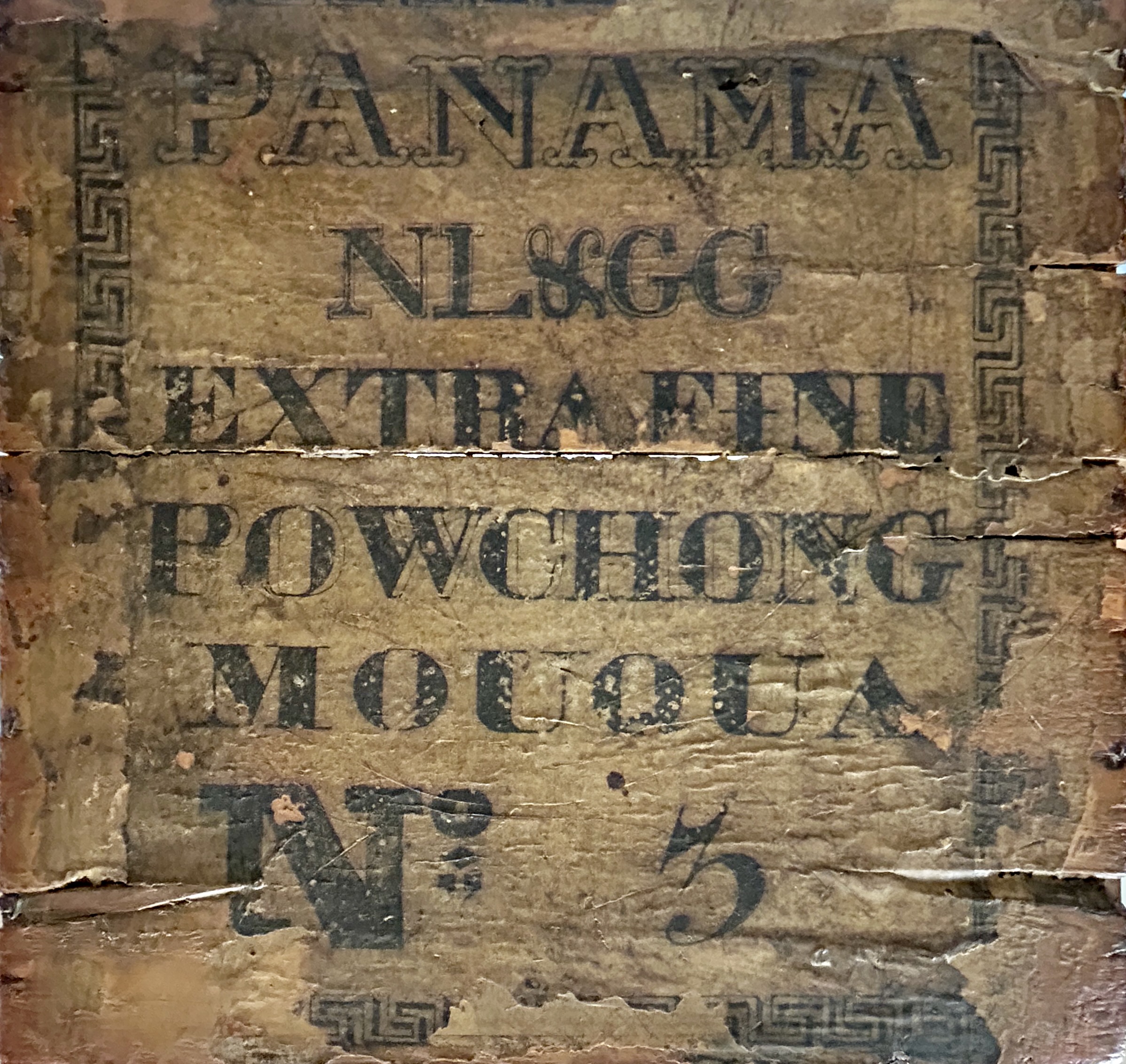
Tea chest from N.L.G.G. Panama tea, Florence Griswold Museum, X1972.244
Once tea had been packed, Chinese workers loaded the chests into ships with speed and precision. It is estimated that 10,000 chests could be loaded within three days. Typically, lesser quality teas would be stowed in the vessel’s lower hold with more valuable varieties in the drier and more protected upper tiers. Bamboo matting was often laid between tiers to absorb extra moisture. Chests would be tapped close together with mallets to ensure a tight fit, and ballast or other goods, such as porcelain or textiles, would be introduced to fill any uneven nooks or crannies. [G9]
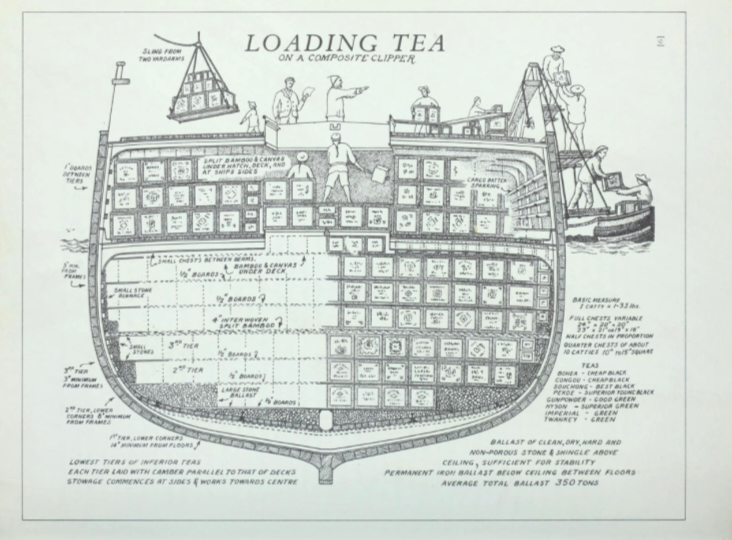
Loading Tea on a Composite Clipper, in George F. Campbell, China Tea Clippers (New York, 1974), p. 19
Upon arrival at the New York harbor, the contents of the N.L. & G. Griswold ships would be put up for sale. Exact business records for the Griswold firm have not been found, and an examination of U.S. Customs records did not yield specific details about their cargo. However, newspaper advertisements clearly indicate that the tea was auctioned by specialty houses. In the April 27,1832, issue of The New-York Evening Post, an advertisement states: “Fresh teas – Cargo of Ship Panama. M. Hoffman & Sons will sell on Saturday, 28th April, at 10 o’clock.” Inspection of an advertised tea shipment might be offered in advance of an auction: “Tea notice – The catalogue of teas, cargo of the ship Panama is now ready and the sample packages may be examined on Monday at the store of Thos. H. Smith & Sons, 166 South Street.”[4] Auction results were also publicized, and a notice in the Boston Morning Post in April 1841 states: “The sale of Panama’s teas today went off with great spirit. The teas were fresh and wanted of fair quality.”[5] An announcement in the New-York Evening Post in May 1849 notes: “Teas – The cargo of the ship Panama was disposed of at auction this morning, to a numerous attendance the trade and brisk demand. Medium grades were well sustained, but the higher knocked off at slightly lower rates.”[6] Whether N.L. & G. Griswold also sold tea directly from its storefront at 86 South Street in New York is not known, but an advertisement in 1838 mentions that Tuankay, a lesser grade of green tea mixed with finer grades, was available for purchase.[7]
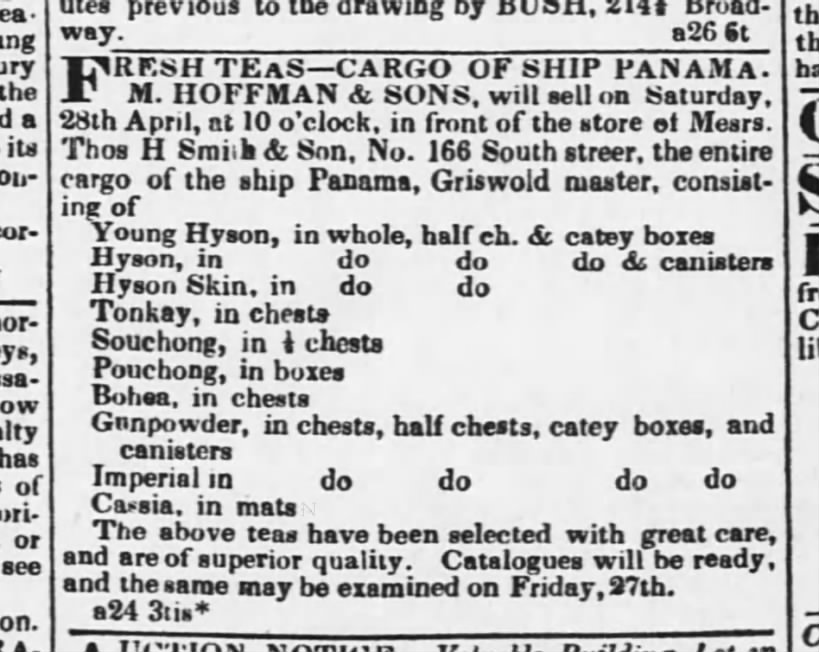
N. L. & G. advertisements: NY Evening Post, April 27, 1832, p. 3
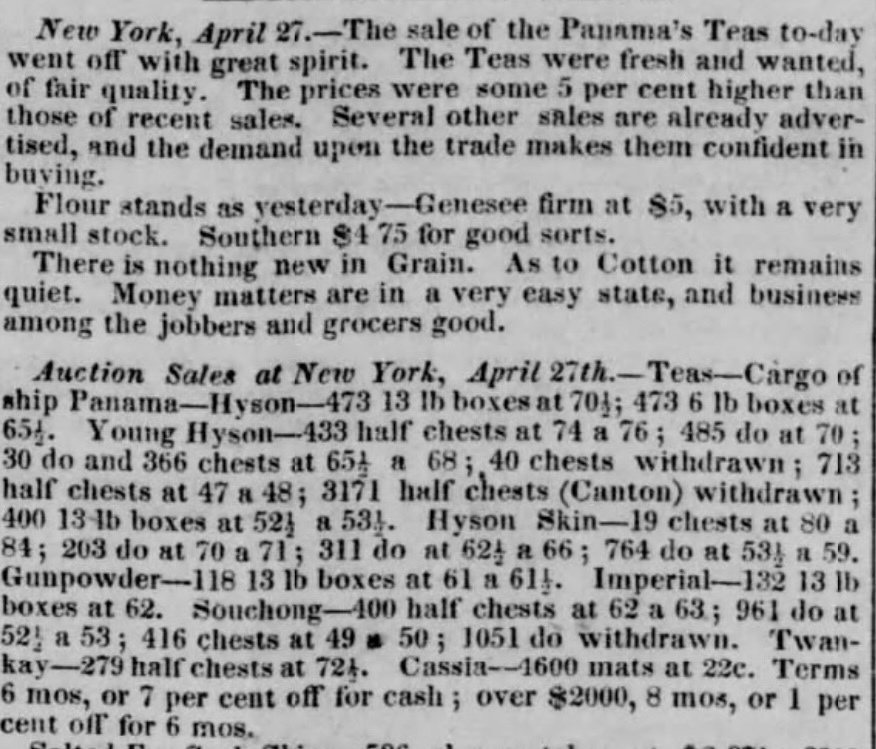
Morning Post Boston, April 29, 1841, p. 2
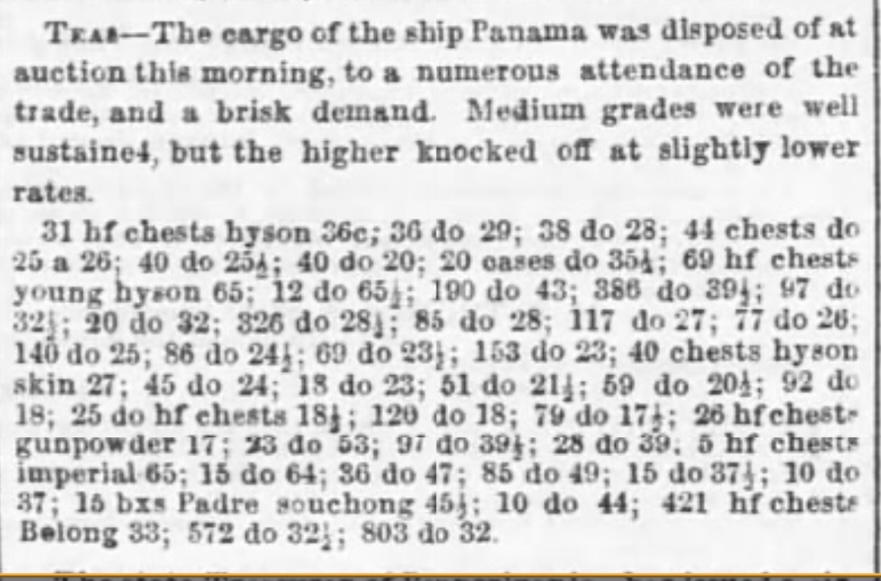
NY Evening Post, May 25, 1849, p. 3
New York supported many tea retailers, including George Francis Gilman, founder of Atlantic and Pacific Tea Company, and William W. Parkin (Nye, Parkin & Company), who built a summer home in the Pequot Colony section of New London in 1875. Tea imported by the Griswolds would be bought by retailers such as Gilman or Parkin and distributed under their brand names, not the Griswold name. While Walter Barrett’s statement about the dominance of Panama tea in grocery stores may be true, no evidence has yet been uncovered to indicate that it was distributed by the Griswolds rather than sold to retailers who then put it on grocery store shelves.
Mention should be made of the enormous risks involved in the China tea trade and the importance of personal trust in each partner, whether a Canton merchant, a New York distributor, or a clipper ship captain, who all played essential roles in bringing goods to market at the most profitable moment. The competition and collaboration among U.S. merchants are hinted at in a note sent from China to the Forbes family in Boston in 1856: “In green teas there is every likelihood of Heard & Co. taking the lead of us. Griswolds, Lows & Appletons, our main supports, all hold back, leaving us only what used to fill the cracks.”[8] A telegram directed to N. L. & G. Griswold in New York in 1867 also noted changing market conditions: “To N.L. & G. Griswolds. Hong Kong August 15. Oolong market not open. Teamen demanding twenty two taels short cargo grade. Stocks accumulating.”[9] Correspondence was sent via ships on intersecting routes, so weeks or months might elapse before critically important information could be exchanged. Because loyalty and honesty were so important in business transactions, it becomes easy to understand why family members often held the key positions in shipping companies.
Nathaniel Lynde and George Griswold created dynastic wealth, a goodly portion of which resulted from their tea imports. The Cohota and Panama tea chests preserved at the Florence Griswold Museum are valuable reminders of the complex 19th century China trade that the Griswold brothers were lucky and savvy enough to cash in on, being at the right place at the right time when consumer demands drove the markets.
I would like to thank Dr. Dan Du at the University of North Carolina; Dr. Paul A. Van Dyke at Sun Yat-Sen University, Guangzhou; Michael Dyer and Maribeth Quinlan at Mystic Seaport; Christopher Sherwood Davis, Boston Tea Party interpreter; Carolyn Wakeman and Amy Kurtz Lansing at the Florence Griswold Museum; and many others for their generous support of my research.
[1] Walter Barrett, The Old Merchants of New York City (New York, 1863).
[2] Thomas Stevens, Old Lyme, a Town Inexorably Linked to the Sea (Deep River Savings Bank, 1959).
[3] Chinese Recorder and Missionary Journal (1884), 15:469; The Missionary Review of the World (1895), 18:254.
[4] The New-York Evening Post (April 20, 1833, p. 3).
[5] Boston Morning Post (April 29, 1841, p. 2).
[6] The New-York Evening Post (May 25, 1849, p. 3).
[7] Ibid. (March 15, 1838)
[8] Edward Cunningham to Paul Siemen Forbes (October 5, 1856), Forbes Family Business Records, Box 2, Folder 23, Mss: 766 1803-1942, F693, Baker Library Special Collections, Harvard Business School.
[9] Francis Blackwell Forbes to Edward Cunningham (August 14, 1867), Vol. N1a, Series N, Forbes Family Business Records, Mss: 766 18033-1942, F693, Baker Library, Special Collections, Harvard Business School.