
Lyme’s Black Veterans, 1777–1782
Reflections on Revolution
The Revolutionary era brought surging patriotism in the Lyme region along with smuggling, hardship, and sacrifice. In 2026 as America celebrates 250 years of independence, the Florence Griswold Museum offers Reflections on Revolution, a series of History Blog articles that explore a time of crisis, how it was experienced, and how it has been remembered. Militia notices, court records, sermons, emancipation certificates, and burial markers offer an intimate look at lives interrupted. A commemorative quilt and a theatrical production remind us of history’s changes.
by Carolyn Wakeman
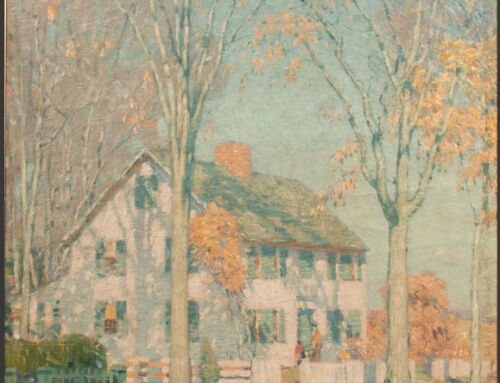
Featured Photo (above): Marker honoring Prince Griswold Crosley, Courtesy Old Lyme Cemetery Association
The story of those enslaved in Lyme who fought in the Revolutionary War has not yet been told, but a color guard ceremony at Duck River Cemetery in May 2024 paid belated tribute to the military service of Prince Griswold Crosley (1755–1818). The Connecticut Society of the Sons of the American Revolution honored Prince Crosley as a patriot more than 200 years after his death with a veteran’s memorial headstone. Other Black veterans have been forgotten. This article recalls the lives of Prince Crosley, his brothers Jim and Sawney York, Pomp Free, Prince Free, Peter Freeman, and Zacheus Still who served in the Revolution to gain their freedom.[1]

Ancient section, Duck River Cemetery
The Ancient Section of Duck River Cemetery, where burials began in 1676, includes markers for 40 Revolutionary War veterans. Prince Crosley is the only African American. His memorial stands behind gravestones marking the burial places of his sister Margaret Crosley Lewia and his brother-in-law Lewis Lewia, his niece Eunice Lewia, and his great nephew John Henry Lewia. Governor Matthew Griswold and his wife Ursula Wolcott Griswold, into whose household Prince, Margaret, and their siblings Judah, Jane, Hulda, Jim, Sawney, and Olive were born into hereditary slavery, have gravestones nearby.

William Earle Williams, Gravestone of Prince Crosley, Duck River Cemetery, Old Lyme, Connecticut, 2024. Silver gelatin print, 7 ½ x 7 ½ in. Courtesy of the artist
At the memorial ceremony in 2024, descendant Keith Edward Wilson presented what is known about Prince Crosley’s life. The son of York, an African American, and Eunice Crosley, a Native American, he was baptized in Lyme’s first parish in 1755 by Rev. Stephen Johnson. He was about age 22 when then Deputy Governor Matthew Griswold sold him in New Milford in 1777 along with his brother Jim. Prince enlisted that year on August 8 as a private in the 7th Regiment of the Connecticut Continental line and served for three years until his discharge on August 5, 1780.[2]

Keith Edward Wilson offering remarks at SAR Ceremony
Wilson traced Prince’s hazardous service in the Revolution. As a private in Connecticut’s 7th Regiment, he would have joined General Washington’s army in Pennsylvania, fought at Brandywine Creek and Germantown, and wintered at Valley Forge in 1777–1778. The Regiment encamped at White Plains the following summer; guarded the Hudson River highlands; was stationed in Redding, Connecticut, in the winter of 1778–1779; and quartered in Morristown, New Jersey, in the following winter when food supplies were exceedingly scarce. Prince reenlisted in 1782, at about age 28, serving for eight months in the 4th Regiment. Details about his brother Jim, who also enlisted in 1777 and died in service, are not known. Their brother Sawney York enlisted in Norwich in the 4th Regiment in 1780 under Capt. John Buell.

Taps played to conclude the color guard ceremony
Prince returned to Lyme where he married Caroline Miller in 1788 and raised a large family. Twenty years after his death in 1818, his widow filed for a veteran’s pension. Depositions given by his family members and others who knew Prince in Lyme offer additional details about his life. His son John Crosley stated that he had gained his freedom after three years of service, and that he was generally known as Prince Griswold before he was granted freedom and as Prince or Prentiss Crosley after that time. He was said to carry a fiddle in his pack and to walk with a limp from a wound received while serving.
A law enacted in December 1776 to increase the size of Connecticut’s militia had excluded “Negroes, Indians, and Mulattoes,” but a committee appointed by the Legislature and chaired by Deputy Governor Matthew Griswold reconsidered that limitation and recommended in May conditions under which slaves could serve in the Connecticut Line. “The effective negro and mulatto [would] be allowed to enlist with the Continental battalions now raising in this state” under the following regulations and restrictions: “that all such negro and mulatto slaves that can procure, either by bounty, hire, or in any other way, such a sum to be paid to their masters, as such negro and mulatto shall be judged to be reasonably worth by the selectman of the town where such negro or mulatto belongs, shall be allowed to enlist into either of said battalions and shall thereupon be, de facto, free and emancipated.”
Griswold recommended also “that the master of such negro or mulatto shall be exempted from the support and maintenance of such negro or mulatto, in case he shall hereafter become unable to support and maintain himself,” stipulating “that if a slave desire to enlist for the war, he may be appraised by the selectman and his master may receive the bounty and half the slave’s annual wages until the appraised sum be equaled.”[3] The upper house did not approve the full recommendations, but the General Assembly enacted in October 1777 a law allowing local selectmen to exempt a master from responsibility for the care of a slave he intended to manumit. Some owners avoided compulsory military service by agreeing to free a slave who served in their place. Others benefitted financially by being released from future support for a slave who agreed to enlist and fight in the Continental Army or by allowing slaves to purchase their freedom using wages earned after enlistment.[4]
Dr. Eleazar Mather in Lyme manumitted on May 26, 1777, his “Negro manservant Pompey of the age sd to be thirty-two years,” releasing him “from all and every Obligation. . .as a Servant during his natural life.” The manumission certificate states that “in this open and Solem Manner,” Pompey from that date became “a Freeman to all Intents and Purposes in Law & Equity giving him the name of Pompey Free.” That same day Pomp Free enlisted in Norwich in Connecticut’s 1st Regiment under Capt. Christopher Ely from Lyme. Pomp’s origins are not known, but Dr. Mather baptized his “servant child” Pompey in Lyme’s first parish in 1751, and he remained in bondage for 26 years. Less than a year after his emancipation, on February 28, 1778, he died while serving.[5] The circumstances are not known, but he likely served at Valley Forge where provisions were scarce and disease rampant.

Painted and drawn by A. Gilbert; lith. and publ. by Philip Haas, Valley Forge, Winter, 1777, ca. 1843. Library of Congress Prints and Photographs Division Washington, D.C. 20540, USA https://www.loc.gov/pictures/item/2006691573/
Whether Pomp Free crossed paths with Prince Crosley at Valley Forge that winter cannot be known, but he almost certainly served with Prince Free, who enlisted one day later in Norwich on May 27, 1777, in Capt. Ely’s Company. Prince had been enslaved by Judge Richard Lord, whose son Enoch Lord entered Prince’s emancipation in Lyme’s land records nine days later on June 5, 1777. Prince Free died while serving in January 1778, one month before Pomp Free’s death and likely also at Valley Forge in January 1778.[6] The similarity of their names and the proximity of their enlistment and death dates suggest that they were brothers.

Witness Stones for Pomp Free, Zacheus Still, Humphrey
Peter Freeman enlisted in Norwich on September 11, 1777, and served initially as a private in Col. Sherbourn’s Rhode Island regiment. He transferred to Lt. Col. Ebenezer Huntington’s 9th Connecticut regiment in May 1780 and received his discharge in September. He is likely the former slave of Samuel Ely of Lyme, who in February 1781 stated his intention “to manumit his servant Peter.” Ely promised his “Negro man that upon his paying me thirty pounds in silver money, and thirty pounds in paper equivalent to silver – to manumit him – sd Peter – set him free next Fall without fraud or deceit.” On June 12, 1784, Samuel Ely, “his Olde Master,” gave Peter Freeman “liberty to hire himself out to any Body. He has paid the biggest part toward purchase of his Freedom and has now a Right to hiring himself out to get the remainder.”[7]

Peter Freeman pension certificate
“Peter Freeman of Lyme” was granted a military pension in 1818 that paid him $8 a month. To continue receiving the pension, he testified two years later that he was a laborer, had no family, and was “so much troubled with the Rheumatism that I am unable to support myself by labour, more than half the time, and have been very sick with a fever the past winter by which I am much weakened.” When he died in Norwich in 1826, he left no wife or children, and his estate was valued at $42.53.[8]

Zacheus Still enlistment
Zacheus Still was already a seasoned veteran when he enlisted in 1777 and served in the 6th Connecticut Regiment under Col. Samuel Holden Parsons, who was Deputy Governor Griswold’s nephew.[9] Zacheus was the eldest child of Temperance Still, a Native American, and Oxford, an African American. He was named Zachary in 1728 when he was born enslaved in the household of Lt. Richard Lord, who died the next year. Judge Richard Lord, who inherited the enslaved family, sold the parents Oxford and Temperance with their infant son Joel in 1735, but retained Zachary and three siblings in hereditary servitude.[10]
After 20 years enslaved by Judge Lord, Zachary used the name Zacheus Still when he served in 1755 in the French and Indian Wars in a New York regiment commanded by Col. Elihu Chauncey.[11] When he returned to Lyme two years later, he refused to continue serving Judge Lord, who then sued a neighbor James Ely for “persuading and enticing his servant man,” valued at “the price and value of Seventy pounds,” to “walk away” and “depart from” his service. The New London Superior Court twice heard arguments from Ely that Zacheus Still was not a “slave for life” because his mother Temperance Still, a Narragansett Indian, had been born free. The court ruled in favor of Judge Lord, awarding him $50 damages plus court costs.[12]
After the decision that he was a “slave for life,” Zacheus enlisted again in the French and Indian Wars in 1759 and served in Connecticut’s 4th Regiment under Capt. Zebulon Butler from Lyme. Capt. Butler would soon marry Judge Lord’s niece Anne Lord and almost certainly knew Zacheus.[13] After his second term of military service, he married and lived in Saybrook with few financial resources. A “mulatto” named Zaccheus was sued there in 1761 in a debt action by Stephen Nott, who the next year sued Phyllis Still, also a “mulatto” in Saybrook, for failure to pay a debt.[14]
Zacheus’s circumstances before and after he enlisted in the Revolution at about age 52 cannot be documented. A Lyme town treasurer’s report notes payment in 1813 for the support of a transient Negro Zacheus for 13 ½ weeks,[15] but by then Zacheus Still would have been almost 87. Whether he returned to Lyme late in life and received town support is not known. His death date and burial place have not been discovered.
Service to the Revolution came not only from Black veterans but also from those who contributed in non-military roles through essential agricultural, domestic, and maritime labor on farms, in households, and on merchant and privateering vessels. On September 4, 1779, Capt. Joseph Mather applied to the selectmen of the town for “liberty to Emancipate his Negro Prince,” who had turned over to his master his share of the spoils from several privateering ventures.[16]
Humphrey, a “Negroman Slave” of Lyme’s wealthiest merchant and shipowner John McCurdy, purchased his freedom in 1778 by paying his master one hundred pounds. Humphrey had likely served on one of McCurdy’s privateering vessels, but his emancipation document states only that he had been a “Slave for life” and that McCurdy, “having obtained a license from the major part of the Selectmen of Lyme for the purpose, did on January 13, 1778, Emancipate and Set free the sd Humphrey and Clear him from my Service forever.”[17]

John McCurdy House, Noyes-Ely Papers, Lyme Historical Society Archives, Florence Griswold Museum

Cream pitcher with which Washington and Lafayette were served at the McCurdy house, possibly by Humphrey. Unidentified maker, Cream pitcher, ca. 1775. Porcelain, 4 ½ in. h. Florence Griswold Museum; Gift of the Old Lyme-Phoebe Griffin Noyes Library from the Evelyn MacCurdy Salisbury Ceramics Collection, 1978.48
In 1776, a year before Prince Crosley and other Black soldiers from Lyme served and died at Valley Forge, Gen. George Washington stopped at McCurdy’s home in Lyme for refreshment while traveling in haste from Boston to New York. His visit continues to be celebrated, but the contributions of those McCurdy enslaved during the Revolution have never been recognized. Humphrey may have stabled Gen. Washington’s horse, prepared the distinguished guest’s room, or served his meal. Connecticut poet laureate Antoinette Brim-Bell envisions in “When George Met Humphrey” how the “darkness of this slave’s eyes” reflected back “Washington’s war-weary face.”[18] She writes:
Humphrey is the darkness Washington steps through
on his way inside to the warm hearth
and smells of roasting mutton and root vegetables.
[1] For additional information about those who lived enslaved in Lyme, see Old Lyme Witness Stones. For additional details about the 2024 ceremony, see Old Lyme Cemetery Association. Gordon O. White lists five from Lyme who served in the Revolution. He includes Nero Croydon and Caesar Goldsmith, whose records have not been found, in addition to Pomp Free, Prince Free, and Peter Freeman. See “The Hometowns of Connecticut’s African American Revolutionary War Soldiers, Sailors and Patriots.” https://libertyfunddc.com/wp-content/uploads/2013/09/NEW-LONDON-COUNTY-BACKGROUND-AFRICAN-AMERICAN-REVOLUTIONARY-WAR-RESOLUTION.pdf
[2] Keith Wilson, “Remarks at the Ceremony Honoring Prince Crosley,” personal correspondence (May 2, 2024); Barbara W. Brown and James M. Rose, Black Roots in Southeastern Connecticut, 1650–1900 (New London County Historical Society, 2001), p. 97. See also Vicki S. Welch, “Slaves of a Governor,” The Connecticut Nutmegger 35:2 (September 2002), 35:3 (December 2002).
[3] George W. Williams, History of the Negro Race in America, From 1619 to 1880 (New York 1882), p. 343; Bruce P. Stark, Lyme, Connecticut: From Founding to Independence (Old Lyme, 1976), p. 90.
[4] David Menschel, “Abolition without Deliverance: The Law of Connecticut Slavery, 1784–1848,” Yale Law Journal 111:183 (2001), pp. 198, 204-5.
[5] Lyme Land Records (LLR) 14:169; Record of Service of Connecticut Men in the War of the Revolution (Hartford, 1889), p. 150.
[6] LLR 14:169; Record of Service of Connecticut Men in the War of the Revolution (Hartford, 1889), p. 150.
[7] LLR 16:322.
[8] Peter Freeman 2d, Revolutionary War Pension #116127501, accessed via Family Search.
[9] Zackeus Still, Private, Parsons (6) Regiment, Connecticut, accessed via Ancestry.
[10] LLR, 4:70. See also Edward and Evelyn McCurdy Salisbury, Family Histories and Genealogies (New Haven, 1892), I:293-4.
[11] Zachary Still, Muster Roll 1755, Rolls of Connecticut Soldiers, French and Indian War, 1755–62, p. 74, accessed via Ancestry.
[12] Richard Lord v. James Ely, New London Court Native Americans Collection (June 1757), Box 2, folder 5, cited in Bruce P. Stark, Finding Aid, p. 5.
[13] Zachary Still, Muster Roll 1759, Rolls of Connecticut Soldiers, p. 169, accessed via Ancestry.
[14] Brown and Rose, p. 396.
[15] Ibid., p. 60.
[16] LLR 15:4.
[17] LLR 14:163.
[18] Antoinette Brim-Bell, “When George Met Humphrey,” Poetry magazine (Nov. 2021), p. 155.